Quick answer: Closing the loop means sending rain, food scraps, shower water and nutrients back into your own soil, not the drain or the landfill. Start with the cheap loops: a compost bin or bokashi bucket (a 10 L Zing Bokashi kit is NZ$72.98, an Earthmaker bin about NZ$249) and a small raingarden on one downpipe. Greywater and composting toilets need council sign-off (prices checked October 2026).
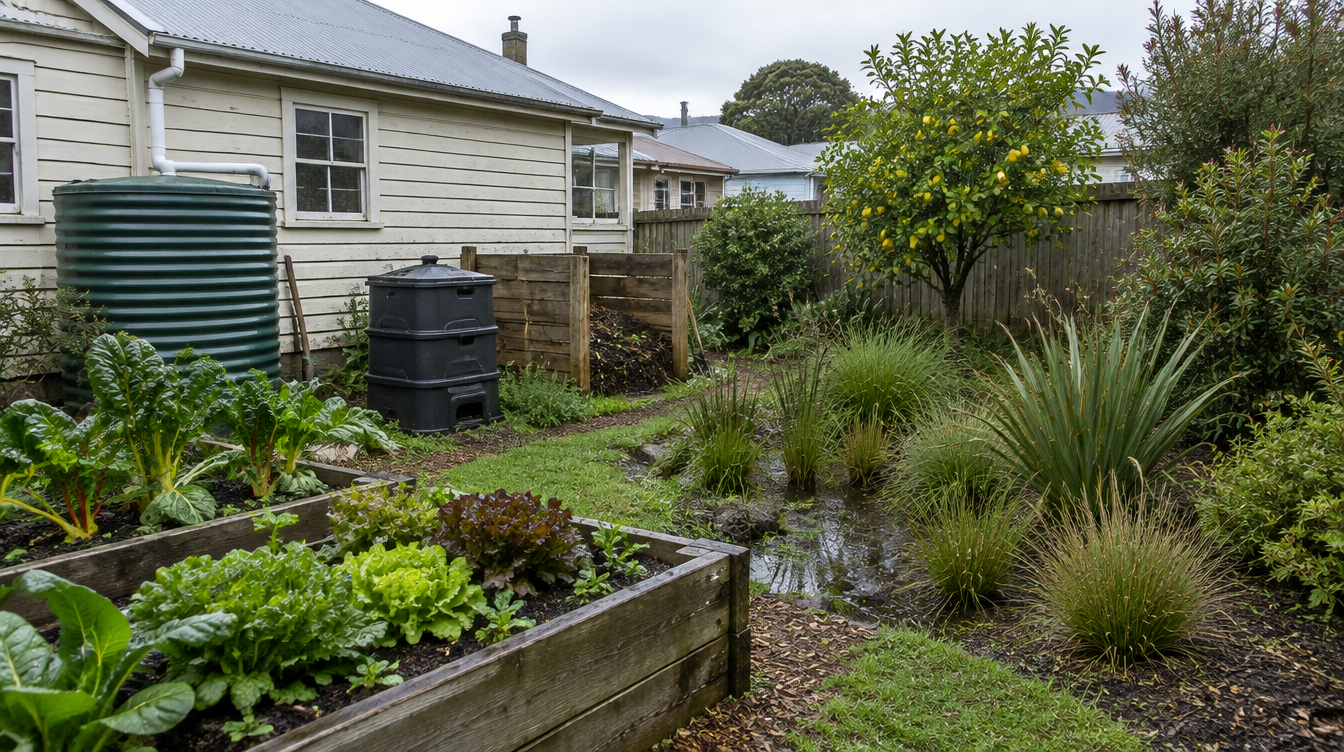
Most Kiwi homes run in a straight line. Water, food, fertiliser and power come in. Rubbish goes out in the wheelie bin, sewage goes down the pipe, and rain runs off the roof into the stormwater drain and on to the nearest stream. Each of those outputs becomes someone else’s problem: a landfill making methane, a treatment plant, a harbour full of sediment.
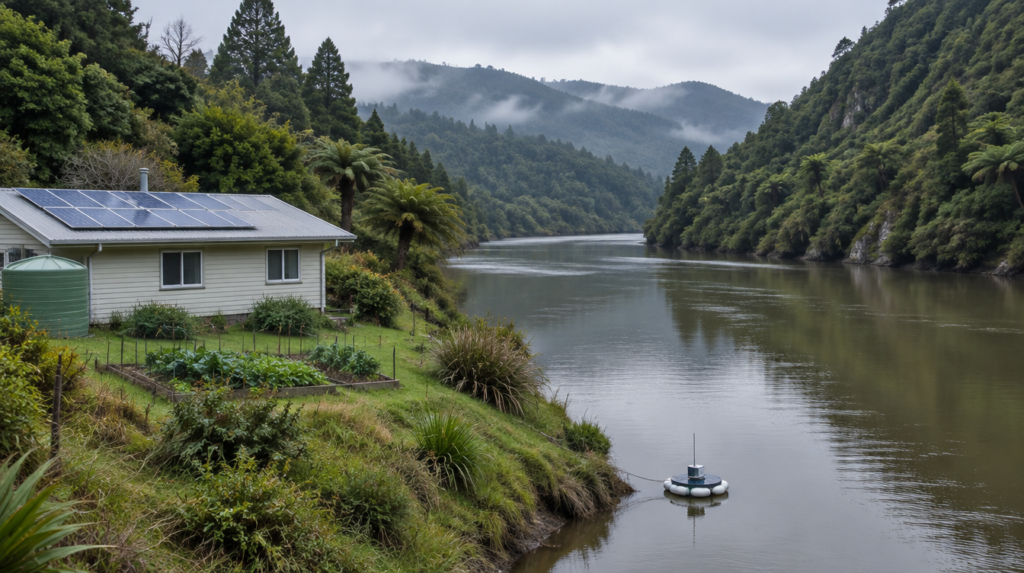
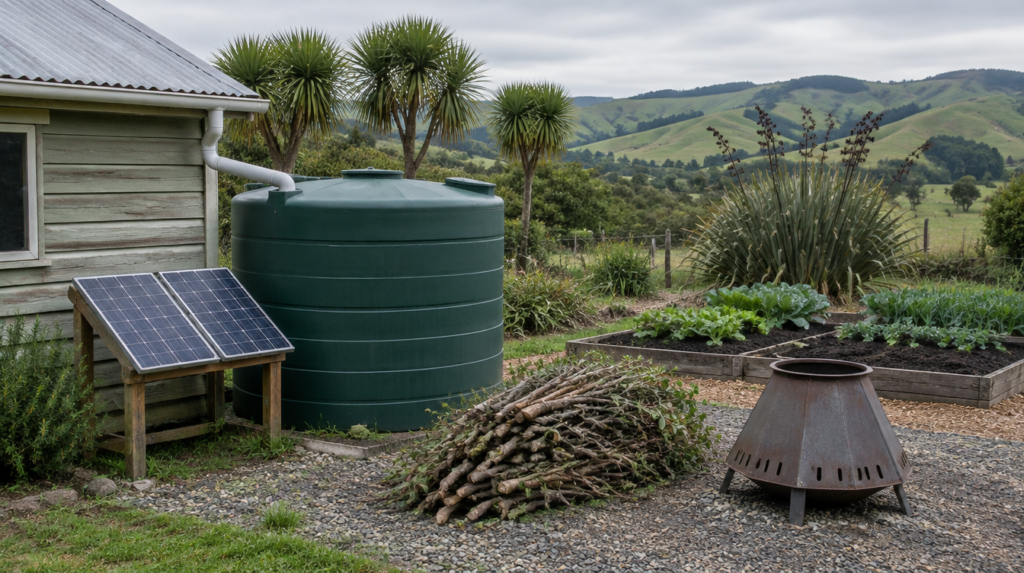
A closed-loop home bends that line into a circle. The scraps feed the soil, the soil grows the food, the roof water feeds the garden, and less leaves the section at all. This page is the hub for our Living Systems series. Each section below gives you the short version of one loop and links to the article that covers it in depth.
Linear home or loop home?
There’s an old permaculture line that sums up the whole idea: the problem is the solution. A pile of lawn clippings is a waste problem until it becomes mulch. A downpipe dumping water against the foundations is a drainage problem until it waters a raingarden. Kitchen scraps are rubbish until a worm farm turns them into fertiliser.
Here’s how the two kinds of home compare:
- Rain: in a linear home it runs off the roof and driveway into the stormwater pipe. In a loop home it soaks into a raingarden or fills a tank for the garden.
- Food scraps: bin and landfill, or compost, worms and bokashi.
- Shower and laundry water: sewer, or below-ground garden irrigation.
- Nutrients: flushed away, or returned to soil that grows trees and flowers.
- Energy: bought in, or partly made on the roof.
Nobody closes every loop. Most households that try end up closing two or three well, and that’s plenty.
Why it matters for the planet
- Food waste. The 2025 Rabobank-KiwiHarvest survey found the average New Zealand household throws out 10.9% of the food it buys. That’s about NZ$1,364 a household each year and roughly NZ$3 billion nationally, as reported by Love Food Hate Waste.
- Methane. Food and garden waste rotting in landfill without air makes methane. New Zealand’s latest greenhouse gas inventory (published by the Ministry for the Environment, which became part of the Ministry for Cities, Environment, Regions and Transport in July 2026) puts waste at 7.5% of New Zealand’s biogenic methane in 2024, and 4.0% of all our greenhouse gas emissions. Almost all the rest of that methane comes from farming. The government dropped the planned requirement for councils to collect household food scraps by 2030 in December 2024, so in towns without a food-scraps collection, home composting is the main way to keep scraps out of landfill.
- Water quality. Roof and road runoff carries copper, zinc and sediment straight to streams. Auckland Council’s testing found raingarden soil mixes removed around 60% of copper and 70% of zinc.
- Nutrients. Urine carries about 90% of the nitrogen a person excretes, 50 to 65% of the phosphorus and 50 to 80% of the potassium, according to a 2018 review in Frontiers in Sustainable Food Systems. In a sewered town, all of it goes to the treatment plant, while farms import phosphate rock to make fertiliser.
None of these problems gets solved on one section. But each loop you close takes a little pressure off a stream, a landfill or a fertiliser ship, and it builds soil while it does.
The loops, one at a time
Water, part one: from your downpipe to a raingarden
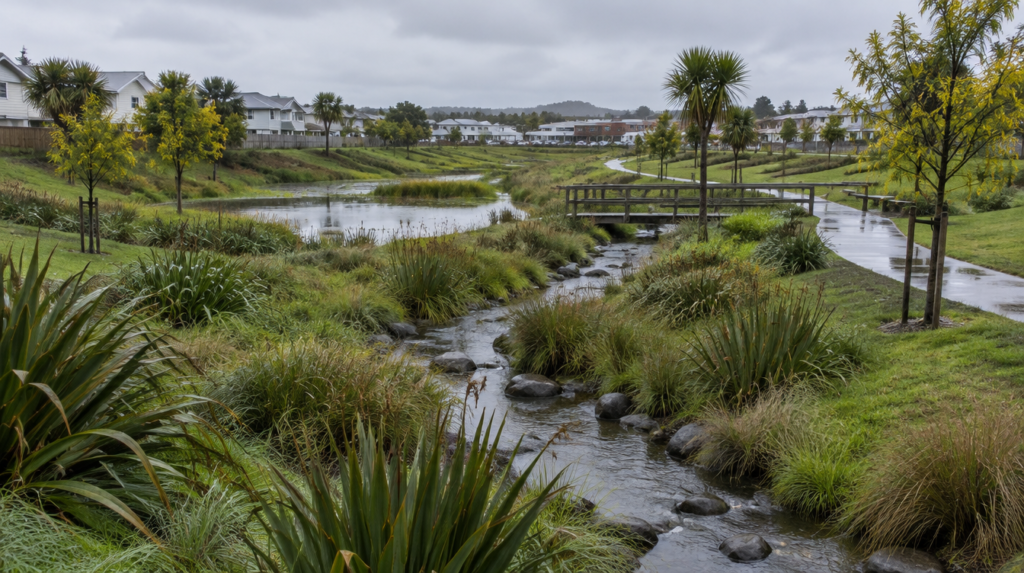
A raingarden is a shallow planted hollow filled with a sandy soil mix. Water from a downpipe ponds briefly, soaks down through the mix and is gone within a day. Christchurch City Council’s guidance is that catching the first 20 mm of a storm deals with around 80% of the year’s runoff, which is where most of the pollution travels. For a typical home, make it about a tenth of the roof area it drains, add a perforated pipe underneath on clay, and plant it densely with tough natives.
Read the full guide: How to build a raingarden in New Zealand (even on clay). For the plants, see native plants that clean water, which draws on ten years of trials at Auckland Botanic Gardens. And for the same idea at the scale of a whole city, see making space for water.
Water, part two: shower water in the garden
Greywater is the used water from showers, baths, basins and sometimes the laundry. BRANZ puts a typical household’s output at 100 to 200 litres a day, which is a lot of garden water to send down the sewer. Its guidance for doing it safely is simple: use the water within 24 hours, irrigate below the surface rather than with sprinklers, keep it off vegetables (fruit trees, shrubs and flowers are fine), and leave kitchen water out because of fats, harsh cleaners and bacteria from raw meat.
The catch is that a permanent system is plumbing, so it needs a building consent and a certifying drainlayer. Our greywater guide covers what’s safe for soil and plants, the laundry-sodium problem, and what a consented system involves.
Food scraps: compost, worms or bokashi
This is the easiest loop to close and the one with the biggest climate payoff, because it keeps methane-making scraps out of landfill. The three main methods suit different households:
- A compost bin takes garden waste and most kitchen scraps. The Earthmaker was invented by Ray Cooper, a Lower Hutt engineer and keen gardener, and is made by IP Plastics in Papakura. It costs NZ$249 at Trade Tested and NZ$248.95 at Bunnings (checked October 2026).
- A worm farm suits smaller sections and turns scraps into worm castings and liquid fertiliser.
- Bokashi ferments scraps in a sealed bucket, and it takes meat, fish and citrus. Zing Bokashi, based in Tai Tapu near Christchurch and developed by horticulturist Neville Burt with trials at Lincoln University, sells a 10 L kit for NZ$72.98 and a 15 L kit for NZ$85.98 (checked October 2026).
If you’re in Auckland, the Compost Collective runs free workshops, and everyone who attends gets a 50% off coupon towards a composting system. The most common failure is rats in an open-bottomed bin. Our compost, worms or bokashi guide covers how to choose and how to rat-proof.
Nutrients: the phosphorus problem
Phosphorus is the nutrient that matters most here, because it can’t be made, only mined. New Zealand’s fertiliser makers import phosphate rock, and where some of it comes from (occupied Western Sahara) is contested. Meanwhile the phosphorus in our food scraps and our wee mostly ends up in landfill or at the treatment plant.
A household can recycle more of it than you’d think, through compost, bokashi and (for the keen) diluted urine on fruit trees and ornamentals. Our article on the phosphorus problem explains why your scraps and your wee matter, and what’s sensible to do with them.
The last loop: composting toilets
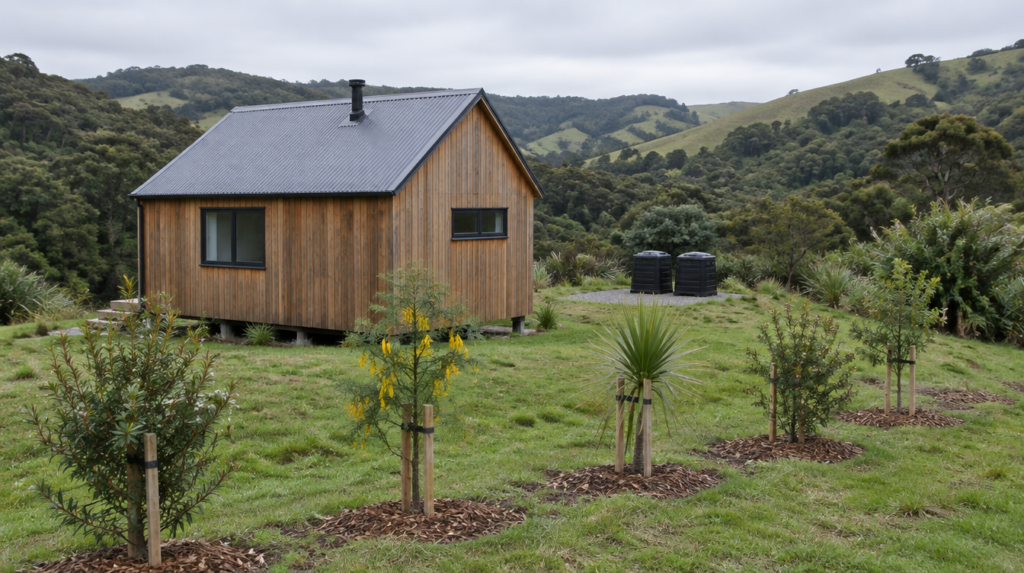
A composting toilet turns human waste into a soil-like material instead of sending it, with a lot of drinking-quality water, to a treatment plant. It works, but it’s the loop to handle with the most care, for health and for tikanga (Māori custom). A 2022 scoping study for ESR, the science institute now called PHF Science, summarises the traditional Māori view that human excreta is tapu and was kept well apart from food production. It also cites evidence that the land is seen as the medium through which tapu waste is made noa (safe) again. In practice that means the finished compost goes on to trees and ornamentals, never the vegetable garden, and only after a long maturing time. Regional rules that allow on-site compost typically expect at least 12 months.
New Zealand has local makers: Bambooloo, a New Zealand family company, sells its bamboo Classic for NZ$1,173.91 plus GST (about NZ$1,350 including GST), made to order (checked October 2026). Read composting toilets in NZ before you buy, because the consent side is the hard part.
A note on rules: composting, worm farms and planting need no permission. Greywater systems and composting toilets are plumbing, so they need a building consent, and composting toilets are generally not allowed where you can connect to a sewer unless your council agrees. Regional councils also set their own rules for what can go on the ground. Ring your council early; rules differ a lot around the country.
Energy: what actually pays back
Energy is the loop most people think of first, and the one where the money is easiest to get wrong. Some systems pay for themselves in a reasonable time, such as rooftop solar, solar running a water-tank pump, rainwater for the garden and biochar made from your own prunings. Others are mostly hobbies, however satisfying: home aquaponics and backyard biogas both struggle in New Zealand conditions. Our payback guide runs through which closed-loop systems actually earn their keep.
If you heat with wood, keep it clean. On sections under 2 hectares a wood burner has to meet the national emissions and efficiency standard, and our rocket stove guide explains how indoor rocket mass heaters run into those rules.
Two New Zealand examples worth knowing
Para Kore: zero waste on marae
Para Kore started in 2009 with a pilot on three Waikato marae: Poihākena in Whaingaroa, Tūrangawaewae in Ngāruawāhia and Kirikiriroa in Hamilton. Its first goal was for every marae in Aotearoa to be working towards zero waste, setting up recycling and composting systems and giving education, bins and signage. Its annual report says the programme was based on whakapapa to Papatūānuku: the genealogical link between people and the earth mother.
Para Kore names kaitiakitanga (guardianship of the natural world) as its first value, and describes all people as descending from Papatūānuku and Ranginui, the earth and the sky. If the earth is an ancestor, sending waste to landfill looks very different. Para Kore lost its Ministry for the Environment funding when the Community Environment Fund was cut in 2024 and had to shrink its team, but it still runs programmes with marae and communities through partnerships and paid courses. If you’re part of a marae, school or community group, its website lists upcoming events.
Earthsong: a neighbourhood that handles its own rain
Earthsong Eco-Neighbourhood in Rānui, West Auckland, is a 32-home cohousing development designed to deal with water on site. Roof water goes into tanks used inside the houses. Carparks and much of the driveway use semi-permeable paving. Rain that isn’t absorbed runs along planted channels beside the paths, filled with native carex, flax and cabbage trees alongside edibles like watercress and berries, and into a pond sized to keep runoff from the site at pre-development levels for storms up to a 1-in-5-year flood.
The real test came in January 2023, when the Auckland Anniversary floods hit Rānui hard. Robin Allison, who led the project, reports that Earthsong’s homes stayed dry in those storms, with rain soaking in or running along the planted swales to the pond. That’s at nearly twice the density of the surrounding 1960s subdivisions. So living in loops doesn’t need a lifestyle block.
Where to start
- This weekend: start a compost bin or a bokashi bucket. It costs under NZ$250 and closes your biggest climate loop.
- This season: disconnect one downpipe into a small raingarden, or put a tank on it for the garden.
- Next year: look at greywater for fruit trees and ornamentals, and talk to your council first.
- Long term: a composting toilet, if you’re off the sewer or building new and willing to manage it properly.
Build the soil as you go. Our guides to no-dig gardening, starting a food forest and seed saving are where your compost ends up doing its best work.
Honest limits
- A home loop won’t fix the system. Most of New Zealand’s biogenic methane comes from farming, and most food waste happens across millions of kitchens. Your compost bin is a real but small contribution.
- Loops need looking after. A neglected compost heap draws rats, an unmaintained greywater line clogs and smells, and a composting toilet run carelessly is a health risk.
- Some loops are legally hard. Greywater and composting toilets need consents, and on a small town section that can cost more than the gear.
- Clay and small sections limit what’s possible. Heavy soils pond, and there’s only so much greywater a small garden can take.
- Raingardens and swales are for everyday rain. Earthsong reports its homes stayed dry in 2023, but no home system will hold a storm like that on its own. Plan where the overflow goes.
The Bottom Line
For most households, two loops do most of the good: scraps into compost and roof water into the ground. If you’re renting or short on space, get a bokashi bucket and you’ve closed your biggest loop for under NZ$100. If you own a standard town section, add a raingarden on one downpipe. If you’re on a lifestyle block or off the sewer, greywater and a composting toilet become realistic, as long as you handle the toilet compost with care and keep it away from food. And if you want the bigger picture of why this matters, our ideas hub, Solarpunk Aotearoa, looks at technology that cares for the land.
Words we use
- Papatūānuku: the earth mother in Māori tradition, from whom all life comes (Te Ara).
- Whakapapa: genealogy. Te Ara describes it as a framework that links all things, living and non-living. Para Kore describes people as linked through genealogy to each other and to all living and non-living things on the planet.
- Kaitiakitanga: guardianship and protection of the natural world, based on the idea of humans as part of nature (Te Ara). Te Ara notes that a kaitiaki (guardian) is given that role by the local iwi.
- Iwi, hapū and marae: iwi means tribe, hapū a sub-tribe, and a marae is a tribal meeting place and its buildings (Te Ara). Aotearoa is the Māori name for New Zealand.
- Tapu and noa: tapu means sacred or under restriction; noa means free of restriction, or safe (as summarised in the ESR composting-toilet study).
Sources and further reading
- Love Food Hate Waste: what we waste (2025 Rabobank-KiwiHarvest survey)
- Ministry for the Environment: New Zealand’s Greenhouse Gas Inventory 1990–2024
- Auckland Council TR2013/011: media specification for stormwater bioretention devices
- Christchurch City Council: rain garden design, construction and maintenance manual
- BRANZ Bulletin 665: residential greywater systems
- ESR (now PHF Science): scoping study on composting toilets in New Zealand (2022)
- Viskari et al. (2018), Frontiers in Sustainable Food Systems: nitrogen recovery with source separation of human urine
- Para Kore: our kaupapa and Para Kore annual report 2024–25
- Earthsong Eco-Neighbourhood: stormwater and Robin Allison, “‘Spongy’ Neighbourhoods Can Reduce City Flooding”, Communities magazine, issue 208 (2025)
- Para Kore pānui: funding changes and programmes
- Te Ara: Papatūānuku, the land, Te Ara: whakapapa and Te Ara: kaitiakitanga
- Earthmaker: about us and Zing Bokashi: about
Affiliate disclosure: Some links on ThrivingKiwi may earn us a small commission if you buy through them, at no extra cost to you. Paid links are marked as sponsored. We only recommend products we genuinely believe are worthwhile.