Quick answer: The most reliable raingarden plants are oioi (jointed rush), Carex sedges such as Carex dissita and Carex testacea, wharariki (mountain flax), low-growing Coprosma and Muehlenbeckia astonii. All lasted a decade at Auckland Botanic Gardens without watering or fertiliser. Nursery-grade natives cost roughly NZ$9.50 to $17 a plant; oioi is around NZ$9.50 for a 2.5 litre pot at Gough’s (checked October 2026).
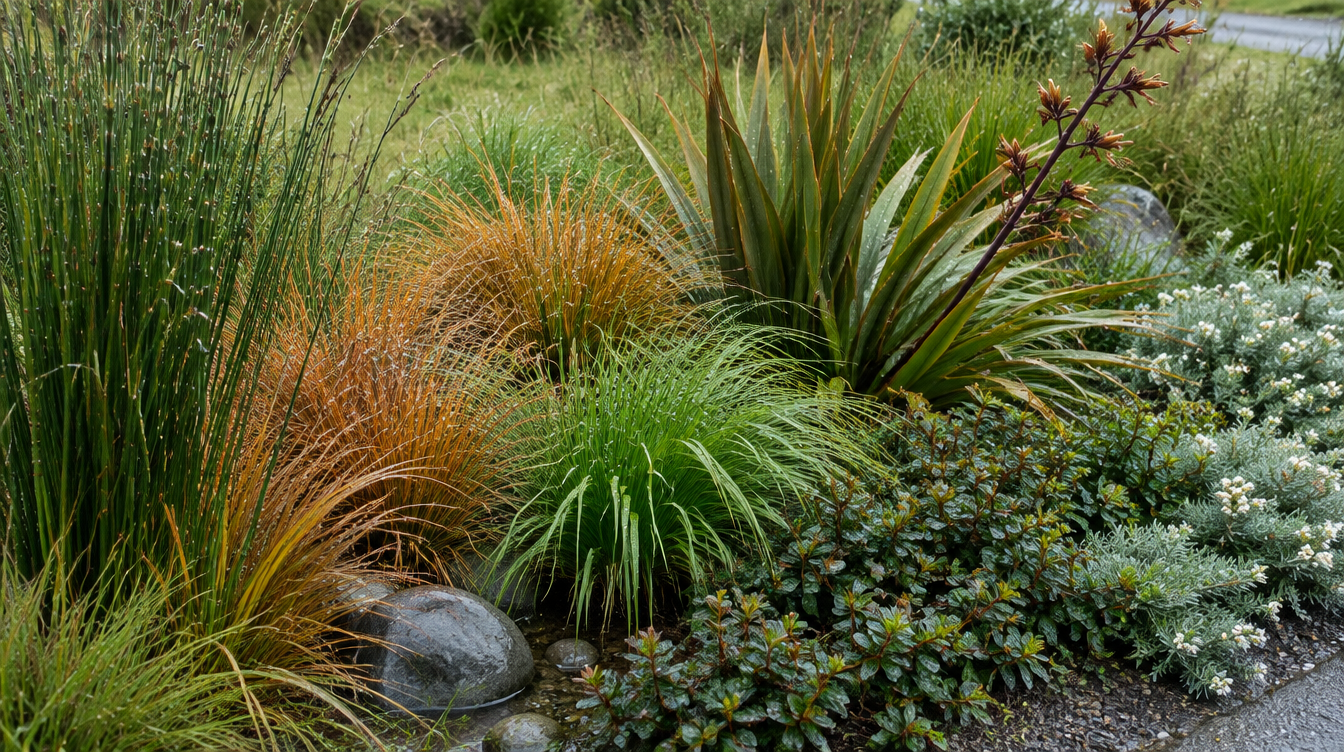
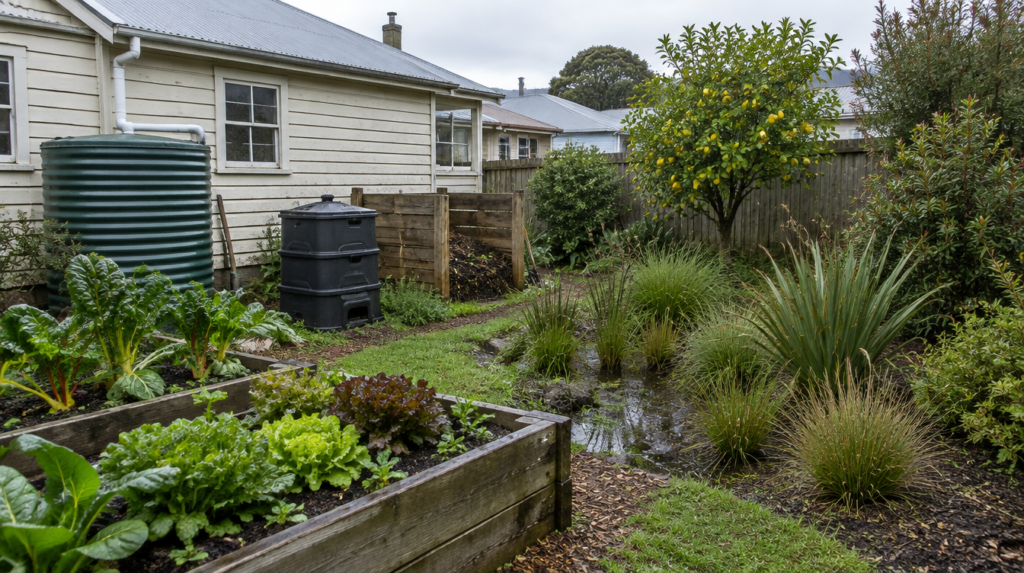
A raingarden’s soil does the filtering, but its plants keep it working. Their roots open channels so water keeps soaking in, they take up some of the nutrients that would otherwise feed algae in streams, and their leaves shade out weeds. Choose badly and you get a bare, compacted dip that ponds for days. Choose well and you get a garden that cleans water every time it rains and looks after itself.
If you haven’t built your raingarden yet, start with our guide on how to build a raingarden in New Zealand. This article is about what to put in it.
Why native plants matter for the planet
- They keep the filter open. Plant roots grow, die back and leave channels behind, which helps water keep moving down through the soil mix year after year. A raingarden without plants clogs faster.
- They feed local life. Native sedges, flaxes and shrubs are part of the food web our insects and birds evolved with. Flax flowers feed tūī and bellbirds, and dense sedges give cover to the small creatures that keep a garden in balance.
- They need nothing added. Raingardens should never get fertiliser or weedkiller, because whatever goes on washes straight through to the stream. Natives suited to poor, free-draining soil thrive without either.
Raingarden plants need to handle drought
A raingarden doesn’t need swamp plants. A well-built one drains within a day, so the plants spend most of their lives in fast-draining, fairly dry soil, then get a brief soaking when it rains. The winners are plants that cope with both, and their roots can reach 0.6 to 1 metre down into the mix to find moisture between storms. In drier regions such as Hawke’s Bay, Marlborough and Canterbury, lean even harder towards drought-tough choices.
What survived ten years at Auckland Botanic Gardens
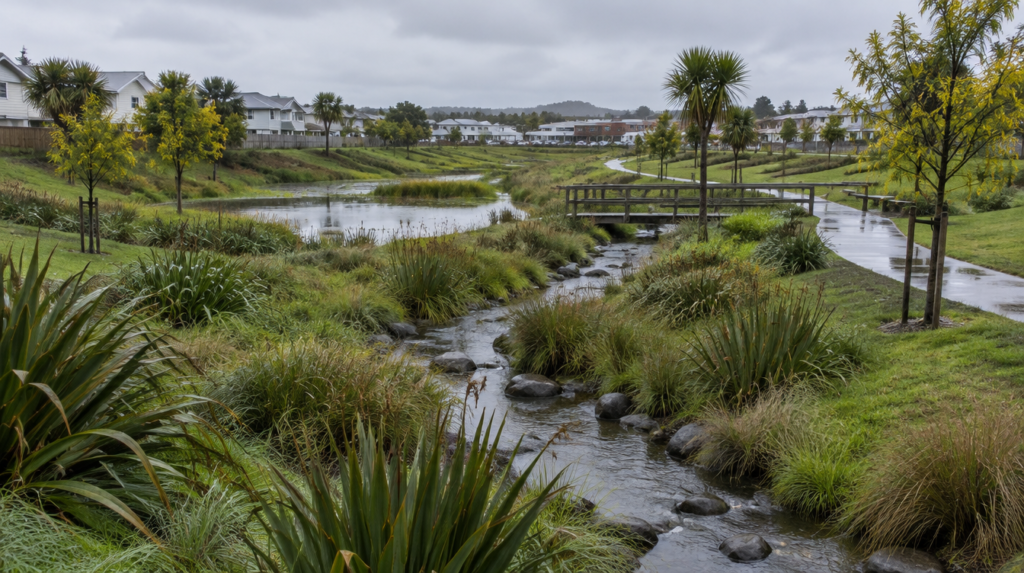
Auckland Botanic Gardens has run raingardens and a planted swale since 2009, with no irrigation and no fertiliser, and recorded how each plant performed. It’s the best long-term evidence for raingarden planting in New Zealand. These did well:
- Oioi (Apodasmia similis), a jointed rush naturally found in coastal wetlands. Tough in both wet and dry. It arches outwards as it matures, so keep it about 50 cm back from paths and edges where it could trip people.
- Carex sedges: Carex dissita, Carex flagellifera, Carex lambertiana and Carex testacea. Bronze and green tussocks that knit the surface together. Carex testacea‘s orange-bronze colour is a good contrast with oioi.
- Low-growing Coprosma: Coprosma acerosa, Coprosma repens forms and Coprosma × kirkii, for groundcover on the drier rim.
- Cyperus ustulatus (giant umbrella sedge), for the wetter centre of larger raingardens.
- Wharariki (Phormium cookianum), the mountain flax, smaller and more compact than harakeke.
- Muehlenbeckia astonii, a twiggy, wind-tough shrub with tiny leaves.
- Mānuka ‘Wairere Falls’ on the edges only, and kōwhai as an occasional accent tree.
Christchurch City Council’s recommended list
Christchurch’s raingarden manual gives a list suited to a cooler, drier climate, and it overlaps with Auckland’s:
- Oioi (Apodasmia similis)
- Astelia fragrans (kakaha, bush lily)
- Kiokio, a native fern, for shadier raingardens
- Chionochloa flavicans, a small tussock
- Dianella ‘Little Rev’
- Juncus edgariae, a native rush
- Libertia grandiflora and Libertia ixioides (mīkoikoi)
- Pānakenake (Lobelia angulata), a creeping groundcover
- Wharariki (Phormium cookianum)
- Pimelea prostrata, a silvery native daphne
Plants to avoid, or use carefully
- Deciduous trees. Autumn leaf drop smothers low plants and blocks inlets and overflows. Stick to evergreen natives.
- Harakeke (Phormium tenax) and Carex secta near edges. Both grow too big for small raingardens and overhang paths (Auckland Transport’s planting guide). Use wharariki and smaller Carex instead.
- Libertia where sediment washes in. Auckland Transport found it doesn’t cope with silt. It’s fine in a raingarden fed by a clean roof, not one fed by a driveway or road.
- Thirsty swamp plants. Raupō and true wetland plants want permanently wet feet, which a working raingarden doesn’t give them.
How to lay out the planting
Think of a raingarden as three zones:
- The base, which gets wet first and most often: oioi, Juncus edgariae, Cyperus ustulatus in bigger gardens, and the hardier Carex.
- The sides, which get wet in bigger storms: Carex, wharariki, Astelia, Libertia (clean-roof gardens only), Dianella.
- The rim, which stays mostly dry: low Coprosma, Pimelea, pānakenake, Muehlenbeckia astonii, with mānuka or kōwhai as an occasional accent set back from the edge.
Plant densely, around four to six plants per square metre for sedges and rushes, so the roots fill the soil and the foliage closes over quickly. In the first year or two you’ll be weeding by hand, because weedkiller is out. Once the plants close over, there’s very little to do.
Where to buy native raingarden plants in NZ
Buy from native specialists where you can. They grow plants suited to New Zealand conditions and can tell you which species are local to your area, which is better for local insects and birds.
- Gough’s Nurseries: oioi around NZ$9.50 for a 2.5 litre pot (checked October 2026).
- The Plant Company: sells online and has a Hawke’s Bay nursery.
- Southern Woods: a wide native range sold online.
- Your local garden centre or hardware store will often carry oioi, Carex and wharariki, typically in the NZ$9.50 to $17 range.
Many councils and catchment groups also run community planting days and native plant giveaways, which are worth looking out for.
What plants can’t fix
Plants keep a raingarden working, but they can’t rescue a badly built one. If the soil mix is wrong (clay mixed with sand is the classic mistake), water will pond no matter what you plant. And no planting turns a home raingarden into flood protection. It’s built for everyday rain and cleaner water, not for cyclones. Get the soil and drainage right first, using our raingarden building guide, then plant.
The Bottom Line
Our pick for most raingardens is a simple, tough mix: oioi in the base, two or three Carex species on the sides, wharariki for height, and low Coprosma along the rim, planted densely and never fertilised. If you’re in a dry region, lean towards Carex, Coprosma and Muehlenbeckia. If your raingarden takes water from a driveway rather than a roof, skip the Libertia. And if you’re short on space, a single downpipe feeding a small bed of oioi and Carex still does real good for your nearest stream.
Raingardens are one piece of a bigger idea, where your section’s water, soil and waste feed each other instead of leaving as waste. Our guide to closing the loop on a Kiwi section pulls it together, and our food forest guide covers native and edible planting on a bigger scale.
Words we use
- Oioi, wharariki, kakaha, mīkoikoi, pānakenake, mānuka, kōwhai, raupō: the Māori names for the plants above. Each is paired with its botanical name where it first appears. Raupō is the native bulrush.
- Tūī: a native honeyeater bird that feeds on flax nectar.
Sources and further reading
- Sibbaldia: Auckland Botanic Gardens’ sustainable water trail and plant performance
- Auckland Transport: bioretention planting guide
- Christchurch City Council: rain garden design, construction and maintenance manual
- Auckland Council: rain garden construction guide
Affiliate disclosure: Some links on ThrivingKiwi may earn us a small commission if you buy through them, at no extra cost to you. Paid links are marked as sponsored. We only recommend products we genuinely believe are worthwhile.