Quick answer: The systems that pay back in New Zealand are the plain ones: a rain tank with no mains supply, a solar pump where grid power is far off, biochar from prunings you’d otherwise burn, and a tank sensor. An NZ-made 25,000 litre tank is around NZ$3,670 to $3,880 at Bunnings or Irrigation Express, and Gallagher’s tank monitor NZ$499 at PGG Wrightson (checked October 2026). Aquaponics, home biogas and compost-heated greenhouses are mostly hobbies here.
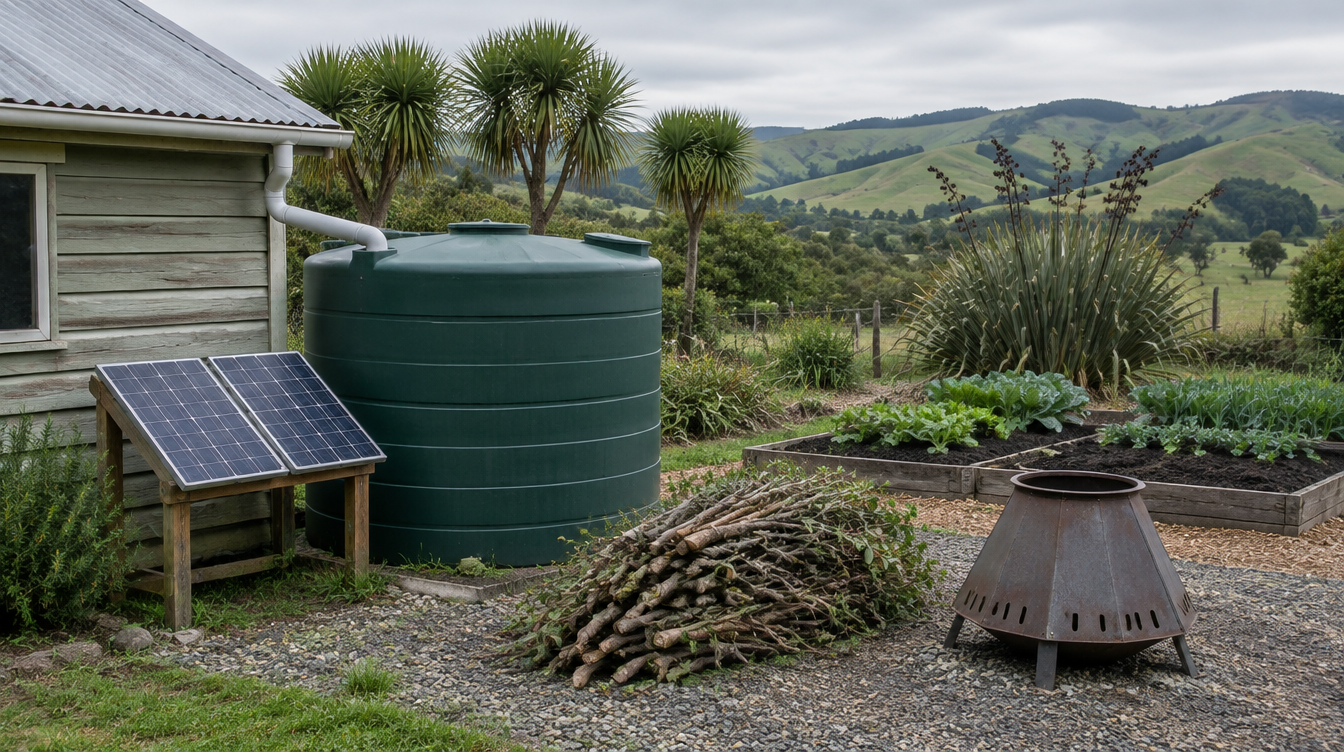
Closed-loop living is full of beautiful diagrams: fish feeding plants, compost heating greenhouses, kitchen scraps turning into cooking gas. Some of these work well on a New Zealand section. Others cost a lot, need daily care, and quietly get switched off after the first winter.
Why it matters for the planet
Money payback and planet payback are different things, and a system can win one and lose the other. A rain tank in a city with cheap mains water may never pay for itself in dollars, but it still eases summer demand on rivers and aquifers. Reusing shower and laundry water does the same job for the garden at almost no cost, and our greywater guide covers how to do it safely. A solar pump on a hill block can be cheaper than running power to the paddock and also let stock drink from a trough instead of a stream. Biochar keeps carbon in the ground that a bonfire would have sent into the air.
So for each system below we weigh the planet win (water, soil, emissions, waste), the money, and the effort, including what happens when you go away for a week.
This is part of our Solarpunk Aotearoa series. New to loops at home? Start with Closing the Loop on a Kiwi Section.
The verdict at a glance
| System | Planet win | Money | Verdict |
|---|---|---|---|
| Solar pump filling a header tank (off-grid site) | Strong: no fuel, and stock can drink away from streams | Often cheaper than bringing in grid power | Pays back |
| Rainwater tank with no mains supply | Strong: less pressure on streams and bores | Pays back against buying or carting water | Pays back |
| Rainwater tank on town supply | Real but modest | Poor: 56 years in a Lower Hutt study, never once interest is counted | Planet win |
| Biochar from your own prunings | Strong if it replaces a bonfire | Small: free soil conditioner from waste | Planet win |
| NZ-made tank sensors | Moderate: catches leaks, saves pump power | Pays for itself the first time it saves a tank | Pays back |
| Aquaponics | Small at home scale | Costly to set up and run | Mostly a hobby |
| Home biogas | Small in NZ temperatures | No NZ distributor or support found | Mostly a hobby |
| Compost-heated greenhouse | Small; the compost does more good on the garden | Big pile, little usable heat | Mostly a hobby |
Solar power running a tank pump
Household rooftop solar now pays back fairly quickly here: industry figures from My Solar Quotes, based on 279 quotes in 2026, put the median at 6.9 years for panels alone and 9 years with a battery. Treat that as a guide, since it’s an industry source.
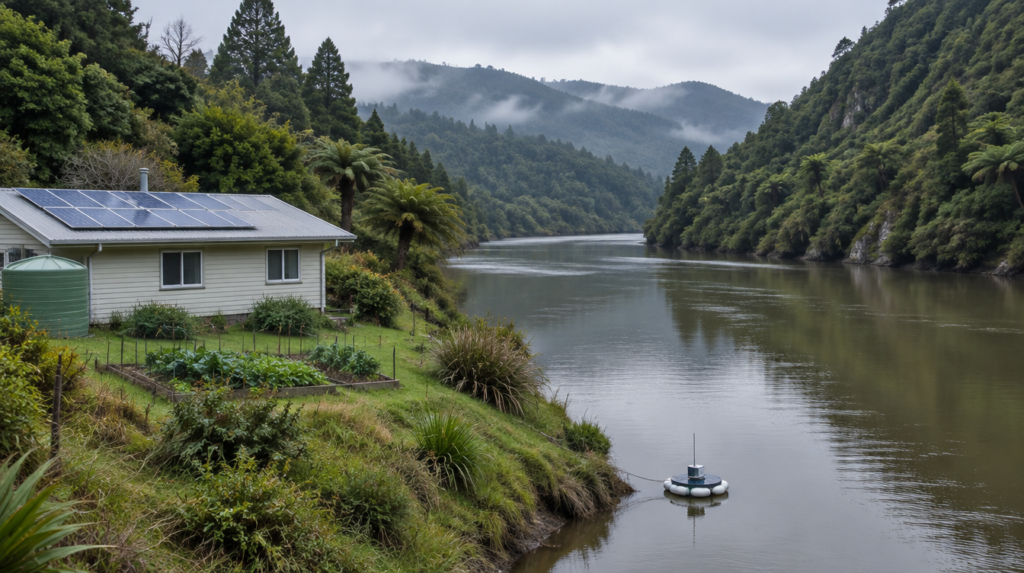
The clearer win is smaller and more specific: a solar panel or two running a pump that lifts water to a tank on higher ground. Farmers Weekly described a Hatuma farm in Central Hawke’s Bay where a submersible pump on two 100 watt panels pushed water about 20 metres uphill to a 25,000 litre tank, which then gravity-fed the troughs. The pump simply slowed down on dull days. The whole job, tank and trenching included, cost about NZ$13,500 in 2017, and the farmer said it was a lot less than getting grid power to the site.
The useful idea here is that a full tank on a hill is a battery. Lifting water while the sun shines and letting gravity deliver it later stores energy far more cheaply than a lithium battery does. You only need a battery if you want pumped pressure at night, such as a house pressure pump with no header tank.
The planet win is real. There’s no petrol or diesel pump to run, and a regional council land adviser quoted in the same article made the point that solar pumping helps farmers keep stock out of natural waterways by giving them a trough instead.
In NZ: On2it Electronics (Waikato) designs and builds solar water pumping systems in New Zealand and quotes for each site. Your local rural supply store or an electrician who does off-grid work can also size a system.
Rainwater tanks
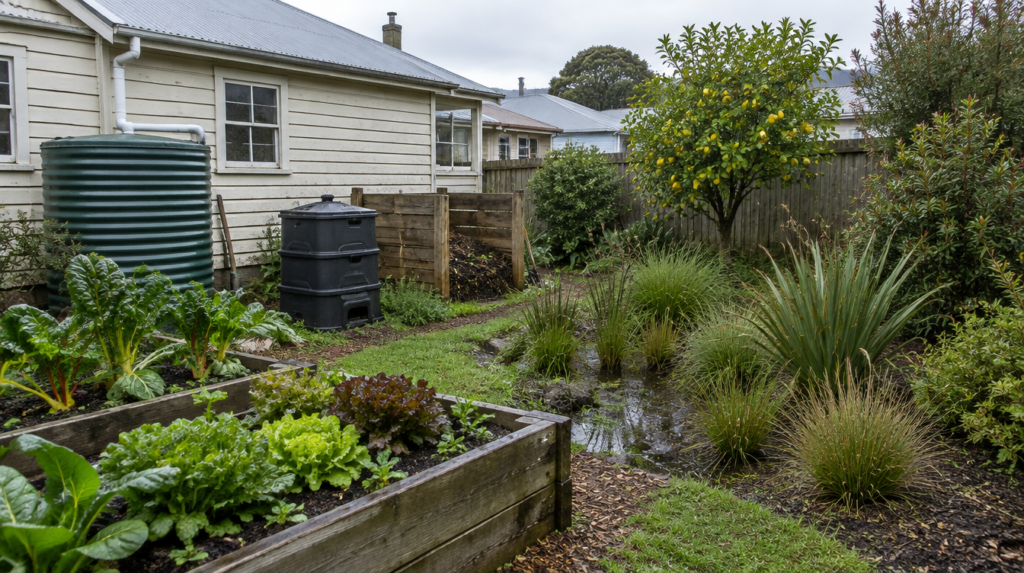
With no mains supply, a tank is your water supply, and the alternative is a bore or a water truck. Here a good tank plainly pays back. NZ-made 25,000 litre tanks sell for around:
- Promax Xpress 25,000 L: NZ$3,669 at Bunnings (special order). Promax is a New Zealand tank maker with North and South Island sites.
- Devan 25,000 L: NZ$3,878.89 at Irrigation Express. Devan has made rotomoulded tanks in Tauranga since 1988, and in Christchurch too.
Both prices were checked in October 2026 and exclude delivery and a level base.
On town supply, the money rarely works. Greater Wellington Regional Council commissioned a study of urban rain tanks in 2011. For Lower Hutt, a 5,000 litre tank used for the garden and toilet flushing cost about NZ$7,500 installed and saved at most NZ$132 a year in water charges. Ignoring interest, that’s 56 years to pay back. Counting interest on the money, the report concluded it would never pay for itself.
The planet case is still worth something. Every litre from the roof is a litre that didn’t have to be taken from a river, treated and pumped, and in a dry summer that matters. If you want your roof water to do the most good in town, a raingarden fed from the tank overflow is often the better partner than a bigger tank.
A note on rules: a tank of 35,000 litres or less that sits directly on the ground doesn’t need building consent, though district plan rules on siting still apply. Plumbing it into the house for drinking or toilets is a bigger job, so talk to your council and a plumber first.
Biochar from your own prunings
Biochar is charcoal made for soil. You burn woody waste hot with little air, then put the fire out with water before it turns to ash. What’s left is mostly carbon in a stable form. Scientists at the Bioeconomy Science Institute’s AgResearch group note that biochar can persist in soil for decades or longer, and in a field trial they began in Waikato in 2025, soil sampled ten days after the biochar went in already held more carbon.
The planet win depends on what you’d otherwise do with the prunings. Compared with a bonfire, it’s large: a study of flame-curtain kilns by Cornelissen and colleagues (2016) found about 40% of the carbon in the wood stayed locked in the char, and the kilns gave off less carbon monoxide and smoke than traditional charcoal kilns. Compared with chipping the prunings for mulch, the gain is smaller, because mulch feeds the soil too.
Two home methods are common:
- The Kon-Tiki kiln: an open, cone-shaped steel kiln designed in Switzerland and shared as an open design. You keep feeding thin wood onto the top so a curtain of flame burns off the smoke.
- The bathtub: an old steel bath used as an open kiln. Some New Zealand biochar makers use them because they’re cheap, easy to find and a burn takes a couple of hours. They quench the char in water mixed with liquid seaweed, comfrey or nettle tea, which puts out the fire and loads the char with nutrients at the same time.
In NZ: if you can’t burn where you live, buy it. Kiwichar, made from NZ-sourced untreated wood, is NZ$18 for 3 litres at Love That Leaf (checked October 2026). Char Bro, based in north Auckland, makes biochar and sells kiln equipment, with guides for adding biochar to compost and bokashi. Its website hasn’t been updated in a while, so check it’s taking orders before you plan around it. Prices weren’t showing on its shop when we checked, so contact them directly. Mixing biochar into your compost or worm farm is an easy start, and our guide to compost, worms and bokashi covers those loops.
Where you can make it matters. Auckland Council doesn’t allow burning garden waste in the urban area, and fire season restrictions apply across the country (check checkitsalright.nz before you light anything). Making biochar is an outdoor, rural or lifestyle-block job. It belongs with the outdoor rocket stove in our rocket stove guide, not inside the house, where any solid-fuel burner on a section under two hectares has to be an authorised appliance meeting the national emissions and efficiency limits.
Tank and soil sensors
A tank sensor sounds like a gadget, but it closes a loop that most rural households leave open: knowing how much water you have before you run out. A split fitting or a stuck float valve can drain a tank overnight, and the first sign is often no water in the morning.
- Water Vision is designed and manufactured in New Zealand. Its desktop starter kit, with a solar-powered tank unit and a touchscreen display, is NZ$799. It estimates the days of water you have left and can send a leak alert within about five minutes.
- Gallagher’s Tank Level Monitoring System, from the Hamilton-based company, is NZ$499 at PGG Wrightson (on special at NZ$459 when we checked in October 2026). It reports to a phone app; check the subscription terms if you have more than one tank.
Either pays for itself the first time it saves you a tank of water or a burnt-out pump. For soil, we couldn’t find an NZ-made home soil moisture sensor worth recommending. A trowel pushed 10 cm into the bed tells you most of what you need.
Aquaponics
Aquaponics links a fish tank to plant beds: fish waste feeds the plants, and the plants clean the water for the fish. It’s a lovely loop, and a hard one to make pay at home.
The rules are simpler than people expect. The Department of Conservation says a personal-use system whose tanks have no inflow or outflow to natural freshwater needs no approval to move fish, and no fish farm licence. But the species matter. Goldfish and legally obtained native species need no approval, trout and perch need Fish & Game approval, koi need DOC approval, and live catfish are banned without MPI authorisation. Selling your fish or vegetables needs an MPI fish farm licence. In practice that limits what you can eat from a backyard system.
The bigger issue is care. The UN Food and Agriculture Organization’s manual on small-scale aquaponics says fish production demands daily management and that some designs are vulnerable to power cuts. It calls backup aeration, such as a battery on the air pump, a valuable asset. A pump failure while you’re away can kill the fish.
In NZ: we didn’t find any NZ-made home aquaponics kits. The kits we found come from Australia; one maker, Practical Aquaponics, says it has exported kits here. If you’re curious, a small goldfish-and-lettuce system is a good way to learn how nutrient loops behave. Don’t expect it to feed you.
Home biogas
A biogas digester turns food scraps into cooking gas and a liquid fertiliser. It works well in warm countries. Temperature is the problem here. The GTZ Biogas Digest, a widely used technical reference, says unheated, uninsulated digesters don’t work satisfactorily when the mean temperature is below 15 °C. NIWA’s 1991–2020 averages put Whangārei at 16 °C, Auckland at 15.6 °C and Napier at 14.7 °C across the whole year, so most of the country sits below that line for months at a time. Heating the digester costs energy that eats into the gas you make.
We also couldn’t find an NZ distributor or service agent for home biogas kits. Your food scraps will do more good in a worm farm, compost bin or bokashi bucket.
Compost-heated greenhouses
The idea, made famous by Frenchman Jean Pain, is to coil water pipe through a huge pile of woodchip compost and use the heat to warm a greenhouse. A pilot study in Finland (2020) built a 40 cubic metre pile with 100 metres of pipe through it. The pile reached 60 °C and stayed hot for 23 days, but the heat collection was so inefficient it made no difference to the glasshouse. We found no working home examples in New Zealand.
The compost itself is the valuable part: spread on beds, it builds soil and holds water. For a warmer glasshouse, an outdoor rocket mass heater warming a bench is the use our rocket stove guide found most workable.
What none of these will do
- They won’t close the loop on their own. A tank, a kiln or a sensor is one link. The biggest wins on most sections still come from food scraps to soil, roof water to the ground, and growing some of your own food.
- They won’t pay back on paper in town. Cheap mains water and power make most urban payback sums look poor. Judge them on the planet win, and buy them because you want that.
- They won’t run themselves or suit every site. The hobby systems need daily care, and burning rules, fire seasons and council rules all vary, so check locally before you buy.
The Bottom Line
Our pick for most people is the boring set: catch rain where it helps, pump with the sun where power is far away, turn woody waste into biochar where you’re allowed to burn, and fit a sensor to any tank you depend on. Leave aquaponics, biogas and compost heating for when you want a project rather than a payback.
- If you’re on a lifestyle block with no mains: get the biggest NZ-made tank your roof can fill, add a Water Vision or Gallagher monitor, and look at a solar pump to a header tank before paying for a power line.
- If you’re in town: skip the big tank sums. A small tank feeding a raingarden, plus bought biochar in your compost, does more for the least money.
- If you have lots of prunings and room to burn: try a bathtub or Kon-Tiki burn outside the fire season, and quench it with liquid seaweed or comfrey tea.
- If you love the idea of aquaponics: start small with goldfish and lettuce, put the air pump on a battery backup, and treat it as a classroom.
For how these pieces fit the bigger picture, read Solarpunk Aotearoa.
Sources and further reading
- My Solar Quotes: What is the payback on solar for NZ homeowners? (2026 data)
- Farmers Weekly: Sunshine waters Hatuma farm (2017)
- Greater Wellington Regional Council: rainwater tank analysis report for Lower Hutt (Harrison Grierson, 2011)
- Building Performance: exempt building work for tanks and pools
- Soil Horizons: Biochar incorporation into soils, initial effects and challenges (2025)
- Cornelissen et al. (2016): Emissions and char quality of flame-curtain “Kon Tiki” kilns, PLoS ONE
- Our Way of Life: making biochar in a bathtub
- Auckland Council: rules for outdoor fires in residential and business areas
- Department of Conservation: freshwater fish farming and aquaponics and possessing freshwater species
- FAO Fisheries and Aquaculture Technical Paper 589: Small-scale aquaponic food production (2014)
- GTZ Biogas Digest, Volume 1: environmental frame conditions
- Figure.NZ: mean annual temperatures across selected New Zealand locations, 1991–2020 (NIWA data)
- Compost heat recovery system: pilot-scale study for greenhouse use (Theseus, 2020)
Affiliate disclosure: Some links on ThrivingKiwi may earn us a small commission if you buy through them, at no extra cost to you. Paid links are marked as sponsored. We only recommend products we genuinely believe are worthwhile.