Quick answer: Phosphorus is what New Zealand soils lack most, and the country imports it as mined rock, some from Western Sahara. Households throw much of it away in scraps and wee. Keep it on your section with compost, hens, a little clean wood ash, and diluted urine on trees and ornamentals, not food crops. Most of it is free; an Earthmaker compost bin is NZ$249 at Mitre 10 (checked October 2026).
A bag of garden fertiliser and the peelings in your kitchen bin both carry phosphorus, nitrogen and potassium, the three nutrients plants need most. One arrives on a ship. The other usually leaves in a rubbish truck or down the toilet. The second half of that trip is the one a household can change, and phosphorus is the nutrient most worth hanging on to.
Why it matters for the planet
Phosphorus sits behind most of the food we eat, and it has two problems: it’s running in the wrong direction, and it ends up in the wrong place.
- It’s mined, and the supply is concentrated. Phosphate fertiliser starts as rock dug out of the ground. Ballance Agri-Nutrients, one of New Zealand’s two big fertiliser co-operatives, notes on its website that Morocco’s OCP Group holds around 70% of the world’s phosphate reserves.
- New Zealand soils are hungry for it. Te Ara records that a lack of phosphorus was identified early on as the main deficiency on most New Zealand soils. The first shipment of superphosphate arrived in 1880, and the fertiliser industry has been built on imported rock ever since.
- Too much of it in water is a pollutant. Land Air Water Aotearoa (LAWA) says much of the phosphorus in our rivers comes from erosion and fertiliser, with domestic wastewater and animal waste adding more. Very high levels cause rapid weed growth and algal blooms that choke streams and lakes.
So phosphorus is mined far away, shipped here, spread on land, eaten, and then flushed or dumped, where some of it ends up feeding algae. A household can’t fix that system, but it can stop being a leak in it.
Where New Zealand’s phosphate comes from
Western Sahara, on the Atlantic coast of north-west Africa, is listed by the United Nations as a Non-Self-Governing Territory. Morocco has controlled most of it since 1975, an occupation that Western Sahara Resource Watch (WSRW) and the territory’s independence movement consider illegal. WSRW, an international campaign group, tracks ships carrying phosphate rock out of the territory. Its P for Plunder 2026 report, published in May 2026, says three shipments totalling about 171,100 tonnes went to Ballance Agri-Nutrients at Tauranga and Bluff during 2025, making New Zealand the third-largest destination that year after India and Mexico. WSRW reports that Ballance’s factories have used Western Sahara rock since the 1980s, and it argues that, under a 2002 UN legal opinion, extracting the territory’s resources without regard to the wishes of its Saharawi people breaches international law.
Ballance’s own statement says it sources phosphate rock from several countries, including Western Sahara, which it describes as the subject of a complex, long-running dispute. It says the Bou Craa rock suits New Zealand soils because it’s high in phosphorus and low in cadmium, and that an independent human rights due diligence assessment, commissioned through the Fertiliser Association of New Zealand, gave it a level of comfort about the supply. WSRW disputes that assessment, saying it ignores the Saharawi people’s right to self-determination.
Whichever way that argument goes, the phosphorus in a New Zealand lettuce may well have started in a disputed mine on the other side of the world. Every bit you return to your own soil is a bit that doesn’t need to be shipped here again.
How nutrients move through a household
Plants need nitrogen (N) for leafy growth, phosphorus (P) for roots, flowers and seed, and potassium (K) for overall hardiness and fruit. Those nutrients come into a home in food. They leave in three main streams:
- Food scraps, which go to landfill or a council food scraps bin unless you compost them.
- Garden waste, which goes to a green waste bin or the tip unless it’s composted or mulched.
- Urine and faeces, which go to the sewer or a septic tank.
A large share of it goes out in wee. A 2018 paper in Frontiers in Sustainable Food Systems (Viskari and colleagues, citing earlier research) puts it at about 90% of the nitrogen, 50 to 65% of the phosphorus and 50 to 80% of the potassium that people excrete. The authors also note that urine from a healthy person contains only small amounts of pathogens, mostly from faecal contamination, which is why urine is the part of human waste that researchers look at first for reuse.
Closing the loop at home
Compost and worms: the easy win
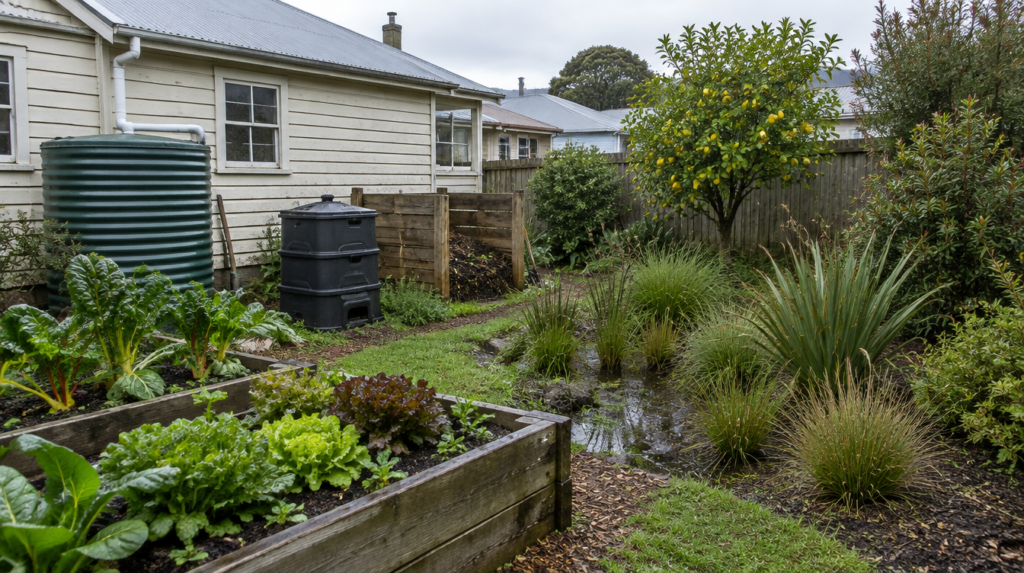
Composting is the simplest way to keep the phosphorus, potassium and much of the nitrogen in your scraps on your section. A compost bin handles garden waste and raw scraps, a worm farm suits small spaces, and a bokashi bucket takes meat and cooked food. Our guide, Compost, Worms or Bokashi?, compares all three, with NZ makers and how to keep rats out.
Chickens
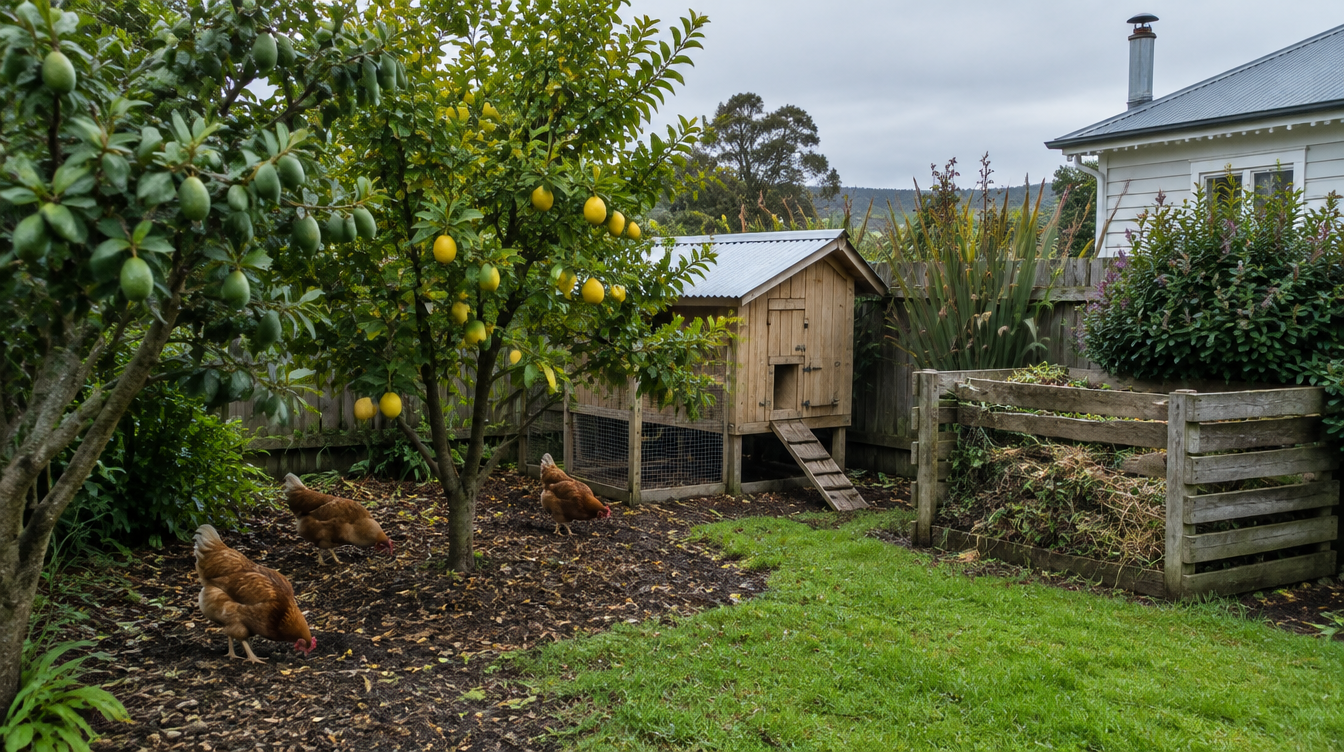
Hens turn kitchen scraps, weeds and garden pests into eggs and a rich manure. That manure needs handling with care. Agriculture Victoria warns that poultry droppings can carry Salmonella and Campylobacter, and that putting poultry manure on a vegetable patch is one way people pick them up. Compost the manure and bedding before it goes near food crops, wash home-grown vegetables well, and wash your hands after handling birds or eggs.
Check your council’s rules before you buy hens. In Auckland, for example, you can keep up to six chickens without a licence on an urban property under 2,000 m² (twelve on a larger one), but no roosters.
Wood ash
If you heat with a wood burner, the ash is a modest source of potassium. The Royal New Zealand Institute of Horticulture’s advice notes that wood ash contains less potassium than compost and most fertilisers, and that it raises soil pH, so spread it sparingly and keep it away from acid-loving plants such as rhododendrons and gardenias. The easiest use is a thin layer in the compost heap with grass clippings or vege scraps.
Only use ash from clean, untreated wood. Much New Zealand building timber is treated with chromated copper arsenate (CCA), and Whakatāne District Council points out that burning treated timber is banned in New Zealand because of its toxicity. Painted wood, plastics and rubbish don’t belong in the fire or the garden either. Our guide to wood-fired cooking covers what makes good, dry firewood.
Urine: safely, and with respect
In Māori practice, human waste is tapu (sacred, under restriction) and has traditionally been kept well apart from food and food growing. A 2022 scoping study on composting toilets by ESR, prepared for the Ministry of Health, sets this out, citing the Ngāi Tahu study Tiaki Para (Pauling and Ataria, 2010). It describes how bodily waste, including mimi (urine), was handled separately from food preparation and leftovers, and notes that, historically, using any kind of manure to grow food was viewed as abhorrent. The same study is careful to say that Māori views aren’t uniform, that customary practice adapts to contemporary situations, and that a commonly held view is that returning human waste to land is far better than discharging it to water.
That’s a good reason, alongside the health ones, to make non-food plants the default for urine. Here’s how to do it safely:
- Use your own household’s urine, collected in a clean container with a lid.
- Dilute it. SSWM’s small-scale factsheet, drawing on the Swiss research institute Eawag, suggests about three parts water to one part urine.
- Pour it on the soil, not the leaves, because neat or strong urine can scorch foliage. Fruit and shade trees, hedges, ornamental shrubs and lawn edges are the obvious places.
- Spread it around. Use different spots rather than the same patch every day, so salts don’t build up.
- Keep it well away from streams, drains, wells and bores.
If you do choose to use it on food crops for your own household, the World Health Organization’s 2006 guidelines on the safe use of excreta say a single household’s urine can be used without storage, provided at least one month passes between the last application and harvest. Apply it to the soil around the plants, never to the parts you eat.
A note on rules: pouring diluted urine around your own trees involves no plumbing. Anything plumbed, such as a urine-diverting toilet, is a building consent matter, covered in our guide to composting toilets in NZ.
Doing it in NZ
You don’t need to buy much to close a nutrient loop, and nothing here needs an overseas product.
- Compost bin: the Earthmaker 466 L, invented in Lower Hutt and manufactured in Papakura, is NZ$249 at Mitre 10 (checked October 2026).
- Bokashi: Zing Bokashi, a family business in Tai Tapu near Christchurch, sells a 15 L kit for NZ$85.98 direct (checked October 2026).
- Worm farm: WormsRus in Wiri, Auckland, sells a three-tray worm farm with 500 g of worms for NZ$225.75 (checked October 2026).
- Free help in Auckland: Compost Collective runs free composting workshops, and attendees get a 50% off coupon towards a compost bin, worm farm or bokashi system.
- Urine: a lidded container and a watering can you keep for the job. That’s all.
Honest limits
- It won’t change the phosphate trade. New Zealand’s farms use phosphate on a scale no garden comes near. Home recycling is about your own patch and your own waste, and it’s a small, real contribution rather than a solution.
- More isn’t better. Compost, manure and urine all add nutrients, and soil can only hold so much. Overdo it and the extra washes out, which is exactly the problem in our waterways. Even compost-rich soil mixes leach phosphorus, as our raingarden guide explains.
- Urine has downsides. SSWM notes a risk of salt building up in soils prone to it. The Frontiers paper notes that about two-thirds of unmetabolised medicines leave the body in urine, and that the long-term effects of those residues in soil haven’t been fully studied. Stored urine also smells strongly of ammonia, so use it fresh.
- Not everyone will be comfortable with it. If you share a garden or a community plot, talk about it first. For many people the cultural point above settles the question, and that deserves respect.
- Chickens are a commitment. They need daily care, secure housing from rats and dogs, and someone to look after them when you’re away.
The Bottom Line
Start with the loop that has no downsides: compost every food scrap and garden clipping you can, and return it to your soil. Add hens if you have the space and the time, put clean wood ash in the compost, and treat urine as a free fertiliser for your trees and ornamental plants.
- If you’re new to this, pick one composting system and get it running well. Our compost, worms or bokashi guide will help you choose.
- If you have fruit trees or a hedge, diluted urine around their roots is the easiest nutrient loop there is.
- If you grow food for family or neighbours, keep urine off the vege garden altogether and stick to compost.
- If you want the whole picture, our hub, Closing the Loop on a Kiwi Section, links every loop together, and our seed saving guide covers the other thing a self-renewing garden keeps: its own seed.
Words we use
- Tapu: sacred, under restriction (ESR, 2022).
- Noa: safe, no longer under restriction. Evidence quoted in the ESR study describes the land as the medium by which tapu material is made noa again (ESR, 2022).
- Mimi: urine (ESR, 2022).
Sources and further reading
- Viskari et al. (2018), Nitrogen recovery with source separation of human urine, Frontiers in Sustainable Food Systems
- Western Sahara Resource Watch: P for Plunder 2026 (data from 2025)
- Ballance Agri-Nutrients: phosphate rock sourced from Western Sahara
- ESR (2022): Composting toilets in New Zealand, a scoping study
- Te Ara: fertiliser industry
- LAWA: phosphorus factsheet
- World Health Organization (2006): guidelines for the safe use of wastewater, excreta and greywater, volume 4
- SSWM: urine fertilisation (small-scale)
- Royal New Zealand Institute of Horticulture: what to do with wood ash
- Whakatāne District Council: never burn treated timber
- Agriculture Victoria: caring for your health when handling poultry and eggs
- Auckland Council: keeping birds and poultry
Affiliate disclosure: Some links on ThrivingKiwi may earn us a small commission if you buy through them, at no extra cost to you. Paid links are marked as sponsored. We only recommend products we genuinely believe are worthwhile.