Quick answer: With garden space and garden waste, a compost bin is the cheapest loop: the NZ-designed Earthmaker is NZ$249 at Mitre 10. If space is tight, a worm farm takes fruit and veg scraps (from NZ$109). For meat, fish and cooked food, add a 15 L Zing Bokashi kit from Christchurch (NZ$85.98). Sit any bin on fine wire mesh to keep rats out. Prices checked October 2026.
Peelings, tea leaves, the last of the bread, the chicken bones from Sunday. In most Kiwi kitchens they go in the rubbish bag and end up in landfill, buried with no air, where they rot slowly and give off methane. The same scraps, handled at home, turn back into soil within weeks or months. Choosing how to do that comes down to three things: how much space you have, what you eat, and how much fiddling you’re willing to do. This guide walks through compost, worms and bokashi in New Zealand conditions, with NZ makers and honest costs, and how to stop the whole thing becoming a rat buffet.
Why it matters for the planet
- Methane. The Ministry for the Environment (now part of the Ministry for Cities, Environment, Regions and Transport) reports that in 2024 the waste sector made up 4.0% of New Zealand’s greenhouse gas emissions and 7.5% of its biogenic methane, mostly from landfills, where organic waste such as food and garden waste rots without air. The ministry notes that biogenic methane has a warming effect about 28 times greater than carbon dioxide.
- Wasted food in the first place. The 2025 Rabobank–KiwiHarvest survey, reported by Love Food Hate Waste, found the average household wastes 10.9% of the food it buys, around NZ$1,364 a year and NZ$3 billion nationally. Cutting that waste comes first; composting deals with what’s left.
- Soil. Everything you compost goes back into the ground as organic matter instead of being trucked away. That’s food for soil life and a better sponge for rain, which ties into the same idea behind a raingarden: keep water and nutrients on your own section.
The national plan to make councils collect food scraps by 2030 was revoked in December 2024, so whether your scraps reach soil or landfill is now largely up to you and your local council. Some councils, Auckland and Christchurch among them, still run kerbside food scrap bins. A home system works alongside those or instead of them, and the goodness stays on your own patch.
Compost, worms or bokashi: the short version
| System | Best for | Takes meat and dairy? | Space | Rough cost (NZ) |
|---|---|---|---|---|
| Compost bin | Households with a garden and lawn clippings, leaves and prunings | No | A square metre of soil | NZ$249 (Earthmaker) |
| Worm farm | Small sections, decks, balconies; fruit and veg scraps | No | A shady corner, carport or porch | NZ$109 to $226 |
| Bokashi | All food scraps, including meat, fish and cooked food | Yes (small bones too) | A cupboard or laundry, plus somewhere to bury it | NZ$85.98 (Zing 15 L kit) |
Many households end up running two. A bokashi bucket in the kitchen for everything, with its fermented contents finished off in a compost bin or dug into the garden, is a common pairing.
How each one works
The compost bin
A compost bin is a managed rotting pile. Bacteria, fungi, worms and slaters break down a mix of “greens” (food scraps and fresh grass, which are rich in nitrogen) and “browns” (dry leaves, twigs, shredded cardboard, which are rich in carbon). Get the balance and the moisture roughly right and it turns into dark, crumbly compost. Get it wrong and you’ll know: too much grass, as the Earthmaker FAQ puts it, gives you slimy wet material. The fix is more browns.
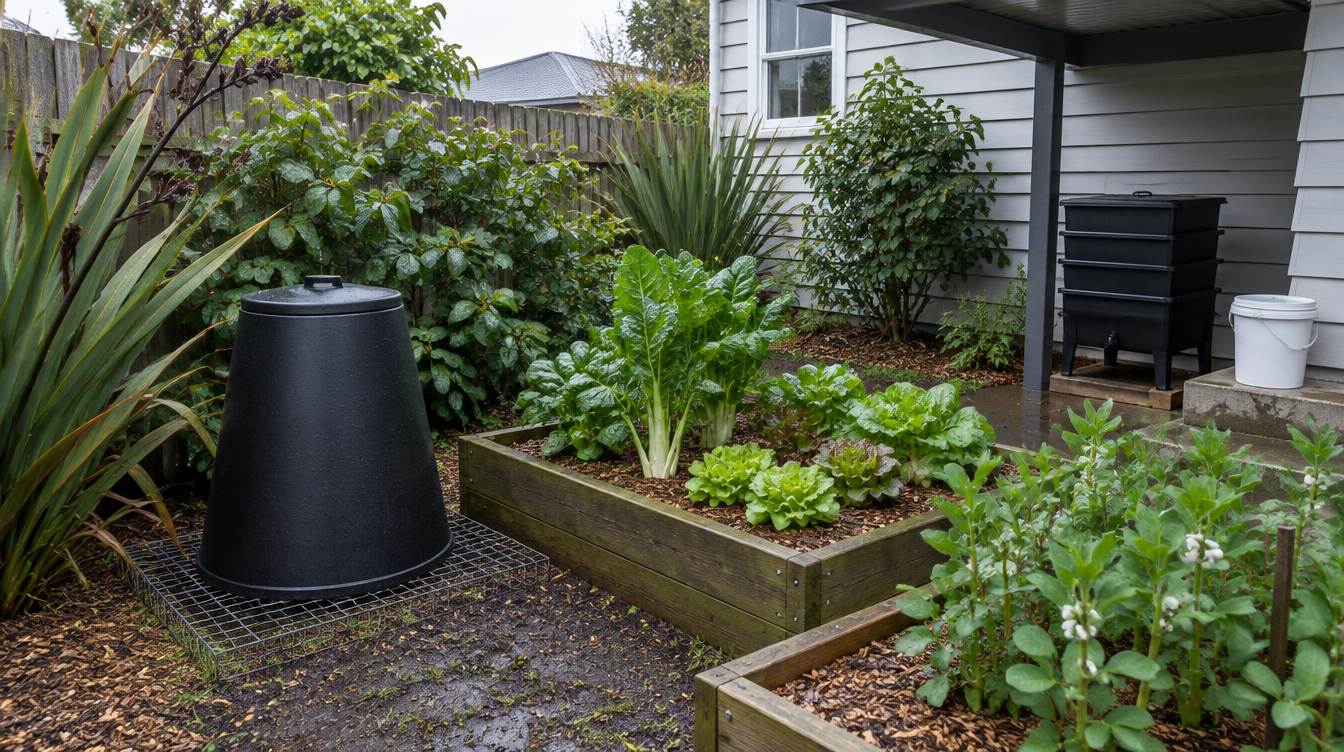
The Earthmaker is a three-chamber bin stacked vertically, so material drops from one chamber to the next as it breaks down, and you take finished compost out of the bottom without turning anything. It holds 466 litres and stands 1.2 m tall. Its makers suggest about one bucket of kitchen scraps to five of garden waste for quick results, and estimate a household of three or four produces 10 to 20 litres of kitchen waste a week. If you have almost no garden waste, a compost bin on its own will struggle, and a worm farm or bokashi is the better fit.
The worm farm
Worm farms use tiger worms or red worms, which are different from the earthworms in your lawn. They eat through food scraps, damp cardboard and paper, and produce worm castings (vermicast) and a liquid known as worm tea. Both are excellent for the garden. Compost Collective’s guide suggests diluting castings one part to ten parts water for a liquid feed.
Worms are fussier than a compost heap. Compost Collective’s list of what not to feed them includes meat and dairy, citrus and acidic food, onion, garlic and chilli, bread and pasta, cooked or processed food, and oils or soups. Most raw fruit and vegetable scraps, coffee grounds, tea leaves and torn wet cardboard are fine. Keep the farm somewhere cool and shaded, like a carport or a covered porch, and start small: 250 g of worms (about 1,000) is enough to begin, and the population grows to match the food you give it over the first six months or so.
Bokashi
Bokashi is a Japanese word for fermented organic matter. You layer food scraps in an airtight bucket with a sprinkle of bran inoculated with beneficial microbes, press out the air and close the lid. The scraps ferment like a pickle instead of rotting, so there’s little smell and no flies. Compost Collective’s guide says bokashi takes cooked and raw meat and fish, small bones, cheese, eggs and bread, which none of the other systems will. It doesn’t take liquids, large bones or plastic.
Bokashi is a two-stage process, and the second stage is the part people forget. Once a bucket is full it sits for 10 to 14 days to finish fermenting, then the contents need to go into soil or a compost bin, where they break down quickly. Zing Bokashi says compost is ready about four weeks after you start. The liquid you drain off every few days is a strong fertiliser: dilute it about 1:100 (two to three tablespoons per five litres of water) before using it on the garden.
Keeping rats out
Rats put plenty of people off composting, and they matter beyond your own backyard. Rats eat native birds’ eggs and chicks, and Predator Free NZ’s backyard toolkit treats a rat-proof compost bin as part of the job of protecting them. Compost Collective worked with Predator Free NZ on its rodent advice, and the fix is cheap.
- Put mesh underneath. Predator Free NZ’s guide uses galvanised wire mesh with holes no bigger than 1.25 cm, because mice and young rats squeeze through anything larger. A piece about 1.25 m square covers a standard bin. Stainless steel lasts longer if you can find it.
- Fold it up the sides. Sit the bin on the mesh with 10 to 20 cm spare on each edge, fold the mesh up at least 10 cm, and cable-tie it tight, covering any air holes, doors or flaps.
- Send meat and cooked food to bokashi. A sealed bokashi bucket is the safest place for the scraps rats want most, and once fermented and buried they’re far less attractive.
- Trap next to it. Predator Free Wellington points out that a meshed compost bin will still smell delicious to rats, which makes it a good spot for a trap.
Worm farms and bokashi buckets are enclosed, so the open-bottomed compost bin is where most rat trouble starts.
Doing it in NZ: makers, suppliers and free help
Free workshops and half-price gear (Auckland)
Compost Collective runs free composting workshops across Auckland, delivered by EcoMatters with Auckland Council funding. Everyone who attends gets a 50% off coupon towards a compost bin, worm farm or bokashi system, emailed within a day of the workshop. If you’re in Auckland, go to a workshop before you buy anything. Elsewhere, ask your council’s waste minimisation team whether it runs workshops or discounts bins.
Bokashi: Zing Bokashi (Christchurch)
Zing Bokashi is a family business in Tai Tapu, on the outskirts of Christchurch. It traces its product back to 1999 and calls itself New Zealand’s original bokashi. Its buckets are made in New Zealand from food-grade plastic, and the business is a member of Buy NZ Made. A 15 L Zing Bokashi kit is NZ$85.98 direct (checked October 2026), and refills of the Compost Zing sprinkle come in 1 kg bags (three for NZ$55.07). Trade Tested also stocks the kits.
Compost bin: Earthmaker (invented in Lower Hutt, made in Auckland)
The Earthmaker 466 L was invented by Ray Cooper, a Lower Hutt engineer and keen gardener, and is manufactured by IP Plastics in Papakura. It’s NZ$249 at Mitre 10 (checked October 2026) and is also stocked by Bunnings and Trade Tested. It’s made from UV-resistant polypropylene that can be recycled at the end of its life.
Worm farms
The best-known Kiwi worm farm, the Hungry Bin, was invented in New Zealand, but since 2025 it has been made in Wisconsin in the USA. Some NZ retailers still list it, so check stock if you want one, but as it’s no longer NZ-made it isn’t one of our picks. If you already have one, WormsRus in Auckland sells worms to suit it.
For a new worm farm, these are sold by NZ businesses:
- WormsRus (Wiri, Auckland), worm specialists who breed and ship tiger worms. Their worm farm with a base and three feeding trays plus 500 g of worms is NZ$225.75, or NZ$144.27 for a base and two trays without worms (checked October 2026).
- The Tui Worm Farm, made from 100% recycled plastic, is NZ$109 at Mitre 10 (checked October 2026). Worms are sold separately.
A note on rules: a backyard compost bin, worm farm or bokashi bucket doesn’t need any consent. The only rules that usually apply are council nuisance rules about smell and vermin, which a well-run, rat-proofed system won’t trouble.
What it won’t do
- No single system takes everything. Worms won’t take meat or citrus, compost bins attract rats with cooked food, and bokashi won’t take large bones or liquids. Expect some scraps to still need the council bin.
- Bokashi needs somewhere to go. In an apartment with no garden you’ll need a compost bin, a community garden or a local compost hub to take the fermented scraps.
- Compost bins don’t kill everything. Earthmaker’s FAQ warns that pumpkin, squash and tomato seeds and oxalis bulbs can survive and sprout, and that wandering willie regrows from any small piece. Keep those weeds out or cook them in a black bag in the sun first.
- Worm farms are slow to start. A new farm handles only small amounts for the first few months. Overfeed it early and you’ll get smells and a sour, wet mess.
- It doesn’t fix food waste. Composting a forgotten bag of spinach is better than landfilling it, but the bigger win for the planet is buying and cooking only what you eat.
The Bottom Line
For most Kiwi households with a garden, start with a compost bin on wire mesh and add a bokashi bucket for the kitchen scraps a compost bin shouldn’t take. That pair handles almost everything a household throws out and costs around NZ$335 at full price.
- If you’re in Auckland, book a free Compost Collective workshop first and buy your gear at half price.
- If you’re in a flat or apartment, a worm farm is the tidiest option for fruit and veg scraps, and bokashi works too if you have somewhere to bury it.
- If you eat a lot of meat or fish, bokashi is the only home system that deals with it safely.
- If rats are already a problem, mesh the bin before anything else, and set a trap beside it.
Finished compost goes straight into no-dig beds and is the backbone of a productive food forest. For the bigger picture of turning a household’s outputs into inputs, start with our hub, Closing the Loop on a Kiwi Section. To see why the nutrients in your scraps matter beyond your garden, read The Phosphorus Problem, and for the final loop, see our guide to composting toilets in NZ.
Sources and further reading
- Ministry for the Environment: options to reduce emissions from organic waste (2026 sector feedback document)
- Love Food Hate Waste: what we waste (2025 Rabobank–KiwiHarvest survey figures)
- Predator Free NZ: how to rodent-proof your compost bin
- Predator Free Wellington: how to rat-proof your compost
- Compost Collective: worm farming guide, bokashi guide and rodent-free compost tips
- Zing Bokashi: about us
- Earthmaker: about us and FAQ
Affiliate disclosure: Some links on ThrivingKiwi may earn us a small commission if you buy through them, at no extra cost to you. Paid links are marked as sponsored. We only recommend products we genuinely believe are worthwhile.