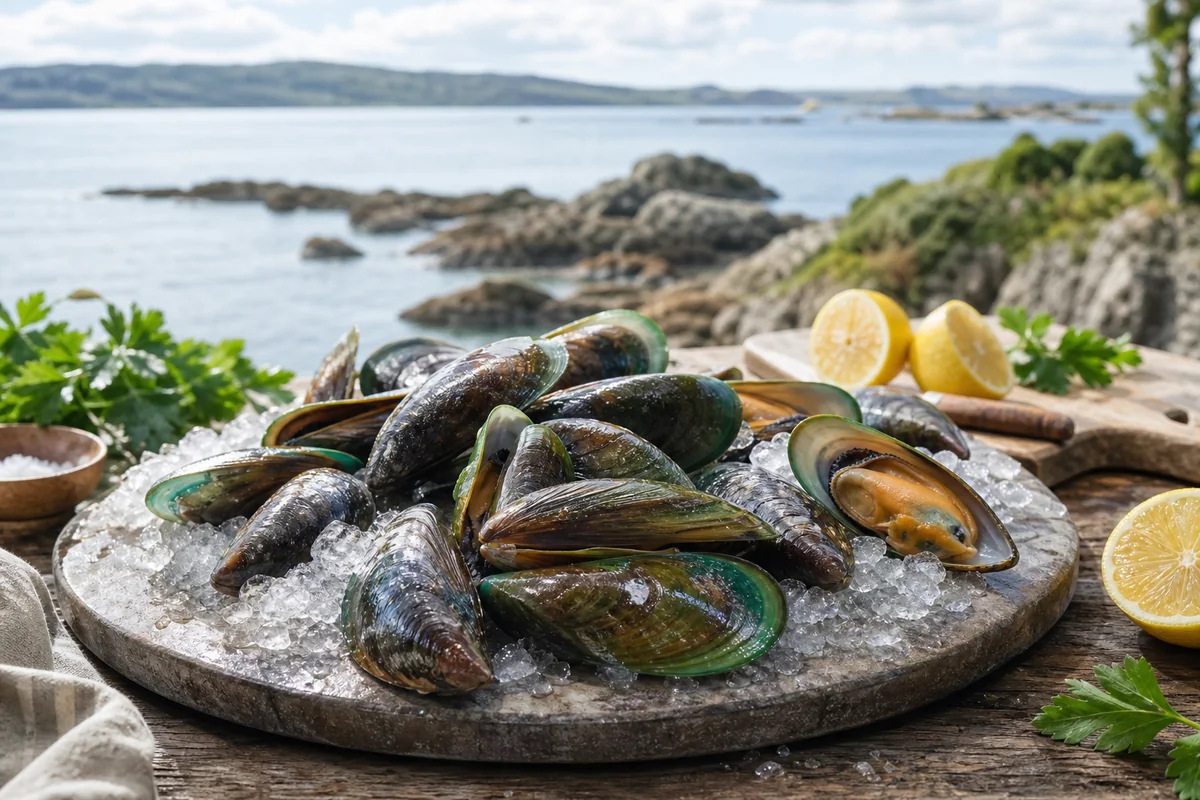
Walk the joint-support aisle and most of what’s on it is hard to judge from the label. One option is easier to look up than most — and it’s uniquely a New Zealand story. The green-lipped mussel (Perna canaliculus), found only in NZ waters and farmed in the Marlborough Sounds and beyond, has a genuine body of clinical research behind it for joint health.
What makes green-lipped mussel different
Green-lipped mussels contain omega-3 fatty acids alongside other marine lipids. That lipid fraction is the part the joint research has focused on, and it’s what the concentrated extracts used in trials are made from. The species is native and endemic to New Zealand, and it’s farmed here at scale.
What the evidence actually shows
This is where green-lipped mussel earns its place. The systematic review of green-lipped mussel for osteoarthritis listed in our sources below concluded that these preparations showed moderate evidence of benefit for arthritis symptoms. Both lipid extracts and whole-mussel powders have been studied, and the reviewers were clear that the small number of trials and their variable quality leave the best product format and dose uncertain.
The honest summary:
- Joint pain and stiffness — where most of the research sits. Trials report reductions in pain and stiffness, though effect sizes are modest and not every study is positive. Think “a useful adjunct that helps some people meaningfully,” not “a cure.”
- Anti-inflammatory action — the proposed explanation for the joint results is what the marine lipids do to inflammation, though the mechanism isn’t settled.
- Comparison to fish oil — green-lipped mussel and fish oil are different products with different evidence bases; current research does not establish that one reliably outperforms the other for joint symptoms. They’re not mutually exclusive.
Where it’s overstated: claims that green-lipped mussel “rebuilds cartilage,” “cures arthritis,” or works for everyone. The research supports symptom relief for some people, particularly with osteoarthritis — a genuinely worthwhile outcome, honestly stated.
Food vs supplement
You can absolutely eat green-lipped mussels as food — they’re delicious, sustainable, high in protein and omega-3, and a great addition to a NZ diet. But the doses used in the joint research are concentrated extracts (powder or oil), well beyond what you’d get from a feed of mussels. So: eat them for general nutrition and pleasure; consider a standardised extract if joint support is your specific goal. For another homegrown food that comes up in the same conversations, see our NZ bone broth guide.
How to choose a product
- Standardised lipid extract vs whole-mussel powder — research includes both concentrated lipid extracts and freeze-dried whole-mussel powders, and reviews have not established an optimal format. Whole freeze-dried mussel powder is cheaper and gentler but less potent per capsule.
- Cold/stabilised processing — the beneficial fatty acids are heat-sensitive, so quality processing matters; reputable NZ producers emphasise this.
- NZ-made and traceable — this is one category where buying NZ isn’t just patriotism; the raw material is literally from here, and the extract inside a good many retail brands is made here too.
- Give it time — this isn’t something you judge over a few days. If you’re going to try it, give it a consistent run and then be honest with yourself about whether anything has changed.
A quirk of this category is worth knowing before you go looking: some of the NZ names you’ll run into aren’t things you can actually buy. Aroma NZ Ltd is a business-to-business ingredient supplier — “Global Supplier of Marine Nutritional Supplement Ingredients” is how it describes itself, and every item in its catalogue is listed at $0.00, meaning trade enquiry only. GlycOmega is Aroma NZ’s ingredient trademark rather than a consumer brand, and Biolane is its cold-extracted green-lipped mussel extract. What you can buy are the retail products those ingredients go into, named right there on the label: GlycOmega™-PLUS is the mussel ingredient in Good Health Mussel 6000, and Biolane™ cold extraction is what’s inside Nutra-Life NZ Green Lipped Mussel 5600+.
What it costs, and what the label numbers mean
Start with the number on the front of the pack, because it’s the one most likely to mislead you. “Equivalent to 2,600mg fresh mussel” and “equivalent to 20,000mg” sit side by side on the shelf — an eight-fold spread — and that gap says far more about how much water was in the mussel before drying than about what you’re swallowing. The honest comparator is the actual powder or extract weight, and those numbers are much tighter: 500mg (Good Health 2500), 600mg per capsule (Xtend-Life), 750mg (Good Health 6000), 800mg (Sanderson) and 850mg of extract (Nutra-Life 5600+). If you compare on fresh-equivalence you’ll conclude one product is eight times stronger than another. It isn’t.
There’s no single industry dose either. Real label directions fall into three patterns: “1–3 capsules daily” (the most common by far), “1 capsule daily” on the high-equivalence powders, and a loading dose that steps down to a maintenance dose (Nutra-Life and Lyprinol). Here’s what’s on the shelf in October 2026, in NZD, with the cheapest per-day cost worked out at the minimum dose on the label.
| Product | What’s actually in a capsule | Label dose | Price (pack) | Per day |
|---|---|---|---|---|
| GO Healthy Go Mussel 2,600mg | Freeze-dried powder, equiv. 2,600mg fresh | 1–3 capsules daily | $62.60 (300 caps, RRP $99.99) | from $0.21 |
| GO Healthy Go Mussel 19,000mg | Powder, equiv. 19,000mg fresh | 1 capsule daily | $41.20 (100 caps) / $94.20 (300 caps), RRP $65.99 / $145.99 | $0.41 / $0.31 |
| Good Health Mussel 2500 | 500mg powder (equiv. 2.5g fresh) | 1 to 3 capsules daily | $70.30 (300 caps) | from $0.23 |
| Good Health Mussel 6000 | 750mg GlycOmega™-PLUS dried mussel (equiv. 6,000mg fresh) | 1–3 capsules daily | No longer available in NZ | — |
| Nutra-Life NZ Green Lipped Mussel 5600+ | 850mg Biolane™ cold-extracted extract (equiv. 5,600mg fresh), plus vitamin C | 2 capsules daily for the first 3 months, then 1 daily | $34.40 (100 caps) | $0.69 loading, $0.34 after |
| Xtend-Life Green Lipped Mussel Powder | Freeze-dried powder, 2,400mg per 4-capsule serve | 4 capsules per day | $45.70 (120 caps, 30 days, RRP $48.95) | $1.52 |
| Lyprinol Marine Lipid Joint Health | PCSO-524 marine lipid extract, 50mg per softgel | 4 capsules daily for 3–6 weeks, then 1–2 daily | $46.90 (50 softgels) | $3.75 loading, $0.94–1.88 after |
| Sanderson Premium NZ Green-Lipped Mussel 20,000 | 800mg powder (equiv. 20,000mg fresh) | 1–3 capsules daily | $53.90 (220 caps) | from $0.25 |
Three things worth knowing before you click buy. The Nutra-Life 5600+ is $34.40 at HealthPost, and HealthPost is no longer the only route: Life Pharmacy has come back into stock at $43.99, Health Chemist NZ has it at $31.65 and Bargain Chemist at $34.49, so four retailers will send you one. Netpharmacy is cheaper again at $33.90 and still sold out. Good Health Mussel 6000 has finished winding down, and you cannot buy it here any more: HealthPost has dropped it entirely, Life Pharmacy and Bargain Chemist return no results for it, and the 300-capsule pack is out of stock at every retailer that still lists it — Health Chemist NZ, supplements.co.nz and Netpharmacy. When we checked in September, Health Chemist NZ and supplements.co.nz could still sell you the 100-capsule pack at $24.93 and $29.90, on what looked like run-out stock rather than a bargain; by 1 October both of those listings had gone. We have left it in the table above so the comparison still reads, marked as no longer available. Every price in the table is a standing one rather than a discount, which is deliberate. The Xtend-Life special that ran to 14 September 2026 has ended and the price has gone back up to $45.70, which is what the table shows — still under the $48.95 RRP, though buying direct from Xtend-Life’s own NZ store now costs the full $48.95. One HealthPost promotion was running when we last looked, and the table ignores it because it is short-lived: Nutra-Life 5600+ is $32.60 until 12 October 2026. (A GO Healthy promotion ended on 5 October, and the GO prices are back to the standing figures shown.) Prices checked October 2026 and will move.
The price also does something the evidence doesn’t: it settles the lipid-versus-powder question for most people. Lyprinol is the only true lipid extract in this line-up — PCSO-524, 50mg per softgel — and its own loading dose runs to $3.75 a day, roughly ten to twenty times what the cheapest powders cost at their minimum label dose. That’s not an argument that the powders work better, because the research doesn’t say that. It’s an argument that the extra you’re paying for the lipid format is buying you something the trials haven’t shown to be worth it.
One last thing, and it’s a gap rather than a feature. Standardisation is thin across this category. Lyprinol is the only product here naming a standardised extract fraction (PCSO-524). Nutra-Life names Biolane cold extraction and Coromandel-grown mussels; Good Health 6000 names GlycOmega™-PLUS and the Marlborough Sounds; Xtend-Life states freeze-drying, Marlborough Sounds sourcing and “traceability” — which is a supply-chain claim, not a test result. Not one product page in this set states independent third-party testing or a certificate of analysis. Several carry TAPS approval numbers (Xtend-Life TAPS PP1759, Nutra-Life TAPS DA2044AS068), and it’s worth being clear about what that is: TAPS is New Zealand’s pre-vetting system for therapeutic advertising. It says the ad was checked. It says nothing about what’s in the capsule.
Who should be careful
Green-lipped mussel is a shellfish product — it’s off the table for anyone with a shellfish allergy, full stop. Interaction data are limited. Check with a pharmacist or GP before use if you take anticoagulants, have a bleeding disorder or are due for surgery. And as always, joint pain that’s new, severe or worsening deserves a medical assessment rather than a supplement — this is symptom support, not a diagnosis. For the over-50s reading this with an eye on joints, it slots into the wider picture we cover in our over-50s supplement guide (where, honestly, strength training still does more for joints than any capsule).
The bottom line
Green-lipped mussel is a joint supplement with some real clinical evidence behind it, and it happens to be grown here. If joint comfort is what you’re after and you want to try something from the natural-health shelf, a standardised NZ extract, lipid or freeze-dried, taken consistently is a reasonable place to start — the research hasn’t settled which format is best. Pair it with the boring fundamentals: movement, strength work, weight management. And eat the actual mussels too, because they’re excellent.
Sources and further reading
- Inflammopharmacology (2021): Green-lipped (greenshell™) mussel (Perna canaliculus) extract supplementation in treatment of osteoarthritis: a systematic review
- British Journal of Sports Medicine (2018): Dietary supplements for treating osteoarthritis: a systematic review and meta-analysis
Health information is general and does not replace advice from a qualified clinician or pharmacist. Check supplements for suitability with your medicines, allergies, pregnancy status and health conditions.