Quick answer: Matakana Superfoods Matcha Organic Tea Powder (NZ), around NZ$42.40 for 100g at HealthPost, for everyday lattes and baking; Wabi Tsubaki Ceremonial Matcha (NZ-owned), around NZ$38.50 for 50g from wabi.co.nz, for whisking plain. Prices checked October 2026.
Disclaimer: This is general information, not medical advice. It does not replace advice from a qualified clinician or pharmacist — worth a word with them if you are watching your caffeine intake.
Matcha has gone from niche Japanese tea ceremony ingredient to a daily ritual for wellness-conscious New Zealanders. But quality varies a lot here, and price is not always a guide to it.
Here’s how to tell good matcha from bad, and where to find the best options in NZ right now. It sits alongside the other everyday options in our NZ supplement guide for 2026.
Ceremonial vs Culinary Matcha: What Actually Matters
The terms “ceremonial grade” and “culinary grade” aren’t regulated — any brand can use them. What they’re meant to indicate is this:
- Ceremonial grade — made from the youngest tea leaves, shade-grown, stone-ground slowly. Intended to be whisked with water and drunk as-is. Bright green, smooth, slightly sweet with umami depth.
- Culinary grade — older leaves, less shade time, often blended. Designed for lattes, baking, and cooking. More bitter and earthy. Fine for smoothies or baking; flat-tasting drunk plain.
If you’re drinking it as a tea or latte where matcha is the centrepiece, buy ceremonial. If you’re adding it to oats or a protein smoothie, culinary grade is fine and considerably cheaper.
What Makes Matcha High Quality?
- Origin — Uji (Kyoto) and Nishio are Japan’s most respected matcha-producing regions. Chinese matcha has improved but Japanese generally sets the benchmark.
- Colour — vibrant, vivid green. Dull olive or yellow-green signals age or low-quality leaves.
- Taste — good matcha is smooth with natural sweetness and umami. Harsh bitterness in a plain whisk means low grade or old stock.
- L-theanine — the amino acid behind matcha’s calm-focus reputation. Shade-growing is generally credited with raising it, though we cannot point you to figures comparing one grade with another.
Best Matcha Available in NZ 2026
Everything below can actually be bought from New Zealand, in New Zealand dollars, without chasing a freight forwarder or guessing at international postage. That is the first test anything has to pass to appear here. Pack prices are listed with a per-serve figure worked out on a 2g serve, so tins of different sizes can be compared honestly. Prices checked October 2026 and will move. One to note if you are buying this week: HealthPost has 10% off the Matakana range until 12 October, which takes that pouch to $38.10, or about $0.76 a serve. The figure below is the standing price.
Matakana Superfoods Matcha Organic Tea Powder (HealthPost)
The easy call for most people, and the cheapest cup on this page. Matakana Superfoods is a New Zealand brand and HealthPost is about as mainstream as NZ online health retail gets, so getting it to your door is straightforward wherever you live. A 100g pouch is $42.40, which works out at roughly $0.85 for a 2g serve — around half what the ceremonial tins cost per cup. Sensible for daily lattes, smoothies and baking.
Wabi Ceremonial Matcha (wabi.co.nz)
Wabi is NZ-owned — Wabi Matcha Ltd — and sells direct, with free NZ shipping over $55. There are three grades to pick from: Haru organic ceremonial Uji matcha at $49.50 for 50g ($1.98 a serve), Tsubaki ceremonial at $38.50 for 50g ($1.54), and a café mixing grade at $26.50 for 50g ($1.06) built for milk drinks rather than whisking plain. All three are in stock. If you want proper ceremonial grade without ordering offshore, this is the simplest way to get it.
Matcha Maiden (Fresh Beauty Co)
Matcha Maiden is an Australian brand and one of the most widely stocked quality matcha brands in Australasia — Japanese-sourced, bright green, smooth in flavour, and a reliable middle ground. Fresh Beauty Co carries the range here in NZ. The 100% pure stone ground matcha green tea powder is around $45.00 for 70g, about $1.29 a serve. The smaller 28.35g organic tin is around $28.20, or $1.99 a serve, which really only makes sense as a try-before-you-commit size. One thing to watch: the flavoured “latte” tins are a latte blend rather than straight matcha powder, so don’t compare them on price with the tins above. Of those, only the Supergreens is in stock, at around $46.40 for 150g; both strawberry listings are sold out. Prices checked October 2026.
MatchaMatcha NZ Organic Ceremonial Grade
Another New Zealand seller, at matchamatcha.co.nz. A 50g tin of organic ceremonial grade is $58.00, which is $2.32 a serve, with free shipping over $120 — or $150 if you are rural. That makes it the dearest cup of the local full-size tins, so buy it because you like what they do rather than as a value play.
Picks We’ve Taken Out: Encha, Zen Green Tea and Ippodo
Earlier versions of this guide recommended Encha and Zen Green Tea for culinary grade, and Ippodo for the top end. None of them can be bought from a New Zealand seller in New Zealand dollars, so all three are gone. We’d rather say that plainly than quietly delete them, because being pointed at a product you can’t actually buy here is exactly the problem this site exists to fix.
Encha — a US brand with no New Zealand stockist we could find. Buying direct from encha.com puts you in US dollars, and their shipping policy offers free shipping to US addresses only, with no international or New Zealand rate stated anywhere on the site. There is no landed NZ price we can quote you, so it doesn’t belong in a guide about where to buy.
Zen Green Tea — they say it themselves, on the product page and again in the FAQ: “Unfortunately, we can no longer ship outside Australia due to high shipping costs.” Their premium grade is A$32 for 60g, which is neither here nor there when the parcel won’t cross the Tasman. For the record, they’re Australian-owned, founded in 2012 by Erin Young. Good option if you’re in Australia; not an option from here.
Ippodo — a Kyoto tea house with over 300 years of history, and very good matcha. But it only sells to New Zealand from its global online store, priced in Japanese yen, so what a tin costs you depends on the exchange rate on the day, international postage and anything collected at the border. There’s no NZ or Australian stockist, and Wabi’s Uji ceremonial grades above do the same job in New Zealand dollars, so it no longer earns a place.
The Wellness Case for Matcha
Matcha contains caffeine — how much depends on the grade and how you make it — but people who switch from coffee consistently describe the lift differently: the L-theanine in it is usually credited with a calmer, steadier effect rather than a spike and crash. That is the common experience rather than something we have linked a study for here. If cognitive effects are what you are chasing, our guide to nootropics in NZ covers that ground.
Matcha is also high in EGCG (epigallocatechin gallate), a well-researched catechin with antioxidant properties. Because you are drinking the whole leaf rather than an infusion of it, you get more of what is in the leaf than brewed green tea gives you. If you are after broader plant coverage rather than caffeine, a daily greens powder is the more direct option.
How to Make a Proper Matcha Latte
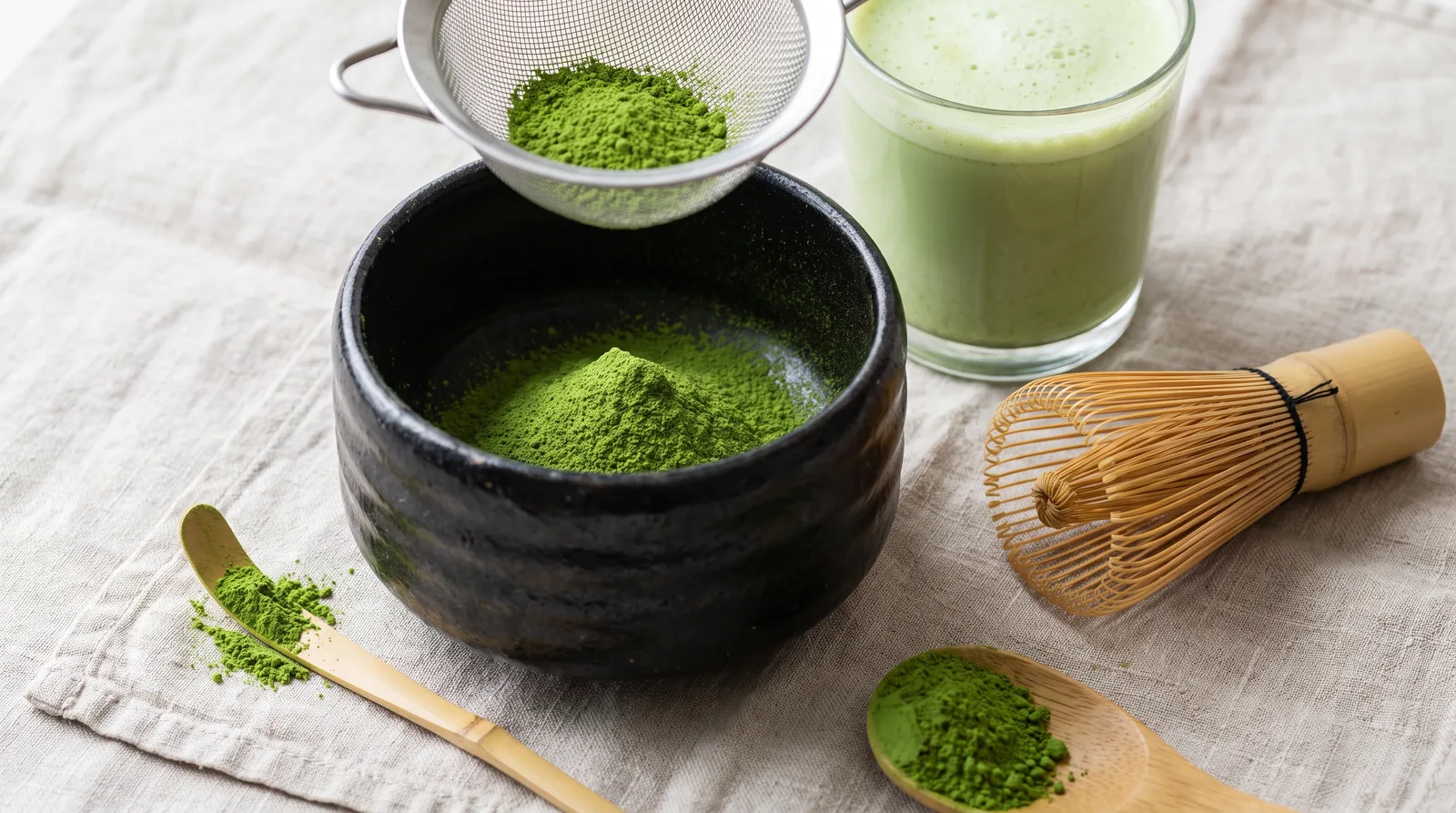
Sift 1–1.5 tsp of matcha into a small bowl or cup. Add 60ml of hot water (not boiling — around 75–80°C). Whisk in a W or M motion until frothy and no clumps remain. Add your choice of steamed milk. That’s it. No sweetener needed with quality ceremonial grade.
The Bottom Line
Cheap matcha is usually cheap for a reason, and it shows up in the taste. For everyday drinking, cooking and smoothies, Matakana Superfoods at about $0.85 a cup is the sensible starting point, and Wabi’s café grade does the same job in milk. For proper ceremonial grade without ordering offshore, Wabi’s Haru or Tsubaki. Matcha Maiden remains a solid, widely stocked middle ground, and MatchaMatcha’s organic ceremonial is the other local tin worth trying if you don’t mind paying more per cup. If caffeine is the reason you are switching, mushroom coffee blends are worth a look too.
Affiliate disclosure: Some links on ThrivingKiwi may earn us a small commission if you buy through them, at no extra cost to you. Paid links are marked as sponsored. We only recommend products we genuinely rate.