Quick answer: The simplest composting toilet here is the NZ-made Bambooloo bucket system (about NZ$1,350); Australian-made Nature Loo chamber systems start at about NZ$2,180. WCTNZ sells both (checked October 2026). Let the compost mature for at least 12 months, then bury it under ornamental or native trees, never in a food garden. You’ll need a building consent, and your regional council’s rules apply.
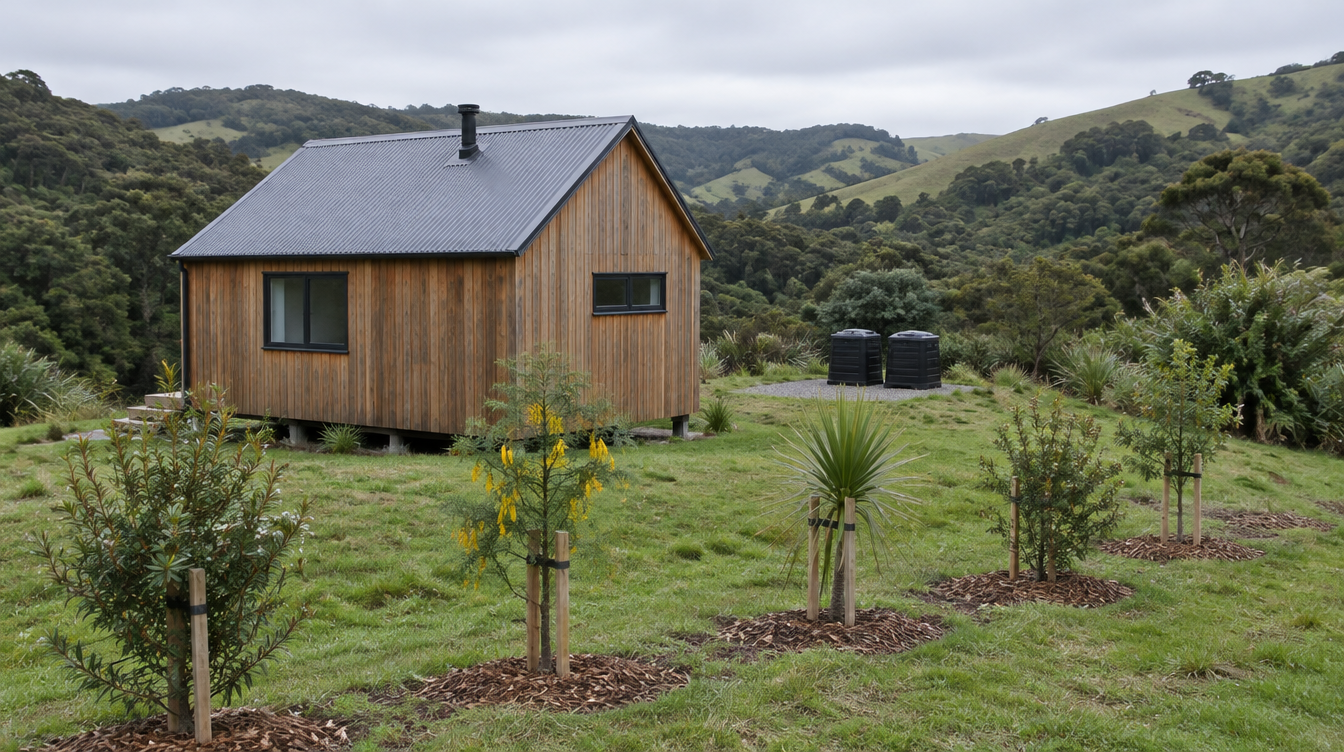
Every flush sends water treated to drinking standard, and a load of nitrogen and phosphorus, off to a treatment plant or septic tank. A composting toilet skips the water and keeps those nutrients on your land, where they turn back into soil. It’s the last and most personal loop to close on a Kiwi section, and it comes with real responsibilities: to your health, to your neighbours and waterways, and to the tikanga (correct practice) that many New Zealanders hold around human waste.
Why it matters for the planet
It saves drinking water. BRANZ puts toilet flushing at 18 to 19% of a household’s total water use. ESR’s 2022 scoping study for the Ministry of Health, citing earlier research, puts the saving from a composting toilet at 15 to 28% of indoor household water use. All of that is water that has been collected, treated to drinking standard and pumped to your house, only to carry waste away.
It keeps waste out of water. A composting toilet has no outlet to a stream, a harbour or a sewer that can overflow in heavy rain. The waste stays on your property and goes back into the ground.
It recycles nutrients. ESR notes that urine is high in nutrients, which makes it a useful fertiliser, and that faeces carry phosphorus, potassium and sulphur that plants can use once composted. Phosphorus in particular is a finite resource, and our article on the phosphorus problem explains why returning it to the soil matters for New Zealand.
It works where pipes don’t. Composting toilets suit baches, tiny homes, off-grid builds and sites with a high water table, and they keep working when the sewer doesn’t. Wellington’s emergency management office trialled compost toilets in 2012 as a backup for when the sewerage system is disrupted, and they were used after the Christchurch and Kaikōura earthquakes.
How a composting toilet works
Composting toilets come in two main types, as ESR describes them.
- Batch systems collect waste in a bucket or chamber. When it’s full, it’s sealed or emptied into an outdoor compost bin and swapped for an empty one, so each batch can finish composting without fresh material being added. They cost less but need more handling.
- Continuous systems have one large chamber under the floor that receives waste from above. The compost slowly moves down and is removed from the bottom through a hatch. They need less handling but more space underneath the house.
Either type can separate urine at the bowl. Keeping urine out of the solids reduces odour and stops the compost going wet and anaerobic. After each use you add a scoop of dry bulking material (sawdust, wood shavings, coco peat or similar), which balances the carbon and nitrogen, lets air in and covers the waste. A vent pipe, often with a small fan, pulls air down through the toilet and out above the roof, which is why a well-run composting toilet doesn’t smell inside the house.
ESR lists the conditions composting needs: plenty of air, moisture around 50 to 60%, temperatures of 40 to 65°C, and a carbon-to-nitrogen ratio of roughly 25 to 35 parts carbon to one of nitrogen. That’s the theory. In practice, small home systems rarely hold those hot temperatures for long, which is where the 12-month rule comes from.
Why 12 months is the benchmark
Heat is what kills most of the bacteria, viruses and parasites in human waste. ESR’s study notes that home composting toilets often struggle to reach those temperatures, which can leave pockets of poorly composted material. The safety margin is time. The international literature ESR reviewed says household compost should mature for more than a year where it’s above 20°C, and up to two years where it’s between 2 and 20°C, which covers much of New Zealand for much of the year. The joint Australian and New Zealand standard for waterless composting toilets, AS/NZS 1546.2, requires the composted material to be buried at least 100 mm deep after 6 to 12 months.
The two regional councils we checked agree on 12 months. Greater Wellington’s rule for composting toilets and Hawke’s Bay Regional Council’s rule 37 both require the compost to have been composting for at least 12 months from the last addition of raw waste before it goes onto land. Bambooloo’s own instructions are similar: fill one bin for a year, then leave it to mature for a further year while you fill the second, and allow longer in a cold climate.
One more risk ESR points out: healthy people’s waste carries few pathogens, but someone who is sick adds far more, and medicines and hormones pass through into the compost too. Time and burial reduce these risks. Neither removes them entirely.
Tikanga: keeping human waste apart from food
For many Māori, human waste is not just a hygiene question. ESR’s 2022 study, drawing on Tiaki Para, a study of Ngāi Tahu values about waste by Pauling and Ataria (2010), describes how traditional Māori practice treated human excreta as tapu (sacred, restricted) and handled it through careful, disciplined processes that kept it separate from other things, especially food. Latrines sat on the edge of a settlement, and using any kind of manure to grow food was viewed as abhorrent. Pauling and Ataria found a consistent theme running through Māori views: the human food chain and human waste streams are kept separate.
ESR also reports a commonly held Māori view that human waste should go to land, not to water, whatever the level of treatment. In evidence quoted by ESR, the land is described as the medium by which tapu material is made noa (free from restriction) and can become part of the earth again. A composting toilet that keeps waste out of streams and returns it to the soil fits with that view. Using the compost to grow vegetables does not.
The study also notes that Māori culture is not uniform and tikanga varies between iwi and can adapt over time. We’re not the right people to speak for any of them, so our advice is simple and conservative:
- use finished compost to feed ornamental and native trees, shelterbelts and amenity planting, not vegetable gardens or fruit you’ll eat;
- keep your compost bins well away from where food is grown, prepared or stored;
- if your land is Māori land, or close to a marae, talk to the local hapū or marae before you install one.
This lines up with the health advice too. Bambooloo’s own disposal guide says not to use the compost on vegetables, herbs, edible flowers or seed crops. It does allow fruit and nut trees, but we’d leave those out as well, for the reasons above. Urine is a separate stream with its own uses (our phosphorus article covers it), but it’s bodily waste too, so the same respect applies.
Doing it in NZ: makers and prices
Prices below are from the sellers’ own sites (checked October 2026). WCTNZ lists prices excluding GST, so we’ve added GST for comparison.
- Bambooloo (made in New Zealand). The Bambooloo Classic is a bamboo bucket commode handcrafted in New Zealand by Waterless Composting Toilets NZ (WCTNZ), a family company based in Henderson, Auckland. It’s NZ$1,173.91 plus GST (about NZ$1,350), and comes with a 20 L bucket and screw-on lid, compostable bags, bulking agents and a manual. It’s a batch system. The toilet is only the collector, and the composting happens in what Bambooloo calls a secondary treatment system: generally two 220 L compost bins per person, sealed around the sides, in a sunny dry spot, used for nothing else. It’s the most affordable option we priced, and suits a bach, tiny home or sleepout.
- Nature Loo (made in Australia). Nature Loo has been making waterless composting toilets in Queensland since 1994, to Australian and New Zealand standards. WCTNZ sells them here. The Nature Loo NL3, with three composting chambers and suited to two people full-time, is NZ$1,892.94 plus GST (about NZ$2,177). The Alectura Comfort, designed for tiny homes with only 500 mm of underfloor clearance, was on special at NZ$2,850.61 plus GST (about NZ$3,278) when we checked. These are chamber systems: you swap chambers as they fill, so there’s less day-to-day handling than with a bucket.
- What about Separett? People often ask about this Swedish urine-diverting toilet. It isn’t one of our picks, because the NZ and Australian options above cover the same need for less money.
Budget for the extras: the building consent, a vent pipe and roof flashing, compost bins, and an ongoing supply of bulking material. A plumber or drainlayer may also be needed if urine or liquid is piped to a soakage area.
The rules, briefly
Installing a composting toilet in a home needs a building consent, and the toilet should meet AS/NZS 1546.2. Where a mains sewer is available, ESR notes the council has to grant a waiver for an on-site system. What happens to the compost is up to your regional council, and ESR found no consistent national approach: Wellington permits it with 12 months of composting, disposal on the property, and a 50 m gap from waterways and bores, while Hawke’s Bay adds vermin-proof storage, 600 mm above groundwater and a minimum section of 2,500 m². Check with your council before you buy.
What a composting toilet won’t do
- It won’t run itself. ESR’s survey of councils and health officials found that how well a composting toilet works, and how safe the end product is, depends mostly on how the household runs it. Bulking material, emptying and bin rotation are your jobs, for as long as you have it.
- It won’t feed your vegetables. For the health and tikanga reasons above, the compost belongs under trees and ornamentals.
- It won’t suit every section. Small urban lots, homes on a sewer line, and sites near streams or bores can all run into the rules. Hawke’s Bay’s 2,500 m² minimum rules out a typical town section there.
- It won’t deal with your other wastewater. The shower, basin, kitchen and laundry still need a proper outlet. If you’re off the sewer, our guide to greywater in the garden covers what’s safe.
- It won’t be quick. From the last deposit to compost you can bury is a year at least, and longer in a cold spot.
The Bottom Line
A composting toilet is the most complete way to close the loop on human waste at home: no drinking water flushed, nothing sent to a stream, and nutrients returned to the land. It suits people who are willing to manage it for the long run and who have the space to compost and bury safely. For most, a NZ-made Bambooloo with a two-bin secondary system is the place to start. Give the compost 12 months at least, then use it to grow trees, not food.
- If you have a bach, sleepout or tiny home, start with a Bambooloo and two sealed compost bins, and talk to your council about consent before installing.
- If you want less handling, look at a Nature Loo chamber system and check your underfloor clearance first.
- If you’re in town on a sewer, expect to need a waiver, and ask your council early.
- If your land is Māori land or near a marae, talk to the local hapū or marae before you decide.
For the bigger picture of how the loops on a section connect, start with our hub, Closing the Loop on a Kiwi Section.
Words we use
- Tikanga: correct procedure, custom, practice, protocol (Te Aka Māori Dictionary).
- Tapu: sacred, restricted, set apart (Te Aka Māori Dictionary; ESR 2022).
- Iwi, hapū and marae: iwi means tribe, hapū a sub-tribe, and a marae is a tribal meeting place and its buildings (Te Ara).
- Noa: free from the restrictions of tapu, ordinary, unrestricted (Te Aka Māori Dictionary).
Sources and further reading
- ESR (2022): Composting toilets in New Zealand, a scoping study (for the Ministry of Health), which cites Pauling, C. and Ataria, J. (2010), Tiaki Para: A study of Ngāi Tahu values and issues regarding waste, Landcare Research
- Greater Wellington: composting toilets permitted activity user guide
- Wairoa District Council: composting toilets information sheet (HBRC rule 37 conditions)
- BRANZ Facts: Greywater reuse systems for New Zealand houses (household water use)
- Bambooloo: secondary treatment of compost and final disposal of compost
- Nature Loo (Ecoflo): about Nature Loo
- Te Aka Māori Dictionary (tikanga, tapu, noa)
Affiliate disclosure: Some links on ThrivingKiwi may earn us a small commission if you buy through them, at no extra cost to you. Paid links are marked as sponsored. We only recommend products we genuinely believe are worthwhile.