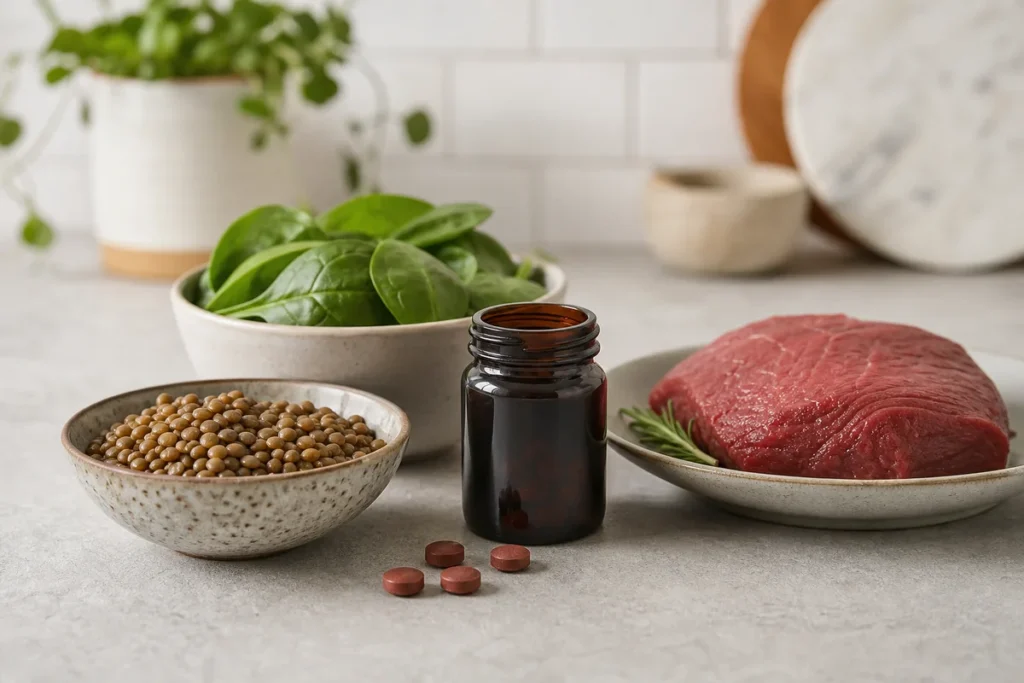

Through a New Zealand winter, the sun over most of the country is too low in the sky for your skin to make meaningful vitamin D for much of the day. Add in that we work indoors, that it’s cold out, and that Kiwis have (rightly) been drilled on sun protection our whole lives, and you get one of NZ’s quietest common deficiencies — concentrated in the May to August window, when the sun sits too low to do much for you.
Vitamin D is also one of the supplements Kiwis reach for most reliably each winter. So here’s the honest guide: what vitamin D actually does, who genuinely needs to think about it, and the one thing most articles skip — that in New Zealand, prescription vitamin D is funded for eligible patients when a clinician considers it appropriate.
What vitamin D actually does
Vitamin D’s headline job is calcium regulation — it’s essential for absorbing calcium from food and maintaining bone density, which is why serious deficiency shows up as bone pain, muscle weakness, and (long-term) osteoporosis risk. Beyond bones, vitamin D receptors exist throughout the immune system, and low status is associated with worse winter respiratory illness — though the supplement trials on infection prevention show modest effects, mostly in people who were deficient to start with. That last clause is the honest theme of this entire article: vitamin D supplementation mainly helps people who are actually low. It’s a repletion story, not a superpower story. Vitamin C gets similar winter attention in New Zealand, and the same question applies there: which forms are actually worth buying.
Why NZ specifically has a winter problem
- Latitude: from roughly May to August, especially south of about Waikato, the sun’s angle means UVB — the wavelength your skin uses to make vitamin D — barely gets through. In Dunedin in July, you could sunbathe at midday (don’t) and produce very little.
- Indoor lives: office hours span the entire window when any UVB is available.
- The sunscreen paradox: our world-leading melanoma rates mean sun protection stays non-negotiable — and yes, consistent SPF meaningfully reduces vitamin D synthesis. The answer isn’t less sunscreen in summer; it’s awareness that winter status needs another plan. (Our sunscreen guide stays in force year-round.)
- Higher-risk groups: people with darker skin (melanin slows vitamin D synthesis), older adults (skin efficiency declines with age), people who cover skin for cultural or religious reasons, shift workers, and anyone housebound.
The bit most articles skip: the funded option
In New Zealand, colecalciferol capsules are a funded prescription medicine — and the dose depends on which situation you are actually in, which is the detail most articles get wrong. For someone who has risk factors for deficiency but is not known to be deficient, the recommended regimen is 1.25mg (50,000 IU) every two to three months. Monthly dosing is for confirmed deficiency, with a more intensive loading course used for moderate to severe cases. If you are reading this because winter and your working hours have you worried rather than because a blood test came back low, the two-to-three-monthly regimen is the one that applies to you.
Current New Zealand prescribing guidance also makes the point that high intermittent dosing is generally avoided where there is a choice, because it is associated with more adverse effects than steadier regimens. That is one more reason this is a conversation to have with your GP rather than a dose to decide on in advance. The medicine itself is funded when prescribed for an appropriate patient; consultation and dispensing costs can still vary. For anyone in the higher-risk groups above, the smartest first move isn’t the supplement aisle; it’s mentioning it at your next GP visit. Routine blood testing isn’t generally recommended for everyone (it’s reserved for genuine clinical need), but the prescription route doesn’t always require a test — GPs can prescribe on risk-factor assessment.
If you’re buying over the counter
- Form: vitamin D3 (colecalciferol) is the standard — it’s what the body makes from sunlight and what nearly all NZ products contain.
- Dose: everyday OTC products in NZ are typically 1,000 IU (25mcg) per capsule, which is a sensible daily maintenance dose through winter. More is not better once you’re replete — vitamin D is fat-soluble and stores in the body, and very high long-term intakes can cause genuine harm (it’s one of the few vitamins where megadosing has a real toxicity ceiling).
- Timing: with a meal containing some fat, absorption improves. Consistency beats timing.
- NZ brands: the mainstream local options — GO Healthy (NZ’s top-selling supplement brand by Circana data), Clinicians (founded by NZ pharmacists in 1997), Nutra-Life and others — all sell straightforward D3 at honest prices. This is a category where the cheap product and the premium product are functionally identical; buy on price and dose, not packaging.
- Pairings: if you’re also taking calcium for bones, or magnesium for whatever reason you take magnesium, vitamin D sits alongside both without trouble — it’s the absorption key for the calcium story especially. Over-50s should read this alongside our over-50s supplement guide, where vitamin D sits at priority one. Zinc is the other nutrient that comes up in winter immune conversations, and it has the same form-versus-marketing problem this one does.
What to actually buy, and what it should cost
The New Zealand vitamin D shelf is unusually simple, because almost everything on it is the same thing: 1,000 IU (25mcg) of D3 in a capsule, tablet or softgel. The differences between products are pack size, format and price, not potency. Prices below were checked in October 2026 and will drift, but the spread between them tells you what a fair price looks like.
- Nutra-Life Vitamin D3 1000 IU — 60 capsules, around $14.50 at HealthPost. Plain D3, no extras, and the cheapest per capsule of the health-store brands here — though the Sanderson softgels below undercut it.
- Clinicians Sunshine Vitamin D3 1000IU with Vitamin K2 — 60 sublingual tablets, around $15.40 at HealthPost, $18.99 direct from Clinicians. Dissolved under the tongue rather than swallowed, and it includes 90mcg of K2 as MK-7.
- GO Healthy GO Vitamin D3 1,000IU — 90 vegecaps, around $26.50 at HealthPost. A bigger pack from the brand most Kiwis will recognise, at a broadly similar cost per capsule.
- BePure Vit D Restore Capsules — 30 capsules, around $20 at Chemist Warehouse to $29 at HealthPost or direct from BePure, delivering 1,000 IU of D3 with 60mcg of K2 as MK-7. Comfortably the most expensive per capsule here, and what you are paying for is the brand rather than a stronger dose.
- Sanderson Premium Vitamin D3 1000iu — 100 softgels, around $15.50 at Net Pharmacy. Stocked mainly through pharmacies and chemist chains rather than health food stores, and at roughly 15c a capsule it is the cheapest way to buy D3 on this list.
Two things are worth noticing. The first is that nothing mainstream on the New Zealand shelf currently goes above 1,000 IU per dose — and that is a regulatory ceiling rather than a market accident. Medsafe classifies vitamin D above 25mcg (1,000 IU) per daily dose as a prescription medicine, so anything stronger cannot legally sit on a general sale shelf. Medsafe ran a consultation in early 2026 on raising that threshold to 50mcg (2,000 IU); if that change is confirmed, stronger over-the-counter products will start appearing and this paragraph will date accordingly. As things stand, if you think you need meaningfully more than 1,000 IU, the answer is a conversation with your GP about the funded prescription, not a bigger bottle from the supplement aisle. The second is that the adult upper limit for total daily vitamin D intake is 4,000 IU (100mcg), and going above that on your own initiative is the point at which a supplement stops being harmless.
On form: NZ products are essentially all D3 (colecalciferol). You will occasionally see D2 (ergocalciferol) on imported or vegan-labelled products. Where you have the choice, D3 is the better buy, because it raises blood levels further and holds them there longer. Softgels and liquids suit people who struggle with tablets, but there is no absorption argument strong enough to justify paying extra for one format over another, provided you take it with food that has some fat in it.
The K2 question
D3 and K2 sold together is one of the supplement industry’s favourite pairings, and the reasoning is easy to follow: vitamin D improves how much calcium you absorb, and vitamin K2 is involved in directing that calcium into bone rather than leaving it in soft tissue. Two of the NZ products above carry it, Clinicians Sunshine at 90mcg of MK-7 and BePure Vit D Restore at 60mcg.
The honest position is that the mechanism is plausible and the evidence is thin. The supporting trial data comes largely from postmenopausal women with diagnosed osteoporosis, not from otherwise healthy adults topping up through a Kiwi winter, and nobody has shown that adding K2 to an ordinary 1,000 IU maintenance dose changes anything you would notice. So if a combination product costs about the same as a plain one, which at the moment the Clinicians tablets do, there is no reason to avoid it. If it costs meaningfully more, you are paying a premium for a maybe.
One genuine caution. Vitamin K is the thing warfarin works against, so a K2 supplement can interfere with warfarin control. If you are on warfarin or another vitamin K antagonist, choose a plain D3 product, or talk to whoever manages your INR before you start anything with K2 in it.
Can’t you just get it from food?
Only partially — food is a minor source for most people. Oily fish (salmon, sardines, canned tuna), eggs, and fortified products (some milks, margarines and cereals in NZ) contribute, but typical dietary intake covers only a fraction of winter needs. Food helps; it rarely solves. It’s still worth eating well through the season — a winter plate built around what’s actually in season in NZ covers plenty of the other nutrients winter thins out, even if vitamin D isn’t one of them.
The bottom line
Vitamin D deserves a risk-based approach in New Zealand. Winter, latitude and limited sun exposure can raise the chance of low status, but supplementation is most useful when a person’s risk, diet, health and medicines are considered together. If you’re in a risk group, ask your GP about the funded prescription first — remembering that for risk without confirmed deficiency, that means a capsule every two to three months rather than every month. If winter, limited sun exposure or another risk factor concerns you, ask a pharmacist or clinician whether supplementation is appropriate and what dose fits your circumstances. Come summer, the sun takes the job back (with sunscreen on, thanks).
Sources and further reading
- Ministry of Health: Vitamin D and sun exposure consensus statement
- PHARMAC: Colecalciferol schedule listing
- bpacnz (2025): Vitamin D supplementation — an update
- Medsafe: Vit.D3 colecalciferol 1.25mg capsule data sheet
- NIH ODS: Vitamin D fact sheet
Health information is general and does not replace advice from a qualified clinician or pharmacist. Check supplements for suitability with your medicines, allergies, pregnancy status and health conditions.