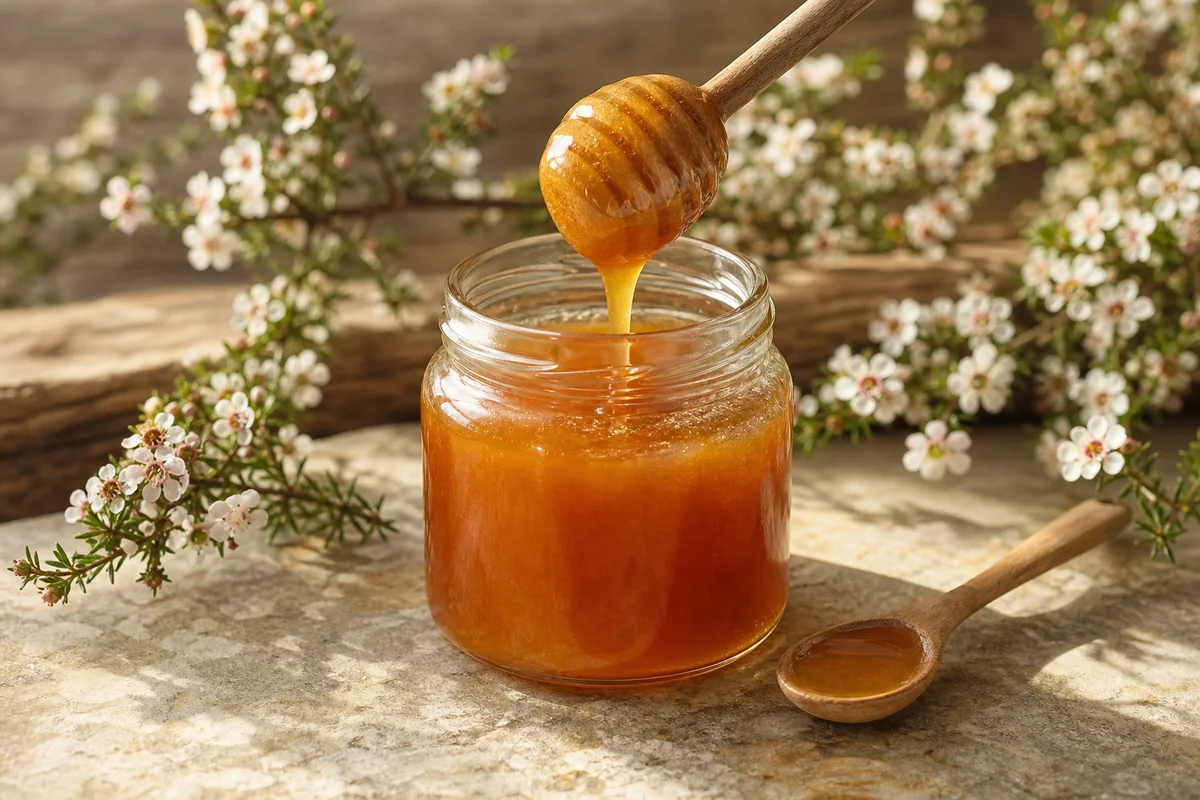
Mānuka honey is one of New Zealand’s most famous exports — and one of its most misunderstood wellness products. Here’s what the science actually shows, what the ratings mean, and how to get genuine value from it.
What Makes Mānuka Honey Different?
Regular honey has some antimicrobial properties due to its hydrogen peroxide content. Mānuka honey — produced by bees that forage on the native mānuka plant (Leptospermum scoparium, which grows across New Zealand and in parts of south-eastern Australia) — contains an additional compound called methylglyoxal (MGO), which gives it stronger and more stable antimicrobial activity in the lab.
MGO activity holds up where regular honey’s doesn’t. Honey’s peroxide activity is destroyed by catalase, an enzyme present in body tissue and saliva; mānuka’s MGO-based activity isn’t, and it’s more stable to light and storage. That’s the real chemical difference, and it’s a narrower claim than “mānuka is stronger medicine”.
Understanding UMF and MGO Ratings
Two main rating systems appear on mānuka honey products:
- UMF (Unique Mānuka Factor) — the most comprehensive rating system, managed by the UMF Honey Association. UMF measures four markers: MGO, leptosperin (a mānuka-specific compound), DHA, and HMF. A product with a valid UMF rating has been independently verified by licensed testing. UMFHA’s own guidance is more modest than the marketing: it suggests 5+ to 10+ as an everyday honey, 15+ to 20+ when you want more potency, and 25+ at the top end. “Therapeutic grade” isn’t a UMF category or a legal one — under the Food Standards Code, honey is food, and food can’t carry treatment claims.
- MGO — a measure of methylglyoxal concentration only. The UMF Honey Association is blunt about this: MGO does not convert to UMF, because UMF is a combination of four measures and MGO is one. What UMFHA does publish in its grading table is the minimum MGO each grade must hit — UMF 5+ needs MGO 83 mg/kg, UMF 10+ needs 261, UMF 15+ needs 512, UMF 20+ needs 826, and UMF 25+ needs 1197. So a jar marked MGO 300+ sits between UMF 10+ and UMF 15+; MGO 550+ clears UMF 15+ but not UMF 16. Treat any tidy conversion chart, including the ones brands publish, as a rough guide rather than an equivalence.
Look for the UMF trademark on New Zealand mānuka honey — it’s your assurance the product has been independently verified as genuine and rated accurately. Some cheaper products lean on MGO numbers without that verification behind them.
What the Law Actually Requires
Before UMF or MGO enters the picture, there’s a government test. MPI’s mānuka honey definition uses five attributes — four nectar chemicals (2′-methoxyacetophenone, 2-methoxybenzoic acid, 4-hydroxyphenyllactic acid and 3-phenyllactic acid) plus mānuka pollen DNA. Clear all five at the lower thresholds and it’s multifloral mānuka; clear 2′-methoxyacetophenone at 5 mg/kg and 3-phenyllactic acid at 400 mg/kg and it’s monofloral.
Here’s the part most buyers don’t know: that testing is compulsory for honey labelled mānuka for export, and it is not currently compulsory for honey sold here at home. MPI is explicit that all honey labelled as mānuka for export must be tested by an MPI-recognised laboratory, while requirements for the domestic market remain subject to further policy work. Domestic jars still have to meet general food law and the Fair Trading Act, but they don’t have to pass the MPI test. That, more than anything, is the argument for buying UMF-certified in New Zealand — it’s independent verification you’re not otherwise guaranteed.
What Mānuka Honey Can Actually Do
Wound Healing
This is mānuka honey’s best-supported use, though the evidence is narrower than the marketing suggests. The 2015 Cochrane review of 26 trials and 3,011 participants found honey dressings heal partial-thickness burns faster than conventional dressings, and infected post-operative wounds faster than antiseptics and gauze. Beyond those two comparisons the reviewers were clear that the evidence is low or very low quality and “does not form a robust basis for decision making” — including for venous leg ulcers and diabetic foot ulcers.
Medical-grade mānuka honey is genuinely used in hospitals, but it’s gamma-irradiated and registered as a medical device. The jar in your pantry isn’t sterile and isn’t the same product. For everyday skin that’s dry or irritated rather than broken, one of the natural skincare brands made here is a more sensible buy than a spoonful of honey.
Sore Throats and Upper Respiratory Infections
The good evidence here is for honey generally, not mānuka specifically. Cochrane’s 2018 review of honey for acute cough in children found honey probably relieves cough symptoms better than no treatment, placebo or diphenhydramine, and a 2021 BMJ Evidence-Based Medicine meta-analysis found honey beat usual care for upper respiratory symptoms.
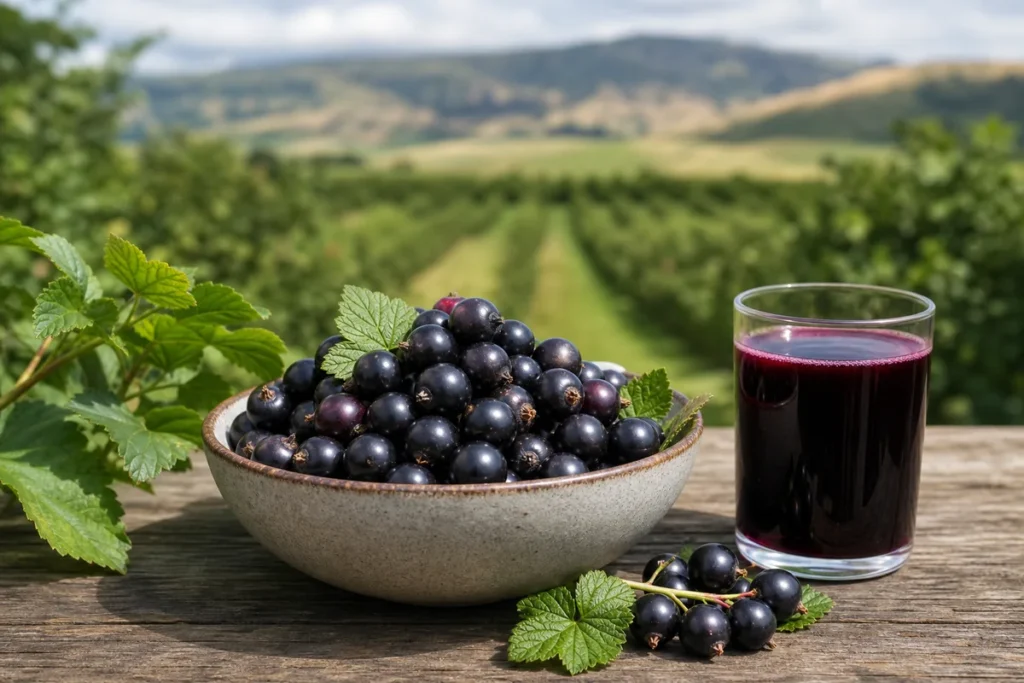
Neither tested UMF-graded mānuka. If a spoonful helps your throat, that’s a real effect — you’re just unlikely to be getting extra value from the UMF number, and a cheap bush honey will do the same job. If you’re building a winter routine around it, New Zealand blackcurrants are a better-value source of the vitamin C people often assume they’re buying honey for.
H. pylori and Digestive Health
Lab studies show mānuka honey inhibits Helicobacter pylori, the bacterium behind most peptic ulcers. The original work was done at the University of Waikato — al Somal, Coley, Molan and Hancock, Journal of the Royal Society of Medicine, 1994 — and it’s a petri-dish result, not a patient result. A 2026 study showed gastroprotective effects in rats.
What doesn’t exist, more than thirty years on, is a single randomised trial in humans. That’s worth saying plainly: this is an interesting lab finding, not a treatment. If gut health is what you’re actually after, the everyday basics have far better evidence behind them than any honey does — and see your GP about persistent digestive symptoms rather than self-treating.
Oral Health
Mānuka honey inhibits Streptococcus mutans in the lab, and two small human studies have looked at plaque and gingivitis. A 30-person Otago pilot in 2004 found a mānuka honey chew reduced plaque scores and bleeding sites over 21 days. A 2018 trial in 135 children found a mānuka honey mouthwash worked — but no better than plain raw honey, and less well than chlorhexidine.
One thing to correct while we’re here: mānuka honey is not low-GI. When it was measured — Chepulis and Francis, e-SPEN Journal, 2013 — five New Zealand samples came in at GI 54 to 59, which the authors called moderate. It’s still sugar, and it still feeds the bacteria that cause decay.
Best NZ Mānuka Honey Brands
Comvita (NZ Brand)
Comvita is New Zealand’s largest mānuka honey producer and globally the most recognised brand. Founded in the Bay of Plenty, it’s a UMF licensee and its range is available at HealthPost, most NZ supermarkets, and internationally. UMF 15+ (250g) is NZ$156 at Comvita’s RRP, and around NZ$100 from HealthPost. Their NZ ladder for a 250g jar runs UMF 5+ ($43), 10+ ($68), 15+, 18+ ($207) and 20+ ($257) at RRP — the price climbs much faster than the rating does (prices checked October 2026).
Manuka Health (NZ Brand)
Another well-regarded NZ producer with a strong international presence. Note their consumer range is graded in MGO rather than UMF — MGO 115+ through MGO 850+. They do hold a UMF licence, and their MGO 573+ jar is certified UMF 16, which is the one to look for at HealthPost if you want a UMF number on the label.
Arataki Honey (NZ Brand)
A Hawke’s Bay mānuka honey producer with a strong domestic reputation and UMF certification. Arataki’s products are available at many NZ supermarkets, through HealthPost and direct from their website. Good value for everyday use in the UMF 5+ to UMF 15+ range. A solid domestic choice supporting a regional NZ producer.
Steens Raw Mānuka Honey (NZ Brand)
Steens produces raw, cold-pressed mānuka honey with a focus on minimal processing. Whether that preserves anything the UMF number doesn’t already capture is a claim we couldn’t find research behind — but Steens is UMF certified, which is the part that’s verifiable. Available online and at select NZ health stores.
How to Use Mānuka Honey
- Daily wellness — 1 teaspoon UMF 10+ daily, taken directly or dissolved in warm (not hot) water, works well alongside the rest of what’s in season through winter. Don’t stir it into boiling liquid: heating mānuka honey to around 90°C measurably reduces its MGO.
- Sore throat or cold — 1 tsp several times daily, dissolved slowly in the mouth. A lower grade is fine here; the evidence is for honey, not for the rating.
- Minor wounds or skin irritation — use a sterile medical honey product, not the jar from the pantry, because table honey isn’t sterile. Ask your pharmacist what’s currently stocked. Medihoney, the best-known brand, is now made by Integra LifeSciences rather than Comvita, and several of its wound and burn lines were recalled in the US in early 2026 over packaging sterility — worth checking what you’re buying.
- Gut health — there’s no human evidence behind this one. We’ve left the old dosing advice out rather than invent a use for it.
One hard rule: no honey of any kind for babies under 12 months. MPI is unambiguous about this — honey can carry the bacteria that cause infant botulism.
The Bottom Line
Mānuka honey is a real product with a real, narrow evidence base — and a lot of marketing stacked on top of it. Medical-grade honey genuinely helps partial-thickness burns and infected surgical wounds. Honey generally helps a cough. Everything past that — gut health, H. pylori, teeth — is lab work and small pilots, not proof.
Buy UMF-certified, because domestic jars don’t have to pass the government’s mānuka test. Don’t pay for more than UMF 15+ without a reason. And treat it as a good honey with a useful edge, not as medicine.
This article is for informational purposes only. Mānuka honey is not a substitute for medical treatment. Consult your healthcare provider for specific health conditions.