Quick answer: Premium: Vortex Prestige 2 (around NZ$10,990, Spa World NZ). Mid-range: Kiva Wellness Rise 2-person (around NZ$3,565, ships free from Auckland). Best value from an NZ-owned seller: Alpine Spas Lyon 2-person (around NZ$2,995). Prices checked October 2026.
A home infrared sauna is a significant investment — from about NZ$2,200 for an entry-level cabin to around NZ$11,000 for a full-spectrum two-person cabin. Get it right and it’s one of the most-used pieces of wellness equipment you’ll own. Get it wrong and it’s an expensive clothes horse.
If you are still weighing it up, start with what the research says about infrared sauna benefits.
Before You Buy: Who Should Not Use a Sauna
Worth getting out of the way before you spend the money, because it is not a small thing. Sauna heat puts a real load on the cardiovascular system — it is not simply a warm room, and it is not appropriate for everyone. Pregnancy, heart conditions, low blood pressure, and any medication or condition that affects how you regulate or sense heat are all reasons to talk to your doctor before buying rather than after. Do not drink alcohol before or during a session. Come out if you feel faint, dizzy or unwell, and build up your session length gradually rather than starting at the maximum. If anyone in the household falls into one of those groups, settle it with a health professional first.
Key Decisions Before You Buy
1. Size: 1-Person, 2-Person, or Full Cabin?
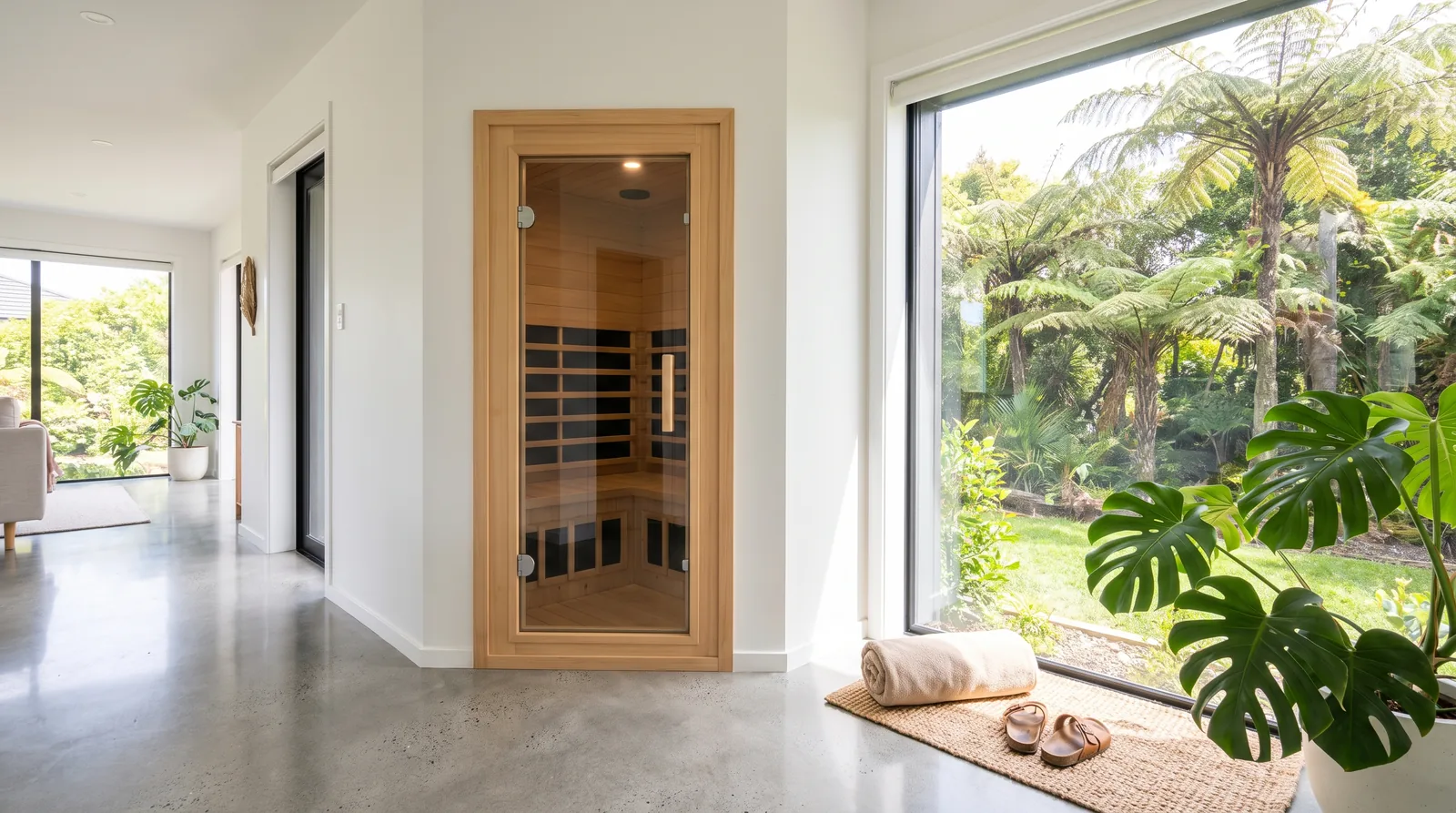
A 1-person sauna is compact (roughly 90x90cm footprint) and fits in most spare rooms, garages, or even large bathrooms. 2-person units allow you to stretch out fully lying down, which significantly improves the experience — and lets you use it with a partner. Measure your space carefully before choosing.
2. Wood, Heaters and EMF
Look for Canadian Hemlock or Western Red Cedar as the primary timber. These are naturally resistant to moisture and off-gassing at heat. Avoid units using plywood or composite board interiors — these can release unpleasant chemicals when heated.
On the heaters: carbon panel heaters offer even, full-body heat coverage and are now standard in mid-to-high-end units. Ceramic rod heaters are older technology — hotter but less even. EMF (electromagnetic field) output varies significantly between manufacturers — low-EMF heaters are worth prioritising, especially for daily use. Check that any unit you consider has independent low-EMF certification, and be wary of a bare EMF number with no measuring distance attached to it, because that figure tells you nothing you can compare.
3. NZ Electrical Compliance
Make sure any sauna you’re considering is compatible with New Zealand’s 230V/50Hz power supply and carries the necessary electrical compliance certification for NZ (the RCM — Regulatory Compliance Mark — or equivalent). Some cheaper units sold online are built for US or European specifications.
Best Home Infrared Saunas Available in NZ 2026
Vortex Prestige 2 (Premium — NZ$10,990)
This guide sticks to saunas sold by New Zealand and Australian businesses, which rules out the big US brands such as Clearlight and Sunlighten. Neither lists New Zealand pricing anyway. At the premium end, Vortex is the in-house sauna brand of Spa World, an Australian-owned spa retailer that has been selling in Australia and New Zealand since 1985. The Prestige 2 pairs full-spectrum heaters on the front and back walls with carbon panels on the sides and under the bench, in Canadian hemlock and western red cedar. Spa World quotes under 1 milligauss of EMF and a lifetime warranty on the heaters and cabinet, with two years on the electrics. One thing to plan for: it needs a 15-amp supply, so most homes will need an electrician to add a circuit. NZ$10,990 from Spa World NZ (checked October 2026).
Kiva Wellness Rise 2-Person (Mid-Range — around NZ$3,565)
Kiva Wellness is an Australian company, going since 2016, with a New Zealand store that ships free nationwide from stock held in Auckland. The Rise 2-person uses Canadian hemlock and carbon-fibre far-infrared panels, runs from a standard 10-amp plug (1,800W), and comes with Bluetooth audio and seven-colour chromotherapy lighting. Kiva quotes an average of 0.4 milligauss of EMF, and backs the heaters with a lifetime warranty and other parts for five years. NZ$3,565 on sale from NZ$4,195 at Kiva Wellness NZ (checked October 2026).
Alpine Spas Lyon 2-Person (Best Value NZ-Owned — around NZ$2,995)
Alpine Spas is a family-owned New Zealand business with warehouses in Auckland and Christchurch. Its Lyon 2-person cabin is FSC-certified Canadian hemlock with low-EMF heaters that Alpine says are independently tested at under 0.5 milligauss, and it runs from a standard 10-amp plug (2,100W). The warranty is five years on the structure and heaters and two years on other components. It was NZ$2,995 on sale against a listed RRP of NZ$6,495 when we checked. The gap is wide enough that we would treat the sale price as the real one. Available from Alpine Spas (checked October 2026).
Budget Options (NZ$2,200–NZ$2,900)
Entry-level 1-person infrared saunas are available on Trade Me and through NZ home improvement retailers. If buying at this price point, prioritise: solid wood construction (no composite), carbon heaters over ceramic rods, and check buyer reviews carefully. Warranty and after-sales support matters — a sauna with no NZ service support is a risk.
Installation Considerations
Most home infrared saunas are flat-pack and can be assembled in 2–4 hours with two people and basic tools. Power is simpler here than the overseas spec sheets suggest: most 1–2 person units run from an ordinary NZ 10A household socket at 230V. Larger cabins and full-spectrum units draw more, and may need their own dedicated circuit rather than sharing one with the rest of the room — check the rated load on the unit and have an electrician confirm it before you commit. Ventilation should be considered if installing in an enclosed space. Avoid placing on carpet; a non-slip mat on concrete, tiles, or timber is ideal. A sauna is usually the largest item in a home wellness setup, so plan the space around it.
Is a Home Sauna Worth the Investment?
Commercial infrared sessions run about NZ$39–85 in New Zealand — $39 was the cheapest we found, in Christchurch, while Auckland studios sit at $55–85. Three sessions a week is roughly 150 a year, so NZ$5,850–$12,750 of studio visits, which means a NZ$4,000 home unit covers its purchase price inside the first year at that rate of use, comfortably. Treat that as the best case rather than a promise: it ignores power and maintenance, and very few people sustain three sessions a week indefinitely. The stronger argument for owning one is convenience rather than payback — in our experience the trip to a studio is the part that gets skipped first. If you have not tried one yet, a few sessions at an infrared sauna studio in Auckland are a low-risk way to find out.
The Bottom Line
If you’re serious about sauna as a long-term wellness practice, buying a home unit is worth the investment. For a full-spectrum premium unit, the Vortex Prestige 2 from Australian-owned Spa World is the pick. In the middle, Kiva Wellness’s Rise is solid value, and Alpine Spas’ Lyon is the NZ-owned option at the lower end. Whatever you buy, prioritise low-EMF carbon heaters, solid wood construction, and NZ electrical compliance. Many owners eventually add a cold tub so they can run contrast therapy at home.
This article is for informational purposes only. Always consult a qualified health professional before beginning any new wellness practice.