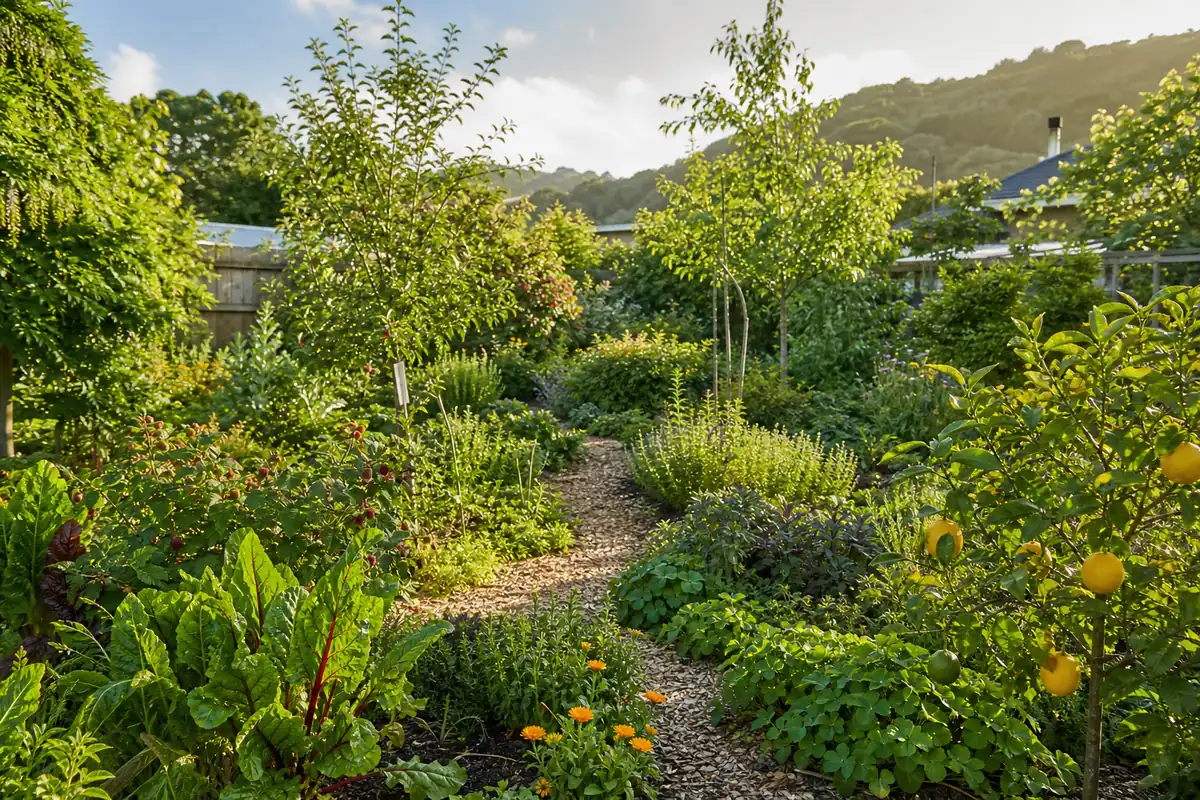
If you’ve seen someone on social media wandering through a jungle of fruit trees, berries and herbs saying “I never water or weed this” — that’s a food forest, and plenty of Kiwis are having a go at one. New Zealand’s climate suits them well. Here’s the honest news: the “never weed again” part takes years to arrive, and the people showing you year-seven abundance skipped filming years one through three.
What a food forest actually is
A food forest (or forest garden) is a planting designed to work like a young natural forest — layered, self-mulching, largely self-managing — except most of the plants feed you. Instead of rows of annual vegetables demanding constant input, you build a perennial system where trees, shrubs and groundcovers occupy different layers of space and light, plants feed and protect each other, and your job shifts from labourer to manager.
The classic model has seven layers: canopy trees (large fruit/nut trees), smaller trees (dwarf fruit), shrubs (berries), herbaceous plants (herbs, perennial veg), groundcovers, root crops, and climbers. In a standard backyard you won’t fit all seven at full scale — and you don’t need to. A “food forest” on a Kiwi section is usually a few fruit trees underplanted with berries, herbs and groundcovers, designed so everything supports everything else. That’s it, and it works.
Why NZ is genuinely suited to this
Temperate maritime climate, decent rainfall over most of the country, and a long growing season — plus a national head start: the feijoa. Half the food-forest species other countries struggle with are Tuesday-normal here. And New Zealand has real food-forest knowledge to draw on locally, from subtropical demonstration properties in Northland (PermaDynamics is the name that usually comes up, though note its courses have been on hold with no dates since at least mid-2026 — see our permaculture courses guide) to the Kōanga Institute’s heritage fruit tree collection — long-running collections of heritage fruit trees and seeds, including lines maintained in New Zealand conditions. Availability changes by season, so check current catalogues before planning around a particular cultivar. Our permaculture courses guide covers where to learn the design side properly.
What to plant, by region (the short version)
- Upper North Island (subtropical-ish): citrus of every kind, feijoa, banana (yes, really, in warm spots), casimiroa, avocado, macadamia, tamarillo, passionfruit as your climber. Frost is your main limit — know your section’s cold pockets.
- Lower North Island / upper South Island (temperate): apples, pears, plums, peaches (choose blackspot- and leaf-curl-resistant varieties), feijoa, quince, hazelnuts, berries of all kinds.
- Southern South Island (cool temperate): heritage apples and pears, plums, cherries, currants and gooseberries (they love the cold), raspberries, rhubarb as your herbaceous workhorse. Skip the citrus dreams or grow them in pots against a north wall.
- Everywhere: comfrey around fruit trees (deep roots pull up minerals; chop leaves for mulch), tree lucerne (tagasaste) as a fast-growing nitrogen-fixing nurse tree, herbs (rosemary, thyme, oregano) as the aromatic understory, and kawakawa if you want a native layer with culinary and rongoā tradition.
How to actually start
- Observe first. Map your sun, wind, frost pockets and wet spots across a few weeks. North-facing slope = gold. This is the permaculture step everyone skips and then regrets.
- Plant the trees in winter. Bare-root fruit tree season in NZ runs roughly June to August, and that’s when the selection is best, heritage lines included. That window closes as budburst begins, so if you are reading this in spring it has already passed for this year — put June in the diary. In the meantime, container-grown trees plant perfectly well right through spring; they just need more watering through their first summer. Either way, space them for their ten-year size, not their nursery size. Crowding is an easy mistake to make and a hard one to undo.
- Sheet mulch underneath — cardboard over the grass, compost on top, mulch over that. You’ve just killed the lawn’s competition and started building forest soil without digging (the same logic as our no-dig guide).
- Add the lower layers over the next year or two — berries, herbs, comfrey, groundcovers. Resist planting everything at once; the system tells you where the niches are as it grows.
- Water and weed for the first 2–3 years. Yes, really. A food forest is low-maintenance at maturity. Young trees need summer water, mulch top-ups and protection. The trend videos skip this bit; your trees won’t let you.
The honest expectations table
| Year | What’s actually happening |
|---|---|
| 1 | Sticks in mulch. Herbs and berries give first small harvests. You water a lot. |
| 2–3 | Berries produce properly; earliest stone fruit and feijoas begin; system starts shading out weeds. |
| 4–6 | Real fruit harvests; maintenance drops noticeably; you give surplus away. |
| 7+ | The Instagram years. Abundance, minimal input — earned, not bought. |
The bottom line
Layered perennial planting is an old idea rather than a new one, and a Kiwi backyard with a few well-chosen trees over sheet mulch is most of the way to a food forest. Start with what thrives in your region, choose cultivars with a documented fit for your region, soil and disease pressures, and treat the first three years as an investment. Pair it with our seed saving and winter growing guides.