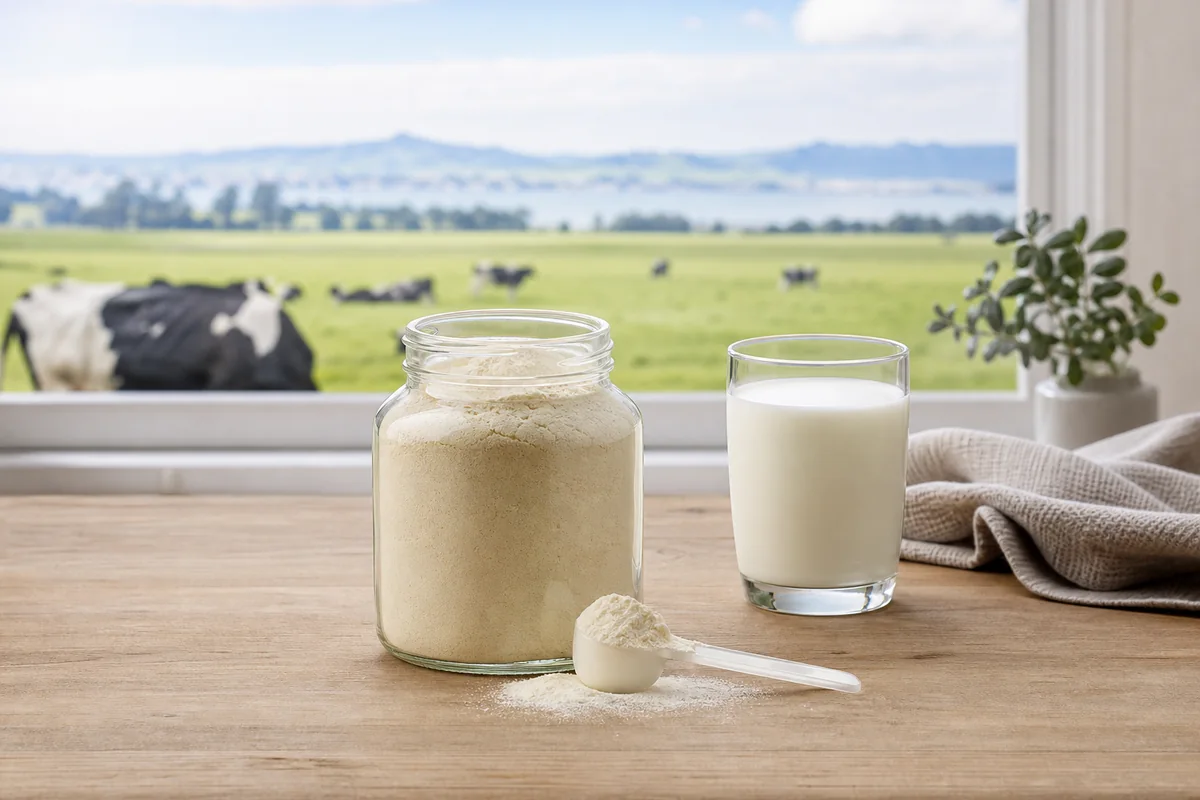
If your social feed has offered you a scoop of creamy powder promising better gut health, immunity, skin and workout recovery all at once, you’ve met bovine colostrum — one of the most-hyped supplements in the world over the past two years. Global demand has exploded off the back of influencer endorsements and a genuine, if more modest, scientific story underneath.
Here’s what makes this one interesting for us. New Zealand has a large, tightly regulated dairy industry with established colostrum processing behind it, so this is a rare wellness trend where the raw material is produced in our own paddocks — which means Kiwis can buy locally while the rest of the world imports it at a premium.
What colostrum actually is
Colostrum is the first milk a cow produces in the days after calving — a concentrated cocktail of immunoglobulins (antibodies, mainly IgG), lactoferrin, growth factors, and protein designed to kick-start a newborn calf’s immune system. Supplement-grade colostrum is collected after the calf’s needs are met, then low-heat processed and spray-dried to preserve the active proteins. Quality hinges on that processing — high heat wrecks the immunoglobulins, which is why how a product is processed, and how much IgG it will actually commit to on the label, matter more than anything else on the pack.
What the evidence supports (and how strongly)
- Gut barrier support — the best-studied claim. The most consistent research area is colostrum’s effect on intestinal permeability, particularly exercise-induced gut stress in athletes — several trials show it reduces the gut-barrier disruption caused by heavy training in heat. If colostrum has a headline use case, it’s this.
- Upper respiratory infections in athletes — unclear. Fewer sick days is a claim you’ll see attached to colostrum constantly. We haven’t found evidence solid enough to stand behind, so treat it as unproven rather than supported.
- General immunity for everyday people — plausible, thinner. The immunoglobulin content is real; whether it meaningfully changes outcomes for a healthy adult with an office job is much less established. Honest answer: maybe, modestly.
- Skin, hair, “glow” claims — mostly influencer inflation. There’s little direct trial evidence here. If skin is your goal, the money is better spent elsewhere (our collagen guide covers the better-evidenced option).
Colostrum is not essential, and it’s not cheap — quality products run NZ$1.50–$3.00+ per day. It’s a “might genuinely help, won’t hurt most people” supplement with one strong niche (athletic gut stress) and a lot of borrowed hype.
The NZ advantage — and how to buy well
New Zealand’s pasture-fed dairy herds, strict dairy regulation and established colostrum processing industry mean there is decent local product to choose from without importing. Buying locally, look for:
- Stated IgG content, ideally in milligrams per serve — a label that won’t tell you the IgG level at all is telling you something. See the note below on why the percentage on its own is only a rough grade.
- Low-heat / gentle processing mentioned explicitly — it’s what keeps the antibodies functional.
- NZ-origin milk stated, not just “packed in NZ.”
- First-milking claims treated with scepticism — marketing loves “first 6 hours”; a batch-tested IgG figure you can check matters more than collection poetry.
About that “20% IgG”
You’ll see colostrum sold as “20% IgG”, “30%” or higher. Worth knowing: those are trade grades, not a regulated standard. No food or medicines authority — not FSANZ, not Codex, not Medsafe — sets a minimum IgG percentage for colostrum sold to people. The one published threshold, 50mg/mL, comes from veterinary practice and describes liquid colostrum good enough to feed a newborn calf (Ahmann et al., 2021).
The raw material is genuinely variable. IgG in fresh bovine colostrum averages around 55mg/mL but ranges from roughly 38 to 68, and it differs by breed — Jersey cows average 66.5 g/L against 41.2 for Friesian-Holsteins (Arslan et al., 2021).
Measurement isn’t exact either. In the collaborative study that validated the standard method for colostrum powders, nine laboratories testing the same sample returned results varying by 13 to 23 percent (Gapper et al., 2013).
So treat a stated IgG percentage as a rough grade rather than a guarantee. The more useful question is whether the brand publishes the actual milligrams of IgG per serve, and tests each batch. One product we looked at was labelled “20% IgG” while declaring 1400mg of IgG in a 6g serve — which is 23 percent, not 20. Milligrams per serve is the number you can check yourself on the pack, so that’s the one to compare.
And an honest limit on all of this: we found no human trial comparing colostrum products of different IgG concentration. A 40 percent product is not demonstrably twice as good as a 20 percent one.
Who should be careful
Colostrum is a dairy product — it’s off the table for dairy allergy, and those with lactose intolerance vary (colostrum is lower-lactose than milk, but not lactose-free). Athletes under anti-doping rules should note that colostrum is not a prohibited substance. It does naturally contain growth factors including IGF-1, which is the reason it comes up in anti-doping conversations at all. Competitive athletes should check current Sport Integrity Commission Te Kahu Raunui advice and use independently batch-tested products because supplement contamination remains a risk. And as ever with immune-active supplements: anyone immunocompromised or on immune-modulating medication should run it past their GP first.
How to take it
Gut-barrier studies have used varied products and doses, often higher than a single consumer serving, so their results cannot be translated into one proven everyday dose. Follow the product label and seek clinical advice if you have a relevant condition. Powder into smoothies or milk is standard; capsules are convenient but expensive per gram. Take it consistently for 4–8 weeks before judging — this isn’t a feel-it-today supplement. Pair it with the foundations that out-earn it: fibre (see our fibre guide) and a decent probiotic (our best probiotics NZ covers the field) remain the better-evidenced gut spend.
The bottom line
Colostrum is a rare trend where NZ holds the quality high ground, and the science — while narrower than the hype — is real in its lane: gut-barrier support, especially for hard-training bodies. If that’s you, a NZ-made, IgG-standardised powder is a justifiable experiment. If you’re chasing glow and general wellness, spend the same money on the boring foundations first.
Sources and further reading
- Nutrients (2024): Bovine colostrum and intestinal permeability meta-analysis
- World Anti-Doping Agency: 2026 Prohibited List
- Ahmann J, Steinhoff-Wagner J, Büscher W. “Determining Immunoglobulin Content of Bovine Colostrum and Factors Affecting the Outcome: A Review.” Animals, 2021;11(12):3587
- Arslan A, et al. “Bovine colostrum and its potential for human health and nutrition.” Frontiers in Nutrition, 2021;8:651721
- Gapper L, et al. “Determination of Bovine Immunoglobulin G in Bovine Colostrum Powders… Collaborative Study.” Journal of AOAC International, 2013;96(5):1026–32
Health information is general and does not replace advice from a qualified clinician or pharmacist. Check supplements for suitability with your medicines, allergies, pregnancy status and health conditions.