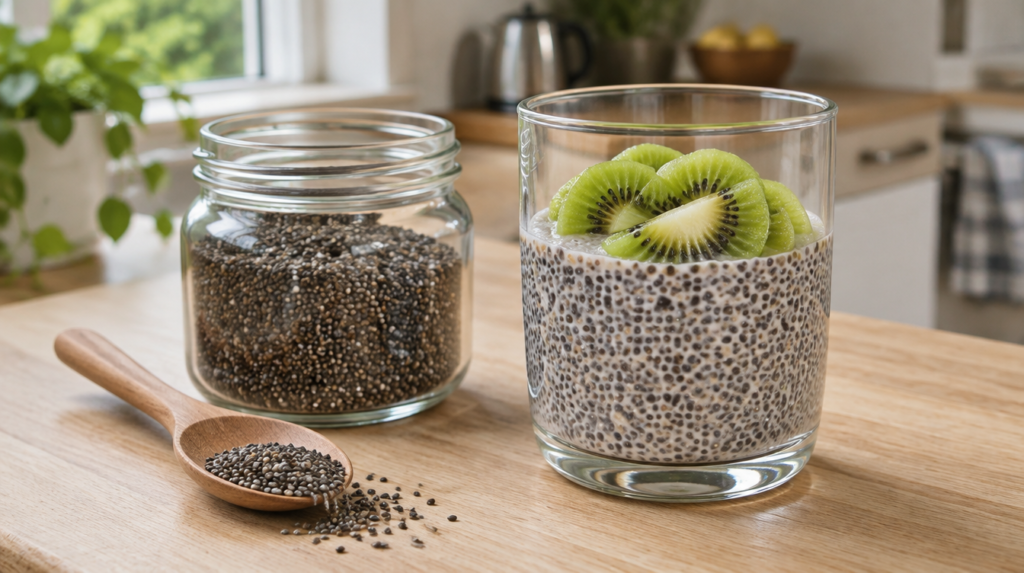
Quick answer: For overnight oats, mix 45 g of rolled oats with 125 ml of milk, 50 g of Greek yoghurt and 1 tablespoon of chia seeds, then leave it in the fridge overnight. That base gives about 7 g of fibre and 16 g of protein, and the fruit recipes below take it to 10 to 15.5 g of fibre. Our pick of the oats is Harraways Rolled Oats (grown in the South Island and milled in Dunedin, NZ$5.40 for 800 g at Woolworths). On a tight budget, Woolworths Rolled Oats (Australian-grown) are NZ$2.49 for 750 g. Prices checked November 2026.
Disclaimer: This article is general information, not medical or dietary advice. If you have coeliac disease or another medical condition, or take regular medicines, check with your doctor, dietitian or pharmacist before changing your diet or adding fibre supplements.
The Base Overnight Oats Method
Overnight oats are raw rolled oats soaked in milk and yoghurt in the fridge until soft. No cooking needed.
Base recipe (one serve)
- 45 g rolled oats (Harraways’ serving size, roughly half a cup)
- 125 ml milk
- 50 g plain Greek yoghurt
- 1 tablespoon (10 g) chia seeds
- A pinch of salt and some cinnamon, if you like
- Stir everything together in a jar or container with a lid.
- Cover and refrigerate for at least 6 hours, or overnight.
- Stir in the morning. Add a splash of milk if it’s too thick, then top with fruit and eat it cold.
The ratio: roughly 1 part oats to 1 part milk by volume, plus the yoghurt. Chia seeds soak up liquid, so add 2 tablespoons of milk for every extra spoon of chia. Our chia seeds guide has more on them.
What the base gives you: about 7 g of fibre and 16 g of protein. That’s from the New Zealand Food Composition Database (FOODfiles) values for NZ rolled oats, milk, Greek yoghurt and chia seeds. Harraways’ own label lists more fibre, 5.4 g per 45 g serve against 3.8 g in FOODfiles, so with Harraways the base comes closer to 9 g. The two sources don’t agree, so treat every figure on this page as approximate.
For scale, the Nutrient Reference Values for New Zealand and Australia set an adequate fibre intake of 25 g a day for women and 30 g for men. Each bowl below covers a third to a half of that.
Six NZ Summer Overnight Oats Recipes
Each recipe is the base above plus the extras listed. The 5+ A Day availability chart shows strawberries, blueberries and raspberries plentiful through summer, blackcurrants and boysenberries mainly in December and January, and feijoas from March to June. Frozen fruit works too. Fibre and protein figures are per serve, calculated from FOODfiles unless another source is named, and rounded.
1. Kiwifruit, Lime and Mint
- Base recipe
- 2 green kiwifruit, peeled and chopped (about 150 g of flesh)
- Zest of half a lime and a few torn mint leaves
Stir the zest through the oats the night before, and add the kiwifruit and mint in the morning. About 10.5 g fibre and 17 g protein per serve. Source: FOODfiles, Zespri Green kiwifruit (2.3 g fibre and 0.8 g protein per 100 g).
2. Blackcurrant and Vanilla
- Base recipe, plus a few drops of vanilla essence
- 60 g blackcurrants, fresh or frozen
- 1 teaspoon honey (optional, not counted)
Blackcurrants are sharp, so stir them in the night before and let them sit in the yoghurt. About 10 g fibre and 16.5 g protein per serve. Source: FOODfiles, frozen blackcurrants (4.8 g fibre and 1.4 g protein per 100 g). Our NZ blackcurrants guide covers where to buy them.
3. Strawberry and Oat Bran
- Base recipe, with an extra 30 ml milk
- 15 g oat bran (about 2 tablespoons)
- 100 g strawberries, sliced
Oat bran is the outer layer of the grain. About 11 g fibre and 20 g protein per serve. Source: FOODfiles, oat bran (15 g fibre and 15 g protein per 100 g) and NZ strawberries (1.8 g fibre per 100 g).
4. Boysenberry and Pumpkin Seed
- Base recipe
- 80 g boysenberries, fresh or frozen
- 10 g pumpkin seeds, scattered on top in the morning
The seeds add crunch and 3 g of protein. About 11 g fibre and 19 g protein per serve. Source: FOODfiles, frozen boysenberries (4.0 g fibre per 100 g) and pumpkin seeds (9.1 g fibre and 31 g protein per 100 g).
5. Feijoa and Ginger
- Base recipe, plus a pinch of ground ginger
- 100 g feijoa flesh, scooped out and frozen in autumn
Feijoas finish before summer, so freeze some flesh in autumn and stir it in straight from the freezer. About 11 g fibre and 16 g protein per serve. Source: FOODfiles, feijoa flesh and seeds (4.0 g fibre per 100 g). Our feijoa nutrition guide has more.
6. Raspberry and Psyllium (Highest Fibre)
- Base recipe, with an extra 60 ml milk
- 1 heaped teaspoon (5 g) psyllium husk
- 100 g raspberries, fresh or frozen
Psyllium soaks up liquid, hence the extra milk. If you’re new to it, start with half the amount. About 15.5 g fibre and 19 g protein per serve. Source: FOODfiles, frozen raspberries (4.4 g fibre per 100 g), and the Ceres Organics psyllium husk label (4 g fibre per 5 g). Our psyllium husk guide covers how to use it.
A fibre blend can stand in for the psyllium. Qenda Everyday Fibre is psyllium plus 21 herbs and seaweeds, with 10.6 g of fibre in a 15 g scoop (NZ$121.99 for 450 g). Its herbs include liquorice root and ashwagandha, so check with a pharmacist first if you’re pregnant or on medicines. We earn a commission if you buy Qenda through our link. It doesn’t change the price you pay.
Want more protein? Stir in a scoop of protein powder and an extra splash of milk, and check the label for the protein per scoop. Our protein powder guide compares NZ options.
Rolled, Quick or Steel-Cut Oats?
- Rolled oats are the standard choice. They soften overnight but keep some bite.
- Quick oats are nutritionally the same. Woolworths’ own rolled and quick oats carry identical nutrition panels (10.8 g fibre and 13.1 g protein per 100 g), and USDA FoodData Central lists regular and quick oats as one entry. They end up softer.
- Steel-cut oats are oat groats cut into pieces rather than rolled, which Harraways says gives a dense, chewy texture. Its steel-cut label lists 13.6 g of fibre per 100 g, against 11.9 g for its rolled oats. They stay firm after a night’s soak, so try a small batch before making several jars.
Oats, Beta-Glucan and Cholesterol
Oats contain beta-glucan, a soluble fibre. The Australia New Zealand Food Standards Code (Schedule 4, permitted high level health claims) lets a food claim that beta-glucan reduces blood cholesterol. The food must contain oat bran, wholegrain oats or wholegrain barley, with at least 1 g of beta-glucan per serving from them, and the claim applies to a diet low in saturated fat that includes 3 g of beta-glucan a day.
The trials back this up, though the effect is modest. A 2014 meta-analysis of 28 trials found 3 g or more of oat beta-glucan a day lowered LDL cholesterol by 0.25 mmol/L on average. A 2016 meta-analysis of 58 trials found a median 3.5 g a day lowered LDL by 0.19 mmol/L.
Harraways Rolled Oats list 1.4 g of beta-glucan per 45 g serve, so one bowl gets you about halfway to 3 g. A second oat meal in the day, or some oat bran, makes up the rest. For other ways to lift fibre, see our gut health guide and fibre supplement guide.
How Long Do Overnight Oats Keep?
Health New Zealand’s food safety sheet says to put leftovers in a container in the fridge within two hours and eat them within two days. Overnight oats aren’t cooked, but they’re made with milk and yoghurt, so we follow the same two-day limit.
- Make no more than two days of jars at a time.
- Keep the jar covered and in the fridge, not on the bench.
- Taking it to work or the beach? The same sheet recommends a chilly bin with ice packs.
- If it smells sour or looks slimy, throw it out. “If in doubt, throw it out” is Health NZ’s rule.
Best Oats to Buy in NZ
We looked for plain oats, checked where each is grown or packed, and compared NZ prices. Of the brands we checked, only Harraways grows and mills its standard oats in New Zealand. The two Woolworths products fill the oat bran and budget slots, and both are grown in Australia.
1. Harraways Rolled Oats: Best Overall
Harraways has milled oats at Green Island in Dunedin since 1867, and its website says the oats are grown on South Island farms. The ingredient list reads “New Zealand Oats (100%)”, and Woolworths lists it as made in New Zealand from locally grown oats. Per 45 g serve: 5.4 g fibre, 6.3 g protein and 1.4 g beta-glucan. It’s NZ$5.40 for 800 g at Woolworths, or NZ$6.60 for the 1.3 kg bag.
Pros: NZ-grown and NZ-milled. The label states the beta-glucan. Cons: About twice the price of the Woolworths own brand.
Best for: Everyday overnight oats from New Zealand-grown grain.
2. Harraways Steel Cut Oats: Best for Texture
Also from the Dunedin mill, with the same “New Zealand Oats (100%)” ingredient line. The label lists the most fibre of the oats we checked, 13.6 g per 100 g, with 15 g of protein. It’s NZ$6.99 for 800 g at Woolworths (NZ$5.59 on special until 15 November).
Pros: NZ-grown, chewy and nutty. Cons: Still firm after soaking, which not everyone likes.
Best for: People who find rolled oats too soft.
3. Ceres Organics Organic Jumbo Rolled Oats: Best Organic
Ceres Organics is a New Zealand organic brand that dates from the early 1980s. These certified organic oats are rolled into large flat flakes, which Ceres says give a hearty texture. The listing says “Packed in New Zealand from imported ingredients” and doesn’t name the growing country. Per 50 g serve: 5.0 g fibre and 6.5 g protein. It’s NZ$7.69 for 700 g from Ceres. Harraways also sells organic rolled oats (NZ$8.90 for 800 g at Woolworths), made from imported organic oats.
Pros: Certified organic, thick flakes. Cons: Imported oats, origin not stated. Costs more than conventional oats.
Best for: Anyone who wants organic oats.
4. Woolworths Oat Bran: Best for a Fibre Boost
We couldn’t find an NZ-grown oat bran in a supermarket-sized pack. This one is labelled “Product of Australia”. Per 15 g serve (about 2 tablespoons): 2.5 g fibre and 2.5 g protein, or 16.7 g of fibre per 100 g. It’s NZ$2.60 for 500 g at Woolworths. For organic, Ceres Organic Oat Bran is NZ$9.59 for 650 g, though its online panel lists only 10.1 g of fibre per 100 g, so check the bag.
Pros: Cheap and easy to add to any recipe. Cons: Australian-grown.
Best for: Stirring a spoonful into any of the recipes above.
5. Woolworths Rolled Oats: Best Budget
Woolworths’ own rolled oats are labelled “Product of Australia” and “100% whole grain”. Per 30 g serve: 3.2 g fibre and 3.9 g protein, a little lower than Harraways per 100 g. At NZ$2.49 for 750 g at Woolworths, they’re the cheapest oats we found. The quick oats are the same price.
Pros: Less than half the price of Harraways. Cons: Australian-grown. No beta-glucan figure on the label.
Best for: Big households and tight budgets.
Comparison Table
| Product | Where grown / packed | Fibre per 100 g | Protein per 100 g | NZ price (checked Nov 2026) |
|---|---|---|---|---|
| Harraways Rolled Oats | Grown in NZ, milled in Dunedin | 11.9 g | 14.0 g | NZ$5.40 / 800 g (Woolworths) |
| Harraways Steel Cut Oats | NZ oats, Dunedin | 13.6 g | 15.0 g | NZ$6.99 / 800 g (Woolworths) |
| Ceres Organics Organic Jumbo Rolled Oats | Imported, packed in NZ | 10 g | 13 g | NZ$7.69 / 700 g (Ceres) |
| Woolworths Oat Bran | Australia | 16.7 g | 16.6 g | NZ$2.60 / 500 g (Woolworths) |
| Woolworths Rolled Oats | Australia | 10.8 g | 13.1 g | NZ$2.49 / 750 g (Woolworths) |
Fibre and protein figures are from each product’s own nutrition panel.
The Bottom Line
Use the base recipe and add whatever fruit is in season. Buy Harraways Rolled Oats: they’re grown and milled in the South Island, and the label shows the beta-glucan. If you like a chewier bowl, get Harraways Steel Cut Oats. If you want organic, get Ceres Organics Jumbo Rolled Oats. If you want the most fibre, add a spoonful of Woolworths Oat Bran or make the raspberry and psyllium recipe. On a tight budget, Woolworths Rolled Oats do the job for under half the price.
Frequently Asked Questions
How long do overnight oats last in the fridge?
Up to two days, covered, following Health New Zealand’s advice for leftovers.
Do I need chia seeds in overnight oats?
No. Oats soften in milk on their own. Chia thickens the mix and adds about 3 g of fibre per tablespoon, based on FOODfiles. If you leave it out, use a little less milk.
Are oats gluten-free?
Not the ones we checked. Every oat product in this article is labelled “contains gluten”. If you have coeliac disease, ask your doctor or dietitian before eating oats.
Sources and further reading
- New Zealand Food Composition Database (FOODfiles)
- USDA FoodData Central: Cereals, oats, regular and quick, not fortified, dry (FDC ID 173904)
- FSANZ: Australia New Zealand Food Standards Code compilation, May 2026 (Schedule 4, beta-glucan health claim)
- Whitehead et al., Am J Clin Nutr (2014): Cholesterol-lowering effects of oat beta-glucan, a meta-analysis
- Ho et al., Br J Nutr (2016): Oat beta-glucan and LDL cholesterol, a systematic review and meta-analysis
- Health New Zealand (HealthEd): Food safety (PDF)
- Nutrient Reference Values for Australia and New Zealand: Dietary fibre
- 5+ A Day: Fruit and vegetable availability chart (PDF)
- Harraways: Rolled Oats nutrition information
Affiliate disclosure: Some links on ThrivingKiwi may earn us a small commission if you buy through them, at no extra cost to you. Paid links are marked as sponsored. We only recommend products we genuinely believe are worthwhile.