Quick answer: Radiance Ashwagandha Stress Shield (KSM-66, around NZ$40.50 a month at HealthPost) is our pick. GO Healthy GO Ashwagandha 8,000+ is the budget option (around NZ$30.30 for two months), and Clinicians Calm & Focus Support (around NZ$24.90) is the familiar pharmacy brand. Prices checked October 2026.
Disclaimer: This article is for informational purposes only and does not constitute medical advice. Ashwagandha may interact with certain medications. Always consult your GP before starting.
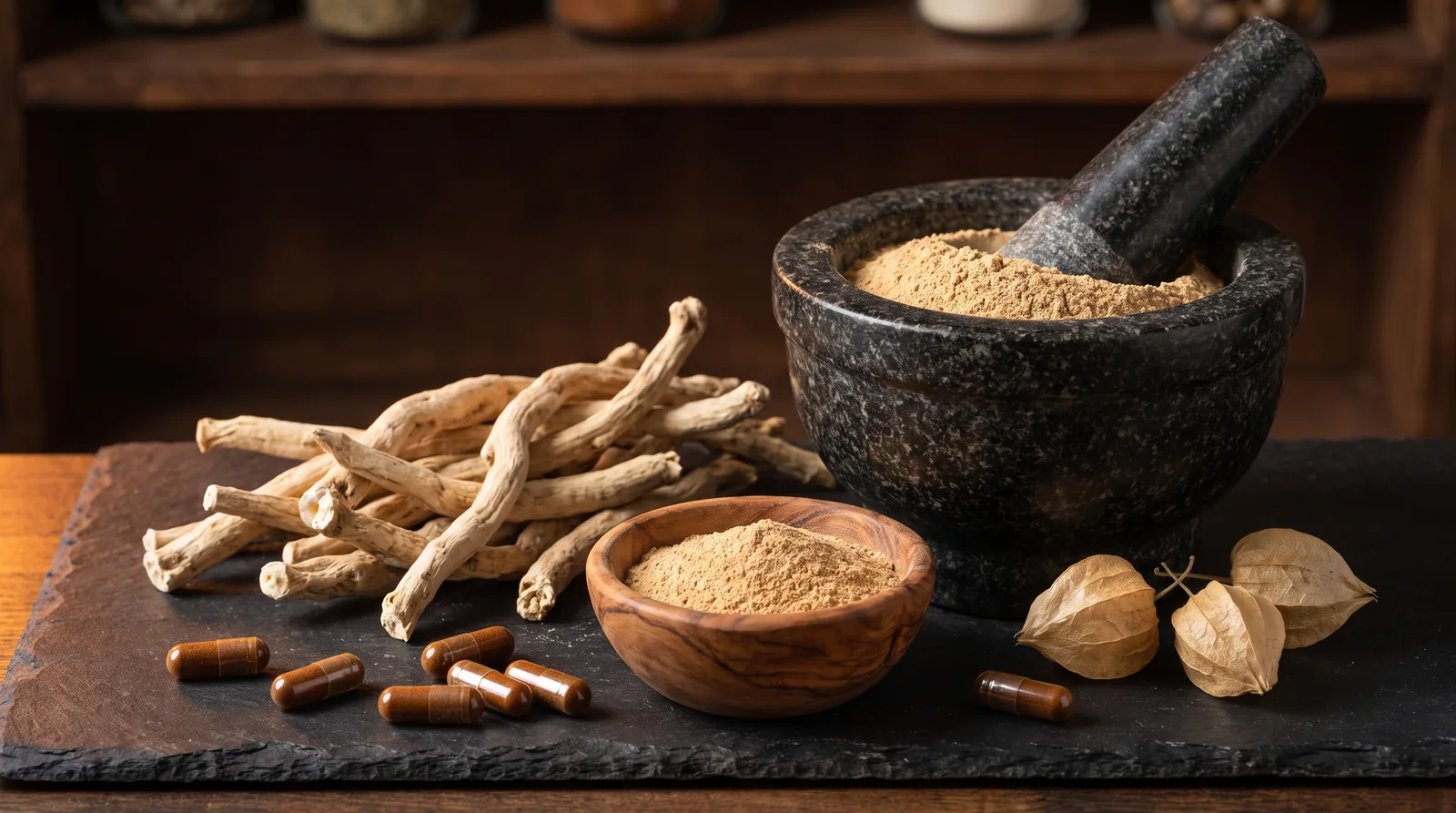
Ashwagandha has gone from an obscure Ayurvedic herb to one of the most purchased supplements in New Zealand and globally. The growth is not pure hype. Unlike many trending wellness ingredients, ashwagandha has been studied more than most herbal supplements.
For how it fits with everything else, see the complete NZ supplement guide.
What Ashwagandha Does (The Honest Version)
Ashwagandha (Withania somnifera) is classified as an adaptogen — a substance that helps the body adapt to stress and restore physiological balance. Rhodiola rosea, the other well-researched adaptogen, is worth comparing if fatigue rather than stress is the main problem. Its active compounds, called withanolides, are the primary drivers of its effects. Here is what it is most often taken for:
- Cortisol reduction: the case for ashwagandha rests largely on its effect on cortisol, the primary stress hormone — chronically elevated levels contribute to poor sleep, weight gain, and immune suppression. Several small randomised trials have found ashwagandha lowers serum cortisol. In the most-cited one, 600mg a day of a standardised root extract for 60 days reduced cortisol by 27.9%, against 7.9% on placebo (Chandrasekhar et al., 2012). Pool the trials, though, and the average effect is more modest — about 1.16 µg/dL — and the same review found that while cortisol fell, people’s own ratings of their stress did not shift (Albalawi, 2025). The trials are small, mostly eight to ten weeks, and the overall certainty of the evidence has been rated low.
- Sleep quality: A 2019 double-blind trial in Cureus (Langade et al.) found ashwagandha improved sleep quality, sleep onset latency, and morning alertness. Worth noting who was in it: the participants had diagnosed insomnia, so it does not automatically follow that someone who simply sleeps lightly will notice the same thing.
- Strength and recovery: ashwagandha is also sold for training recovery and strength gains. We do not have a citation to hand for that one, and any effect is a good deal smaller than the marketing on the tub suggests.
- Thyroid function: ashwagandha can affect thyroid hormone levels. That matters if you have hyperthyroidism or take thyroid medication — talk to your GP before starting.
The Extract Standard That Matters
Not all ashwagandha products are equal. The research on cortisol reduction and sleep was largely conducted using standardised root extract, and in practice that means one extract in particular: KSM-66 (5% withanolides). The cortisol trials are overwhelmingly KSM-66 specifically, and we could not find comparable cortisol trial evidence for Sensoril (10% withanolides), the other standardised extract you will see named on NZ labels. So it is worth being precise — the evidence above is evidence for KSM-66 at a particular dose, not for ashwagandha generically. Generic root powder without standardisation may have inconsistent withanolide content and less predictable effects, so check the label for the extract type.
One more thing to hold in mind while you weigh all that up: nearly all the key trials used KSM-66 supplied free of charge by its manufacturer, Ixoreal Biomed. That does not make the results wrong, and declaring it is the proper thing to do. But when the research base for a branded ingredient is largely underwritten by the company selling it, that is worth knowing before you read the numbers.
The Best Ashwagandha Supplements Available in NZ (2026)
1. Radiance Ashwagandha Stress Shield (KSM-66) — Best Match for the Research Dose
Radiance is a well-established New Zealand natural health brand, and its Ashwagandha Stress Shield uses KSM-66 root extract — the most researched ashwagandha extract on the market — at 300mg per capsule. The directions are one capsule twice daily, so 600mg a day, which is precisely what Chandrasekhar’s 2012 trial used. If you want to match the research rather than approximate it, this is the one that does it. It is widely stocked in NZ through HealthPost, pharmacies and health stores: $40.50 at HealthPost (RRP $44.99) for 60 capsules, which at two a day is a 30-day bottle and works out at about $1.35 a day.
Best for: Stress management, sleep support, and anyone who wants KSM-66 at the dose the trials actually used.
2. Clinicians Calm & Focus Support (with Ashwagandha) — Best Pharmacy-Grade NZ Option
Clinicians delivers ashwagandha through its Calm & Focus Support formula, which pairs an ashwagandha root extract equivalent to 6,000mg of dry root with Zembrin 25mg, at one capsule a day. It is $24.90 at HealthPost (RRP $33.49) for 30 capsules — about $0.83 a day. HealthPost had it out of stock when we checked in October 2026; Clinicians sells it direct at the $33.49 RRP. One caveat: the label does not name the extract type. No KSM-66, no Sensoril, no withanolide percentage. You know the dry-root equivalent and that is about it, so you cannot line it up against the trials the way you can with Radiance. If focus rather than stress is the goal, supplements aimed at focus and cognition are a better starting point.
Best for: Those who prefer a familiar NZ brand with pharmacy-grade credibility.
3. GO Healthy GO Ashwagandha 8,000+ — Best on Cost Per Day
GO Healthy’s GO Ashwagandha 8,000+ uses Shoden extract at 160mg per capsule (equivalent to 8,000mg of dry root and leaf) alongside Siberian ginseng, at one capsule a day. It is easy to find at pharmacies, health food stores and online. At $30.30 from HealthPost (RRP $48.99) for 60 capsules, that is $0.51 a day — a little over a third of what Radiance costs to take, because Radiance needs two capsules a day where this needs one. The sticker price understates it: the two bottles are not far apart on the shelf, but one of them empties in half the time. The trade-off is the extract — the cortisol trials above ran on KSM-66, not Shoden.
Best for: Keeping the daily cost down, if you are not set on matching the trial extract.
Every price above is a standing one rather than a discount, with the RRPs in brackets alongside for comparison. A HealthPost promotion is running as this goes up and we have deliberately left it out of the figures above, because it ends soon: the Clinicians range, including Calm & Focus Support at $23.90, is discounted until 12 October 2026. Prices checked October 2026 and will move.
Who Should Be Cautious
Ashwagandha should be avoided or used with caution in the following situations: pregnancy (some evidence of uterine stimulation — avoid); autoimmune conditions including rheumatoid arthritis, lupus, or Hashimoto’s (ashwagandha can stimulate the immune system); hyperthyroidism or thyroid medication (it affects thyroid hormone levels); and people taking sedative medications including benzodiazepines (additive sedative effects possible). This is not an exhaustive list — consult your GP if any of these apply.
How to Take It
Standard research doses are 300-600mg of KSM-66 extract daily. It can be taken morning or evening — for sleep benefits, evening is often preferred. Some people notice effects within a week; for stress and cortisol effects, 4-8 weeks of consistent use is typically when the full benefit is felt. If getting to sleep is the main issue, other sleep supplements worth considering are covered separately.
The Bottom Line
Radiance Ashwagandha Stress Shield is the pick if you want a NZ-made product using the extract the cortisol research was actually done on, at the dose it was done at — that is worth the $1.35 a day. If keeping the daily cost down matters more to you than matching the trial, GO Healthy’s one-a-day comes in at $0.51. If you’d rather a familiar pharmacy brand, Clinicians Calm & Focus Support is $0.83 a day, though its label doesn’t name the extract. Either way, look for the extract type on the label — and check with your GP if you have thyroid issues, are pregnant, or take regular medications.
Sources and further reading
- Indian Journal of Psychological Medicine: Chandrasekhar et al. (2012), randomised trial of high-concentration ashwagandha root extract on stress and cortisol
- Nutrition and Health: Albalawi (2025), meta-analysis of ashwagandha on cortisol and perceived stress
- Phytotherapy Research: Akhgarjand et al. (2022), systematic review and meta-analysis on anxiety and stress
- Cureus: Langade et al. (2019), ashwagandha root extract in insomnia and anxiety
Affiliate disclosure: Some links on ThrivingKiwi may earn us a small commission if you buy through them, at no extra cost to you. Paid links are marked as sponsored. We only recommend products we genuinely believe are worthwhile.