Quick answer: In New Zealand you can build a permanent outdoor fireplace or oven without a building consent as long as it is no more than 2.5m tall, has a cooking or fire surface of no more than one square metre, and sits at least one metre from any legal boundary or building. Exceed any one of those, or attach it to your house, and you need a consent. The rules that catch people out more often are the fire season rules, which are separate, change through the year, and differ by fire type — a pizza oven and a brazier are not treated the same.
Cooking over fire has become fashionable again, and the internet is full of build guides written for places that are not New Zealand. Most of them ignore the two questions that actually decide whether you can do this: can you build it, and can you light it. Those have different answers, come from different agencies, and the second one changes with the weather.
The building consent exemption, and its three limits
Since the Schedule 1 exemptions were widened in August 2020, a permanent outdoor fireplace or oven is exempt from building consent when it meets all three of the following, as set out in MBIE’s guidance on permanent outdoor fireplaces and ovens:
- No more than 2.5 metres in height. This is the one most commercial outdoor fireplaces fail. A tall flue is what pushes a lot of off-the-shelf units over the line.
- A cooking or fire surface of no more than one square metre. Generous for a pizza oven, tight for an ambitious outdoor kitchen with a long grill bar.
- At least one metre from any legal boundary or building. Note “or building” — a metre from the fence is not enough if it also sits against the garage.
Exempt from consent does not mean exempt from the Building Code — the work still has to comply, you just don’t have to prove it to a Building Control Authority in advance. And if the fireplace is attached to an exterior wall of your house, the exemption does not apply at all. That is a consent, regardless of size.
Separately from the building rules, your district plan may impose setbacks of its own. These vary by council and by zone, and they are a resource management matter rather than a building one, so the building exemption gives you no cover. If you are anywhere near a boundary, ring the council before you pour a slab.
Fire seasons: the rule that actually stops you
You can have a perfectly legal, fully exempt oven sitting in the garden and still be breaking the law by lighting it. New Zealand runs three fire seasons, set by Fire and Emergency New Zealand and varying by district and by time of year:
- Open season — most fire types allowed without a permit, subject to the usual care.
- Restricted season — certain fire types are allowed if you meet the safety requirements; others need a permit.
- Prohibited season — most outdoor fires are banned outright, with a short list of exceptions.
The important detail is that fire types are treated differently, and this is where a permanent oven earns its keep:
- Gas barbecues and cookers are authorised in both restricted and prohibited seasons.
- Charcoal grills and liquid-fuelled cookers are also authorised in both, provided you meet the safety requirements.
- Pizza ovens and permanent fireplaces are authorised, and a permit is the route if you can’t meet the safety requirements outright.
- Fire pits and braziers are authorised in a restricted season but become a prohibited fire type once a prohibited season is declared.
- Campfires, bonfires and burn piles need a permit in a restricted season and are out entirely in a prohibited one.
That difference is a genuine argument for building something permanent rather than buying a fire pit. Through a hot Hawke’s Bay or Canterbury summer, the fire pit is the first thing to become illegal and the permanent oven keeps cooking.
Check your own district before every burn at checkitsalright.nz, which gives you the current season for your address in three steps. Permits, where needed, come from firepermit.nz. The full breakdown by fire type is on the FENZ open air fire rules page. Seasons change at short notice in a dry spell, so a check in December tells you nothing about February.
City rules are a third layer
If you live in a city, your council’s air quality rules sit on top of both of the above. Auckland is the clearest example: open fires are banned across Auckland’s entire urban area, residential and business land alike, and burning rubbish or garden waste is prohibited outright (Auckland Council’s rules for outdoor fires). Gas barbecues are fine. Permanent outdoor fireplaces and ovens may be permitted, but the council asks you to check your specific address, because the urban/rural classification is what decides which set of rules you are under.
Other urban councils take similar positions with different boundaries. The practical upshot for a city section is that a contained, permanent, properly flued oven is usually the version that survives all three layers of rules, and an open fire pit usually isn’t.
What to actually build
A simple masonry hearth
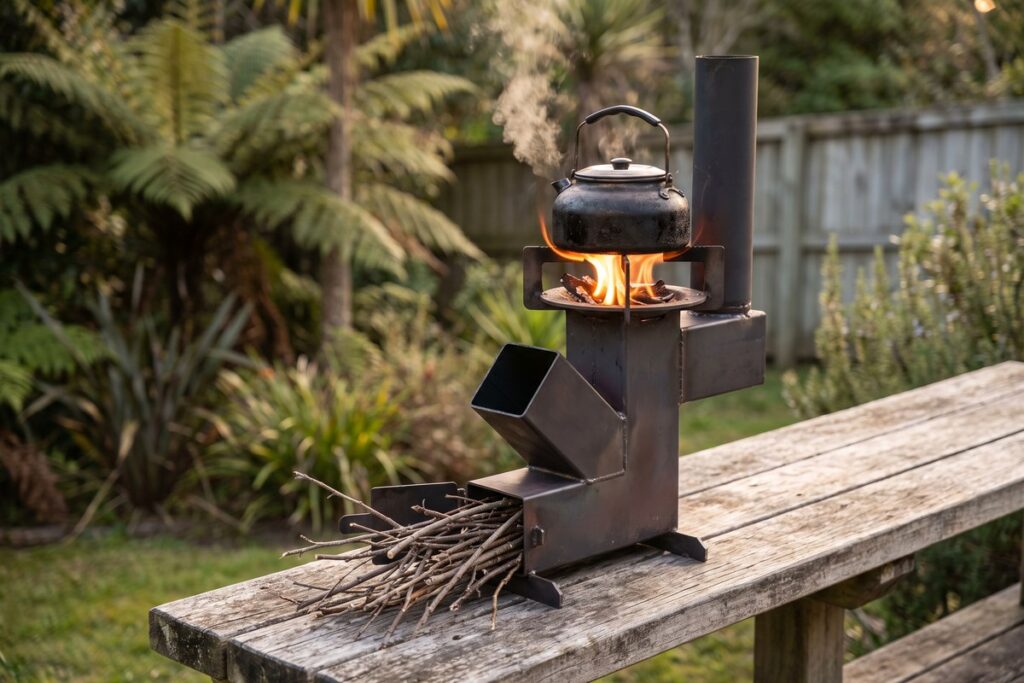
A stone or block hearth with a firebox underneath and a flat cooking surface on top is the cheapest permanent option and the easiest to keep inside the exemption. Kept low and wide rather than tall, height is never an issue. A cast-iron plate or a grill bar over the fire gives you a hob; a camp oven sitting in the coals gives you an oven. Materials are firebrick for anything that touches flame, ordinary block or stone for the structure, and a proper refractory mortar rather than standard mortar in the hot zone.
A wood-fired oven
The domed masonry oven is the version most people picture. It takes longer to build and considerably longer to heat — two to three hours to bring the dome up — but it holds heat for most of a day. That is the real argument for one: a single firing gets you bread at the top of the heat, then a roast, then vegetables, then something slow overnight as it falls away. Kitset and precast domes are sold in New Zealand and remove most of the difficult work. Price those against a scratch build before deciding, and check the finished height against the 2.5m limit once the dome is on its stand and flued.
The cheap option that works
An iron tripod and a cast-iron camp oven over a contained fire is the most forgiving outdoor cooking there is, costs a couple of hundred dollars, and needs no building work at all. The catch is that it is a fire pit for fire-season purposes, which means it stops being legal exactly when the weather is best for it. Which is the thing to know before deciding the permanent build isn’t justified.
Firewood is most of the result
Green wood is the single most common reason outdoor cooking disappoints. Wood wants a full summer split and stacked under cover, with the rain off and the wind through, before it is worth putting in a fire. Split small, stack loose, and leave it a season. Untreated hardwood for heat and coals, softwood only for getting things started, and never anything painted, treated or manufactured — the fumes end up in your food and your neighbour’s washing.
If you are planting for the long run, the same species that make good shelter and firewood also do useful work in a food forest — tree lucerne in particular grows fast, fixes nitrogen and coppices well.
Frequently Asked Questions
Do I need a building consent for a pizza oven in NZ?
Usually not. A permanent outdoor oven is exempt from building consent if it is no more than 2.5m tall, has a cooking or fire surface of one square metre or less, and stands at least one metre from any legal boundary or building. If it exceeds any of those, or is attached to an exterior wall of the house, you need a consent. Your district plan may also impose its own setbacks.
Can I use my pizza oven during a total fire ban?
Pizza ovens and permanent fireplaces are treated as an authorised fire type, with a permit available where the safety requirements can’t be met outright. This is different from fire pits and braziers, which become a prohibited fire type in a prohibited season. Always confirm the current season for your address at checkitsalright.nz before lighting, because seasons change at short notice.
Can I have an outdoor fire in Auckland?
Not an open one. Open fires are banned throughout Auckland’s urban area, covering residential and business land, and burning rubbish or garden waste is prohibited. Gas barbecues are permitted. Permanent outdoor fireplaces and ovens may be allowed — check your specific address with the council, since the urban or rural classification of your property determines which rules apply.
How far from the boundary does an outdoor fireplace have to be?
At least one metre from any legal boundary or building for the building consent exemption to apply. Some district plans require more — setbacks of three metres from a street boundary and 1.5 metres from side and rear boundaries appear in some council plans — so treat one metre as the building minimum, not the final answer.
Does a wood-fired oven really cook better?
For some things, yes, and for honest reasons rather than romantic ones. A masonry oven runs far hotter than a domestic oven and cooks by radiant heat from the dome as much as by hot air, which is what produces the char and lift on a pizza base in ninety seconds. For a slow braise, a conventional oven does the same job with less work. The real advantage is thermal mass: one fire, many hours of usable heat at descending temperatures.
The Bottom Line
The building rules are more permissive than most people expect — 2.5 metres, one square metre of cooking surface, one metre of clearance, and you are away without a consent. The fire rules are stricter and more changeable, and they are the ones that will actually interrupt your summer. Build permanent rather than portable if you want to keep cooking through a dry season, keep it under the three limits, and check the season before every burn.
This article is for general information only. Building consent exemptions, district plan rules and fire season restrictions vary by council and change over time — always confirm with your local council and check the current fire season for your address before building or lighting. Information current as of September 2026.