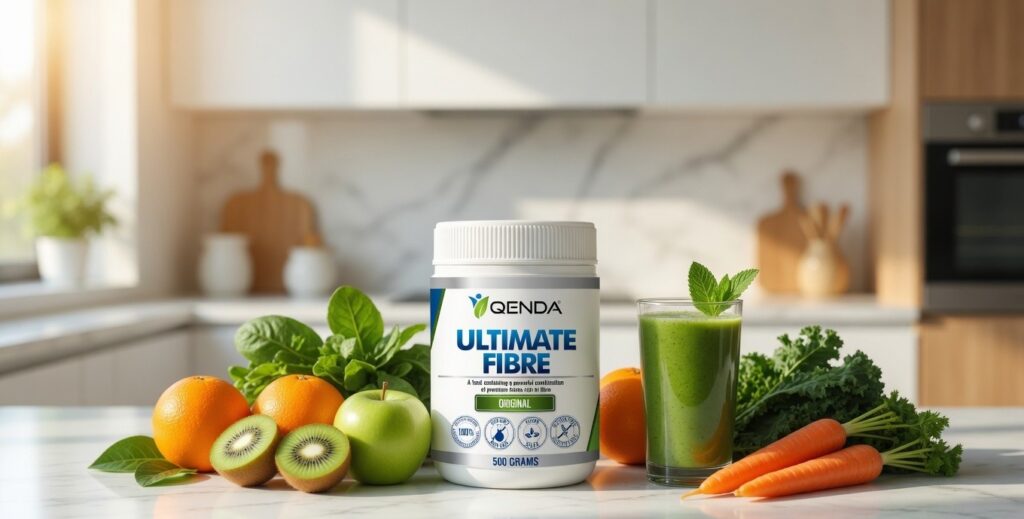
Most gut health supplements do one thing: add fibre. Qenda Ultimate Fibre does something fundamentally different — and once you understand what it actually contains, you’ll see why comparing it to standard fibre products misses the point entirely.
We’ve looked at three other popular gut health products available in New Zealand. The conclusion is clear: Qenda isn’t competing in the same category. It’s operating on a different level altogether.
Disclaimer: This article is for informational purposes only and is not a substitute for professional medical advice. Always consult your GP or registered health professional before starting new supplements, particularly if you have existing health conditions or are pregnant.
The Key Differentiator: Antiparasitic & Anti-Inflammatory Herbs
Before we talk about price, taste, or how to take it — this is the most important thing to understand about Qenda.
Qenda Ultimate Fibre contains a suite of powerful antiparasitic and anti-inflammatory herbs that simply don’t exist in any other gut health supplement widely available in New Zealand. Wormwood and Black Walnut Hulls are among the most well-regarded traditional antiparasitic herbs in botanical medicine. Turmeric, Liquorice Root, and Meadowsweet bring significant anti-inflammatory action. Barberry Bark adds antimicrobial properties. Slippery Elm and Marshmallow Root soothe and repair the gut lining from the inside out.
None of the other products on this list — not Lifestream, not No.2, not Nutrient Rescue — come anywhere close to this. They are fibre supplements or nutritional top-ups. Qenda is a complete botanical gut reset.
What Is Qenda Ultimate Fibre?
Qenda is an Australian brand — manufactured in a HACCP-certified facility in Western Australia — and is available in New Zealand through The Reset Collective. It’s positioned as a premium, deeply herbal gut health and cleansing supplement rather than a straightforward fibre product.
The product comes in two formulas: Everyday Fibre (a gentler daily maintenance option) and Ultimate Fibre (the intensive cleansing formula). This review focuses on Ultimate Fibre — the one generating the most conversation in NZ wellness circles.
Ultimate Fibre vs Everyday Fibre: Which One Do You Actually Want?
This is the question most people arrive with, and the answer is more specific than “one’s stronger.”
Ultimate has 32 ingredients. Everyday has 22 of the same base. The eleven that appear in Ultimate and not in Everyday are, almost entirely, the laxative and antiparasitic fraction: black walnut hulls, horsetail, cascara bark, Turkish rhubarb, meadowsweet, dandelion root, aloe ferox, wormwood, fennel seed, witchhazel and clove bud. One ingredient goes the other way — Everyday contains aloe vera, the inner-leaf kind that isn’t a laxative, where Ultimate contains aloe ferox, which is.
Qenda describe the difference themselves. Ultimate is “more intensive” and “has anti-parasitic herbs in the formula that Everyday Fibre doesn’t.” Everyday is “gentle, non-laxative detox support,” “designed for long-term, daily use,” and “especially between Ultimate Fibre cleanses.”
Note what that second description quietly concedes: the brand applies the word “non-laxative” to Everyday only.
| Ultimate Fibre | Everyday Fibre | |
|---|---|---|
| Ingredients | 32 | 22 |
| Pack size | 500g | 450g |
| Serve | 20g (2 scoops) | 15g (1 scoop) |
| Serves per pack | 25 | 30 |
| Fibre per serve | 14.68g | 10.6g |
| Iron per serve | 6.4mg | 6.15mg |
| Stimulant laxative herbs | Yes — cascara, rhubarb, aloe ferox | No |
| Antiparasitic herbs | Yes — wormwood, black walnut, clove | No |
| Brand’s intended use | 3–4 months at a time, up to 4× a year | Daily, ongoing |
| Price (The Reset Collective) | $134.99 | $121.99 |
The part that decides it for most people: by weight the two cost almost exactly the same — 27.0 cents a gram versus 27.1. So this isn’t a budget decision. It’s a decision about whether you want the eleven extra herbs.
If what you want is more fibre in your day, Everyday does that at a gentler serve and is built to be taken indefinitely. Ultimate is the brand’s own short-course product, and they say so: three to four months at a time, up to four times a year. Buying Ultimate for permanent daily use is using it against its own instructions — and paying the same per gram to do it.
What’s In It?
Qenda Ultimate Fibre contains exactly 32 certified organic and wildcrafted ingredients: Psyllium Husk, Black Walnut Hulls, Hibiscus Sabdariffa, Liquorice Root, Horsetail, Rosehip, Oat Straw, Slippery Elm Bark, Cascara Bark, Marshmallow Root, Cinnamon Bark, Irish Moss, Yucca Root, Turkish Rhubarb, Chlorella, Turmeric, Bladderwrack, Astragalus Root, Ashwagandha Root, Meadowsweet, Barberry Bark, Dandelion Root, Aloe Ferox, Wormwood, Skullcap, Fennel Seed, Passionflower, Mullein Leaf, Violet Leaf, Paw Paw Leaf, Witchhazel, and Clove Bud.
The psyllium husk provides the fibre backbone, but what sets Qenda apart is everything else. Wormwood and Black Walnut target parasites. Cascara Bark and Turkish Rhubarb stimulate healthy bowel motility. Ashwagandha and Passionflower address the nervous system and stress-gut connection — a dimension no standard fibre supplement touches. Chlorella and Bladderwrack bring mineral density and detox support. This is a formulation designed for deep, systemic gut restoration — not just keeping things moving.
How Do You Take It?
Two level scoops (20g) in 350–400ml of water in a shaker bottle, once or twice daily. Drink immediately — it thickens quickly. Best taken 10–30 minutes before meals. Available in Original (unsweetened), Wildberry, and Chocolate flavours. The original is an acquired taste, but most serious users get used to it quickly and say the results make it entirely worth it.
Who Should Not Take It
This is the section most reviews of this product skip, and it matters more than anything else on this page.
Ultimate Fibre is not a gentle daily fibre. Three of its ingredients — cascara bark, Turkish rhubarb and aloe ferox — are stimulant (anthraquinone) laxatives. These work by irritating the bowel wall to force a contraction, which is a different mechanism from psyllium bulking the stool. Stimulant laxatives are intended for short-term use. Prolonged use can cause cramping, electrolyte disturbance and dependence, where the bowel becomes less responsive without them. This is the pharmacological reason behind Qenda’s own instruction to run it as a three-to-four-month course rather than take it indefinitely — the limit is not a marketing device.
A fourth, wormwood, contains thujone, a neurotoxic compound at sufficient dose and the reason wormwood preparations are restricted in food use in many countries.
Do not take Ultimate Fibre if you are pregnant. Retailer product data for this item carries the plain statement “Not recommended for pregnant women.” Stimulant laxatives and wormwood are both reasons for that. It is also not a product to start while breastfeeding, or to give to children, without professional advice.
Talk to a pharmacist or GP before starting it if you have inflammatory bowel disease, a bowel obstruction or any undiagnosed change in bowel habit; if you take medicines that are affected by gut transit time or potassium levels, including diuretics, digoxin, lithium, warfarin or the contraceptive pill; or if you have a kidney or heart condition. Psyllium-based products also need to be taken with plenty of water and separated from other medicines by a couple of hours, because they slow absorption.
None of this makes it a bad product. It makes it a short-course product with real pharmacology in it, which is exactly how the brand positions it — and it is worth knowing before you order a tub.
What Does It Claim to Do?
- Deep internal cleansing of the digestive tract
- Supports elimination of parasites, mucus, and waste build-up
- Provides 49% of the recommended daily fibre intake per serve
- Exceeds 50% of daily iron requirements per serve — see the note below, because this one depends on who you are
- Supports gut repair, energy, skin clarity, and immune function
- May assist with leaky gut and gut dysbiosis recovery
The iron claim needs a qualifier. A serve contains 6.4mg of iron. Against the Australian and New Zealand nutrient reference value of 8mg a day for adult men and post-menopausal women, that is about 80%, so “more than 50%” holds. Against the 18mg a day recommended for women aged 19 to 50, it is about 36%. Given who actually buys gut-cleanse products, the headline figure will overstate the contribution for a large share of readers. It is a useful amount of iron either way — it just isn’t “more than half your daily needs” for everyone.
NZD Pricing and Where to Buy
NZ$134.99 for a 500g tub from The Reset Collective, the New Zealand distributor — price checked September 2026. At the label’s serve of two scoops twice a day a tub lasts about 12 days; at one serve a day it lasts 25. Qenda’s recommended course is three to four months. Independent health food stores also stock it, from around NZ$125.
How Does Qenda Compare? The Honest Picture
We looked at three other gut health products popular with New Zealanders. Here’s what they offer — and why they’re simply not in the same category as Qenda. We cover the prebiotic side separately in our guide to choosing a prebiotic supplement in NZ.
Lifestream Fibre Biotics
A trusted NZ-made daily fibre and probiotic product. Contains psyllium husk, inulin, and five probiotic strains. Solid and affordable for basic daily gut maintenance — but no antiparasitic herbs, no anti-inflammatory botanicals, no cleansing action. Priced at NZ$28–NZ$50/month. Good for what it is; not in the same league as Qenda for gut repair or cleansing.
No.2 Good Gut Fibre
A psyllium husk supplement made in New Zealand from imported ingredients. Worth being precise about what it is: not a pure psyllium product, but a flavoured one. The lemon version is 92.5% psyllium husk powder (3.7g per dose), with malic acid, natural lemon flavour, salt, potassium citrate and natural sweeteners (stevia, thaumatin) making up the rest — which is the point of it, because it is far easier to drink than plain husk. Psyllium itself is genuinely well studied for regularity, cholesterol and blood sugar support.
NZ$24.95 for a 200g pouch, which is 50 doses; at the label’s one to two doses a day that is roughly NZ$15–30 a month. What it doesn’t have: any herbal complexity, no antiparasitic action, no anti-inflammatory botanicals. If your gut simply needs fibre, this does that job well, cheaply, and with the best evidence base of anything on this page.
Nutrient Rescue Green Shot
A NZ-grown superfood shot made from six greens — organic wheat leaf, organic barley leaf, green pea, broccoli sprout, organic spearmint leaf and organic mānuka leaf — all grown and produced in New Zealand. Great for nutritional top-up and plant diversity. It is not a fibre supplement and not a cleansing product, but we should be accurate about what it does contain: the brand’s nutrition panel lists 1.7g of dietary fibre per 5g serve, so “no fibre” would be wrong. It is simply not where its fibre content is the point. NZ$45.88 for 30 serves, or NZ$39.00 on subscription. Complementary to Qenda rather than an alternative to it.
Full Comparison: How Qenda Stacks Up
| Feature | Qenda Ultimate Fibre | Lifestream Fibre Biotics | No.2 Good Gut Fibre | Nutrient Rescue Green Shot |
|---|---|---|---|---|
| Antiparasitic & anti-inflammatory herbs | ✅ | ❌ | ❌ | ❌ |
| 32 organic botanical ingredients | ✅ | ❌ | ❌ | ❌ |
| Deep gut cleanse & detox action | ✅ | ❌ | ❌ | ❌ |
| Adaptogenic herbs (stress-gut axis) | ✅ | ❌ | ❌ | ❌ |
| Mucilaginous gut-lining repair herbs | ✅ | ❌ | ❌ | ❌ |
| Iron per serve | 6.4mg (≈80% of the 8mg NRV for men; ≈36% of the 18mg NRV for women 19–50) | ❌ | ❌ | ❌ |
| Fibre support | ✅ 14.68g/serve | ✅ | ✅ 3.7g/dose | Minor — 1.7g/serve |
| Probiotics included | ❌ | ✅ | ❌ | ❌ |
| NZD price/month | NZ$162–324 | NZ$28–50 | NZ$15–30 | NZ$39–46 |
A note on that last row, because it’s the one most likely to mislead. Qenda is sold by the tub, not by the month. NZ$162 is what a month costs at one serve a day; NZ$324 is what it costs at the label’s twice-daily serve. The other three products are priced as ongoing monthly supplies. Qenda is also the only one of the four that the brand itself tells you to stop taking after three to four months.
So — Is Qenda Worth It?
The honest answer is yes — but only if you understand what you’re buying.
Qenda Ultimate Fibre is not a daily fibre supplement. It’s not trying to compete on price with No.2 or Lifestream. It’s a periodic, intensive product that combines traditional antiparasitic herbs, anti-inflammatory botanicals, adaptogenic support, stimulant laxatives and fibre into a single formula — a combination we haven’t found in another product sold here.
On the quality claims, be clear about where they come from. Qenda states that its products are made in its own HACCP facility in Western Australia, and that it batch tests ingredients and finished products for herbicides, pesticides, fungicides and heavy metals. We have not found an independent certificate, certificate of analysis or third-party audit published anywhere, so these are the brand’s own statements rather than externally verified facts. Two things follow. HACCP is a food-safety process standard — it governs how contamination hazards are managed on the production line, and says nothing about the quality or potency of the herbs going in. And the “100% certified organic and wildcrafted” claim names no certifying body; the label itself concedes at least one ingredient is “wildcrafted when certified organic is not available,” and wildcrafted is not a certified organic category. None of that is evidence of a problem. It is simply the difference between a brand claim and a verified one, and you should price it accordingly at NZ$134.99 a tub.
If you’re dealing with persistent gut symptoms, chronic bloating, or you’ve simply never done a short course of something like this, Qenda is a well-made product with an unusual formula. We can’t tell you it works: there are no published clinical trials on this formulation, the testimonials are just that, and “suspected parasites” is something to have diagnosed by a GP with a stool test rather than treated speculatively with herbs.
The three products we’ve compared here are all good at what they do. But what they do is fundamentally different from what Qenda does. If you want daily fibre and probiotic maintenance, Lifestream or No.2 are fine choices. If you want to actually reset your gut from the inside out — antiparasitic cleanse, anti-inflammatory action, full herbal restoration — Qenda stands alone.
The Bottom Line
Qenda Ultimate Fibre is a genuinely unusual formula, and if the herbal complex is what you want, nothing else sold here matches it. But buy it for what it verifiably is — a short-course, herb-heavy fibre blend with a stimulant laxative fraction, run for three to four months and then stopped — rather than for a gut transformation nobody has measured. If what you actually need is more fibre in your day, No.2 or Lifestream will do that for a fraction of the price, indefinitely, and with better evidence behind them.
See also: Best Probiotics NZ 2026 | Gut Health NZ: The Complete Guide
Prices, pack sizes, ingredient lists and nutrition panels for all four products checked against the brands’ and distributors’ own listings in September 2026. Supplement prices and formulations move — check before you buy.
This article is for informational purposes only and is not a substitute for medical advice. Always consult your GP, pharmacist or registered health professional before starting new supplements, and particularly before taking any product containing stimulant laxative herbs.
Affiliate disclosure: the links to The Reset Collective in this article are affiliate links — ThrivingKiwi may earn a small commission if you buy through them, at no extra cost to you. They are the only paid links in this article and they did not influence our assessment.
Related reading
- Colostrum NZ — the other gut-barrier supplement having a moment, and what the evidence actually supports.
- Contrast therapy NZ — the science behind alternating sauna and cold plunge.
- Bath salts NZ — Epsom, magnesium flakes, Dead Sea and Himalayan compared honestly.