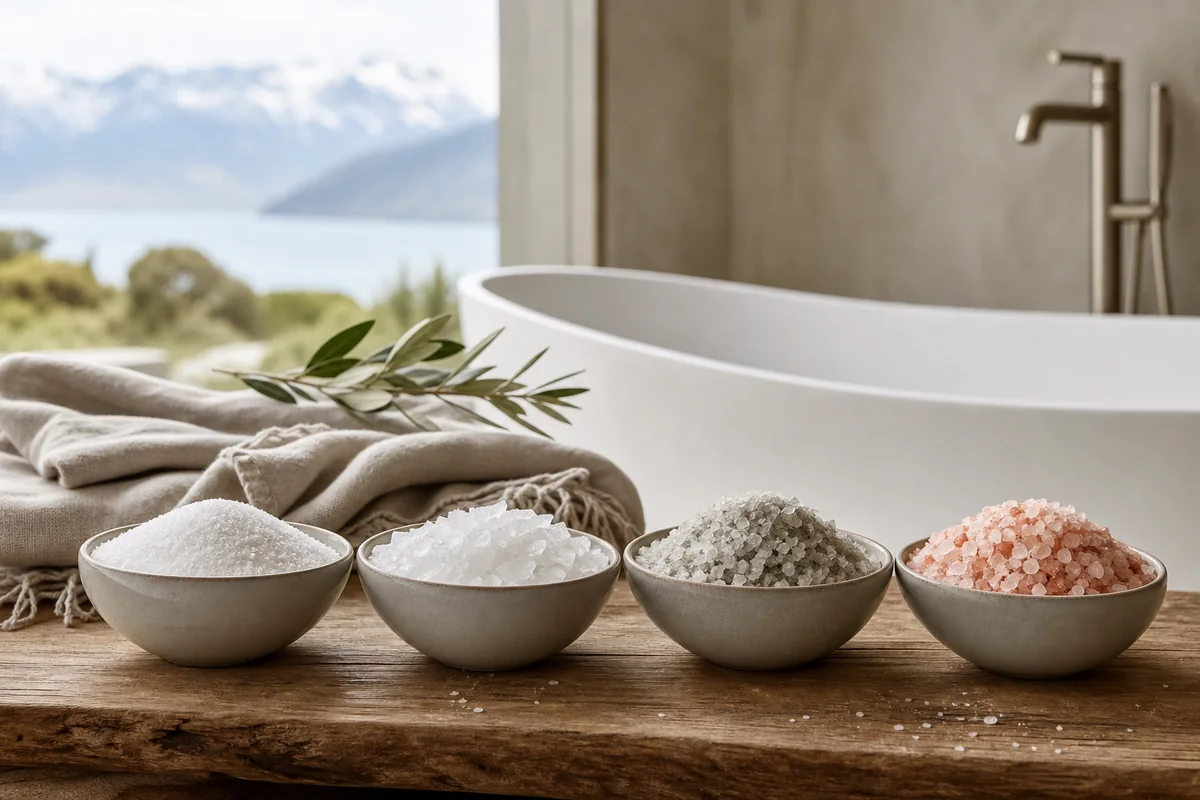
Walk down any wellness aisle in New Zealand and you’ll see bags of white and pink crystals all promising roughly the same thing: relaxation, recovery, better sleep, softer skin. But Epsom salts, magnesium flakes, Dead Sea salt and Himalayan pink salt are chemically different products with genuinely different properties — and the evidence behind them ranges from solid to almost entirely marketing.
The quick comparison
| Salt | What it is | Best for | Evidence level |
|---|---|---|---|
| Epsom salts | Magnesium sulphate | Relaxing soaks, post-exercise wind-down | Moderate (mostly the bath itself) |
| Magnesium flakes | Magnesium chloride | Foot soaks, concentrated magnesium baths | Moderate–limited |
| Dead Sea salt | Mixed mineral sea salt | Dry, irritated skin | Good for skin barrier support |
| Himalayan pink salt | Rock salt with trace iron | Colour, texture, DIY blends | Cosmetic — no unique health evidence |
Epsom salts (magnesium sulphate)
Epsom salt is the classic bath salt — magnesium, sulphur and oxygen. It’s been used for muscle soaks since the days when “taking the waters” was a prescription, and it remains the cheapest way to run a mineral bath (around $8/kg in NZ).
The honest bit: the popular claim that you “absorb magnesium through your skin” in an Epsom bath is surprisingly poorly supported. Skin is a very effective barrier to ions like magnesium, and the small studies claiming meaningful absorption have never been robustly replicated. The warm water is doing most of the work here. A 20-minute soak is a pleasant way to slow down at the end of the day, and the salt makes the water feel silkier and the ritual more deliberate, but that is about the size of it.
That doesn’t make Epsom baths pointless. It makes them a cheap, pleasant recovery ritual with a real (if mostly thermal) mechanism. If you’re deficient in magnesium, an oral magnesium supplement is the evidence-backed route.
How to use: 1–2 cups in a warm (not scalding) bath, 15–20 minutes, ideally 1–2 hours before bed.
Magnesium flakes (magnesium chloride)
Magnesium chloride flakes are more concentrated and more soluble than Epsom salts, which is why they’re the go-to for foot soaks and “magnesium baths.” The transdermal-absorption caveat above applies here too. Magnesium chloride brines are noticeably softening on skin, though, and a foot soak is a genuinely relaxing way to wind down after a long day on your feet.
If you want to cover the actual magnesium base, treat the soak as the relaxation layer and get your intake sorted through food (pumpkin seeds, legumes, whole grains, leafy greens) or a good oral supplement.
Dead Sea salt — the one with real skin evidence
Dead Sea salt has one small, specific controlled study worth noting, but it is not broad proof for every skin condition or a whole-body health effect. A German trial found that bathing the forearm in a 5% Dead Sea salt solution for 15 minutes improved skin barrier function, increased skin hydration, and reduced roughness and redness in people with atopic dry skin — with the researchers attributing the effect largely to its unusually high magnesium content. Dead Sea salt is compositionally different from ordinary sea salt: it’s much richer in magnesium, calcium and potassium chlorides and relatively low in sodium.
If you have dry, flaky or easily irritated skin, Dead Sea salt is arguably the most justifiable “premium” salt on the shelf. It usually costs more than Epsom salt, so compare current price per kilogram and avoid paying extra for unsupported therapeutic claims.
A sensible caveat: if you have eczema or broken skin, salt baths can sting, and anything beyond mild dryness deserves a chat with your GP or dermatologist rather than a DIY protocol.
Himalayan pink salt — pretty, but be honest about it
Himalayan pink salt is rock salt from Pakistan with trace iron oxide, which gives it that lovely blush colour. The “84 trace minerals” marketing is technically true and practically meaningless — the amounts are far too small to matter, whether you eat it or bathe in it.
What it genuinely offers: beautiful colour and texture for DIY bath blends, body scrubs and gift jars. If you’re making your own products, it’s the aesthetic layer, not the therapeutic one. New Zealand sea salt does a similar job in a scrub, and it hasn’t travelled as far to get here.
Why blend your own?
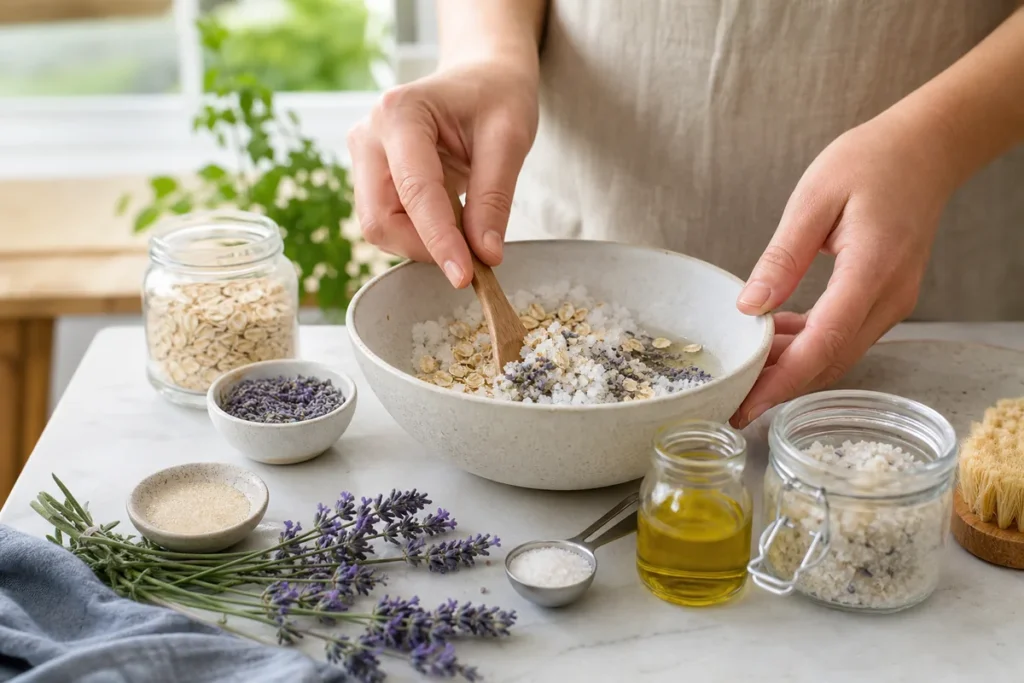
Once you know what each salt does, the DIY logic becomes obvious, and it’s why a lot of Kiwi makers build their own soaks rather than buying pre-mixed ones. Fragrance is the layer worth reading up on first; see our guide to essential oils and how to use them safely. A sensible starting blend:
- Base (relaxation + cost): 2 parts Epsom salts
- Skin support: 1 part Dead Sea salt
- Concentration: 1 part magnesium flakes
- Looks: a handful of coarse Himalayan pink salt
- Optional fragrance: use only a professionally formulated bath-safe product according to its directions. Carrier oil does not reliably disperse essential oil through bath water, so omit essential oils unless you have an appropriate solubiliser and formulation.
Suppliers like PureNature in Auckland stock all four salts in bulk (1kg–5kg bags), which works out dramatically cheaper than buying branded soaks — Epsom salts from $8/kg, magnesium flakes from $8/250g, and both fine and coarse grades of the rest. Prices checked October 2026 and will move.
The bottom line
Bath salts are one of the cheapest wellness rituals available in NZ, and the ritual is real even where the mineral-absorption marketing isn’t. If your actual goal is raising magnesium levels, do that with food or an oral supplement, not the bathtub.
Pair a salt bath with the rest of your recovery stack — see our guides to recovery and biohacking in NZ and the best hot pools around the country if you’d rather outsource the warm water entirely.
Sources and further reading
- Nutrients: Review of transdermal magnesium claims
- International Journal of Dermatology: Dead Sea salt and atopic dry skin
Health information is general and does not replace advice from a qualified clinician or pharmacist. Check supplements for suitability with your medicines, allergies, pregnancy status and health conditions.