Quick answer: NZ has several commercially available recycled plastic building products that are consent-ready and in active use. The standouts are saveBOARD (building boards from recycled packaging, CodeMark-certified), Critical. Cleanstone (architectural panels from reclaimed NZ plastic), and Future Post (fence posts from 100% recycled soft plastic). All are genuinely circular — the waste materials that would otherwise go to landfill become durable, long-lived building products.
There’s a persistent assumption that sustainable building means going back to natural materials — mud, hemp, timber. And those materials are excellent. We’ve written separately about building a hempcrete home in NZ and whether you can build an earthship in Aotearoa. But there’s another dimension to building sustainably: dealing with the plastic waste stream that already exists, and turning it into something useful and durable. New Zealand is developing a genuinely interesting industry in this space, and most Kiwis who build, renovate, or farm have no idea it exists.
Why Recycled Plastic for Building?
The argument for recycled plastic building products is straightforward: plastic has already been made, it’s in the waste stream, it’s durable, and landfilling it is a poor outcome given its energy content and longevity. Transforming waste plastic into a structural product gives it a second life of decades or centuries, removes it from landfill, and reduces demand for virgin materials.
The specific advantages of recycled plastic as a building material are also compelling: it doesn’t rot, it doesn’t absorb moisture, it doesn’t need paint or treatment, and it’s highly durable in NZ’s variable climate. The major considerations are embodied energy (high for virgin plastic, lower but non-trivial for recycled plastic) and end-of-life recyclability (the better NZ manufacturers address this with buyback programmes).
The NZ Products Worth Knowing About
saveBOARD — Building Boards from Packaging Waste
saveBOARD makes building boards from recycled packaging waste — the mixed paper, plastic, and aluminium packaging from drink cartons, coffee cups, and similar materials that are typically hard to recycle. The manufacturing process uses heat, pressure, and time (no adhesives or chemical binders) to bond the waste material into a rigid board.
Key facts about saveBOARD:
- CodeMark-certified — the strongest product assurance pathway in the NZ system (see below)
- Product range covers internal linings, multi-use panels, ceiling tiles, roof board and formwork, plus rigid air barrier and bracing products
- Diverts packaging waste that would otherwise be landfilled — saveBOARD gives project-level figures rather than a single per-board number
- Available from building material retailers across NZ
- Manufactured in NZ and Australia
saveBOARD’s certification is significant, and it is worth being precise about why — the distinction matters in a consent application. saveBOARD describes its boards as CodeMark-certified. Under the Building Act 2004, a Building Consent Authority must accept a CodeMark product certificate as evidence of Building Code compliance and cannot demand further evidence, provided the product is used within its stated scope and limitations. CodeMark carries legal status equivalent to an Acceptable Solution or Verification Method.
This is not the same as a product appraisal — a BRANZ Appraisal, for instance. Appraisals have no legal standing; per MBIE, it is up to the professional judgement of the BCA whether an appraisal provides enough evidence. Appraisals are widely accepted in practice and form useful evidence, but acceptance is discretionary. If someone tells you a council is obliged to accept an appraisal, they are wrong. Always check a product’s current certificate and its scope directly with the manufacturer before specifying it.
Critical. Cleanstone — Architectural Panels from Reclaimed NZ Plastic
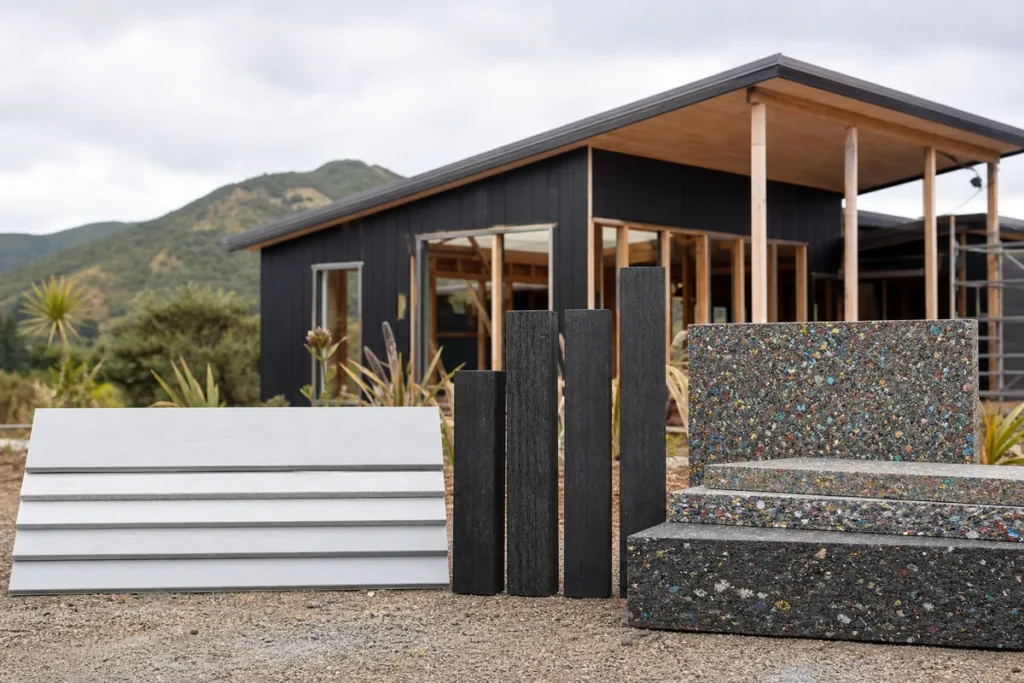
Critical. makes “Cleanstone” — solid panels manufactured from 100% reclaimed NZ plastic waste. The panels are used in interior fit-outs, shopfronts, hospitality spaces, and architectural feature applications.
Key facts about Critical. Cleanstone:
- Supplied as solid panels in a range of thicknesses — confirm current sheet sizes with Critical. directly
- Very low embodied carbon: 0.006–0.012 CO₂e/kg
- End-of-life buyback programme — the panels can be returned and remade
- Listed in the Sustainable Business Network’s Circular Economy Directory
- Available in multiple colours depending on the plastic waste feedstock
Cleanstone is primarily an interior product — feature walls, bench tops, splashbacks, and display installations — rather than a structural building material. But in the context of a renovation or fit-out where you’re choosing surface materials, it’s a genuinely excellent choice: durable, visually distinctive (the mixed-plastic aesthetic is increasingly appreciated in architectural interiors), and with a circular end-of-life that most building materials don’t have.
Future Post — Fence Posts from Recycled Soft Plastic
Future Post is a NZ company with an excellent origin story: founded by Jerome Wenzlick and Bindi Ground in Waiuku, South Auckland, it makes fence posts from 100% recycled soft plastic — the kind of plastic that can’t go in the yellow recycling bin, including shopping bags, bread bags, and frozen food packaging.
The posts are made from soft plastic blended with HDPE from milk bottles. They are UV stabilised, have a 50+ year life expectancy, and don’t need the treatment that wooden posts require against rot, fungi, and boring insects. Future Post reports having recycled 10,768 tonnes of plastic as at May 2026 — the equivalent, by their figures, of 615 million bread bags and 137 million milk bottles.
Key facts about Future Post:
- Made from 100% recycled soft plastic blended with HDPE
- 50+ year life expectancy claimed by the manufacturer
- UV stabilised and moisture resistant
- Available in standard fence post dimensions
- Manufacturing based in Waiuku, South Auckland
- Widely distributed through rural fencing suppliers across NZ
Future Post is the most widely distributed of the NZ recycled plastic building products — if you’re a rural landowner or farmer, you can very likely source them through your regular rural supplier already. The life expectancy advantage over treated timber is genuinely significant over a farming or land-holding horizon.
Plastics Recycling NZ (PRNZ) — Industrial-Scale PVC Recovery
PRNZ is a joint venture between WM New Zealand and Aliaxis (owners of the Marley brand), supported by a grant from the Plastics Innovation Fund. It operates what it describes as Aotearoa’s only uPVC reprocessing facility, in Auckland, alongside a Christchurch site operating since 2005. They reprocess uPVC and HDPE from construction waste — pipe, window frames, spouting, conduit and similar materials — back into new construction products. (We previously gave an investment figure and an opening date here; published figures for the project vary and we could not confirm either, so both have been removed.)
PRNZ is important because it closes the loop on construction-grade plastics that have historically gone to landfill. Window frames and pipes from demolition sites can now be reprocessed and returned to the construction supply chain. This is industrial-scale circular economy infrastructure — not a consumer product, but important infrastructure for sustainable construction in NZ.
Precious Plastic NZ — Grassroots Plastic Crafting
The global Precious Plastic movement — which provides open-source machinery designs for shredding, extruding, and moulding recycled plastic — has had hubs in NZ, including one in Tauranga. Hubs are volunteer-run and come and go, so check whether one is currently active in your area before making the trip. These community workshops collect, sort, and mould plastic bottle tops and similar materials into small objects and sheets.
Precious Plastic NZ is currently at craft and small-scale scale — it produces decorative items and small panels rather than structural building products. But it represents genuine community infrastructure for plastic recycling and is worth connecting with if you’re interested in hands-on circular economy work at a local level.
NZ Circular Economy Infrastructure
Behind these products sits infrastructure that’s increasingly substantial. The Packaging Forum runs the Soft Plastics Recycling Scheme (recycling.kiwi.nz) through collection points at supermarkets — the soft plastic that Future Post uses comes partly through this scheme. WasteMINZ (the national waste industry association) has been driving construction and demolition (C&D) waste reduction — up to 50% of NZ landfill content is C&D waste, making building-sector recycling one of the highest-impact interventions available.
Frequently Asked Questions
Are recycled plastic building products consent-ready in NZ?
saveBOARD is CodeMark-certified, which a Building Consent Authority must accept as evidence of Building Code compliance when the product is used within its stated scope. Future Post fence posts don’t require building consent (fencing generally doesn’t). Critical. Cleanstone is used for interior applications that don’t require structural consenting. PRNZ’s recycled uPVC is designed to meet the same product standards as virgin uPVC. Generally, these products are designed for mainstream building use, not as alternative-solutions experiments.
Where can I buy saveBOARD in NZ?
Through building material retailers across NZ — the saveBOARD website (saveboard.nz) has a stockist locator. It’s increasingly available through mainstream building supply channels, not just specialist sustainable suppliers.
Are Future Post products available nationally?
Yes — Future Post manufactures in Waiuku, South Auckland and distributes through rural supply networks nationally. They’re the most widely available of the NZ recycled plastic building products for rural and agricultural applications.
Is using recycled plastic actually better for the environment?
In most cases, yes — particularly where the alternative is landfill. Recycled plastic has significant embodied energy from its original manufacture, but converting it to a long-life building product (50+ years for a fence post) avoids landfill, displaces virgin material production, and sequesters the plastic in a durable product form for the life of the building. The end-of-life story varies by product — Critical. Cleanstone’s buyback programme is the most circular design; Future Post posts are durable but not currently recyclable at end of life. Lifecycle analysis varies by product and application.
The Bottom Line
NZ’s recycled plastic building products sector is more developed than most people realise. saveBOARD, Critical. Cleanstone, and Future Post are all commercially available, real products used in real buildings and farms right now. They’re not experimental alternatives — they’re working circular economy solutions that happen to use waste plastic as their feedstock.
If you’re building, renovating, or farming, there’s at least one of these products relevant to your project. The soft-plastic fence post replacing a treated timber post, the recycled packaging board in your wall framing, the reclaimed-plastic panel feature wall in your kitchen — these are practical choices that are available today.
Reviewed September 2026. Certification status, company details and product availability change — verify directly with manufacturers, and check any product’s current certificate and its stated scope before specifying it.