Quick answer: New Zealand’s Building Code is performance-based, meaning you can use almost any building material — including hempcrete, rammed earth, straw bale, bamboo composites, and recycled plastic products — provided you can demonstrate it meets the code’s performance outcomes. The most developed NZ natural building sectors are earth building (supported by the NZS 4297/4298/4299 standards, revised in 2024 — though the Acceptable Solutions still cite the 1998 editions), hempcrete (several completed homes, active builders), and recycled plastic products (commercially available, CodeMark-certified). This guide covers what’s available, what it costs, and how to get started.
Most Kiwis assume natural building materials are either illegal, impossibly expensive, or practically unavailable in NZ. None of these assumptions are accurate in 2026. New Zealand has a genuine and growing natural building sector — smaller than Australia’s or the UK’s, but real, active, and increasingly well-resourced. The barriers are lower than most people think.
Disclaimer: This article is for informational purposes only. Always consult licensed building professionals and your local council before making building decisions.
How the NZ Building Code Actually Works for Natural Materials
The single most important thing to understand about building with natural materials in NZ is that the Building Code is performance-based, not prescriptive. You don’t have to use specific approved materials. You have to demonstrate that your building meets performance outcomes across relevant clauses — structural stability, durability, weathertightness, thermal performance, fire safety, and others.
There are three compliance pathways under the Building Act 2004:
- Acceptable Solutions: Pre-approved methods that councils must accept without further evidence. Standard timber-frame construction under NZS 3604 uses this pathway. If your material is covered by an Acceptable Solution, this is the easiest path.
- Verification Methods: Calculations, tests, or measurements that prove compliance. Also pre-accepted. Some materials use this pathway.
- Alternative Solutions: You provide sufficient technical evidence to convince the Building Control Authority (BCA) that your design meets the performance outcomes. This is the pathway for most natural and alternative materials. It requires more documentation and engineering support — but councils cannot simply refuse; they must assess the evidence you provide.
The practical implication: natural building materials aren’t blocked by regulation — they’re governed by an evidence requirement. The more NZ-specific performance data exists for a material, the easier and cheaper that evidence is to assemble. This is why hempcrete (which has well-documented NZ builds and international performance data) is more straightforward to consent than earthships (which have no approved standard for tyre walls in NZ).
Natural Building Materials Available in NZ
Hempcrete
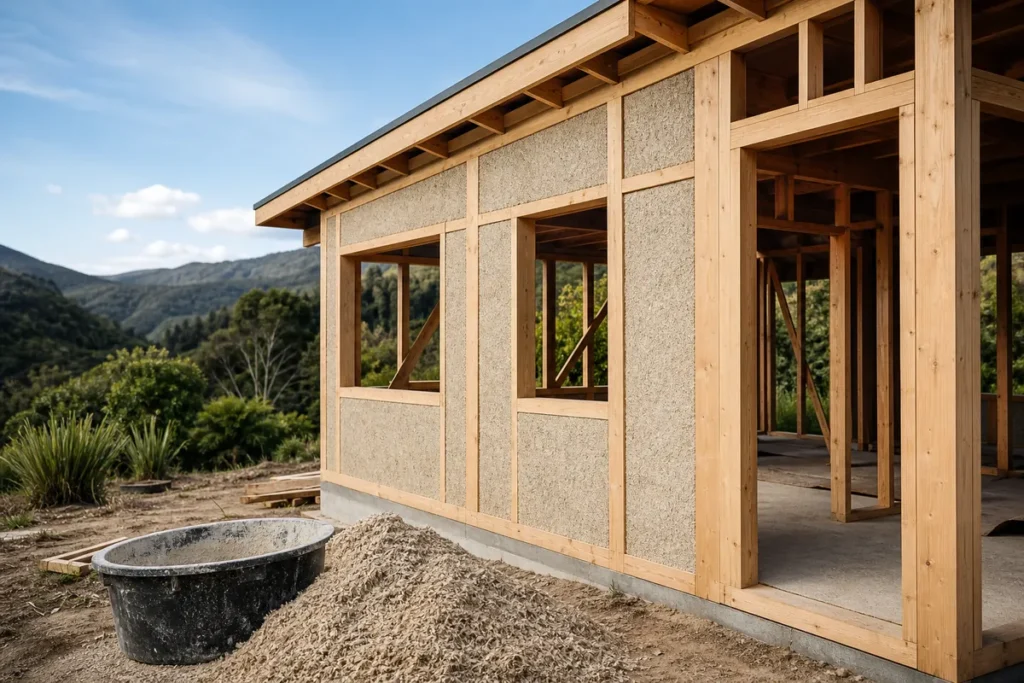
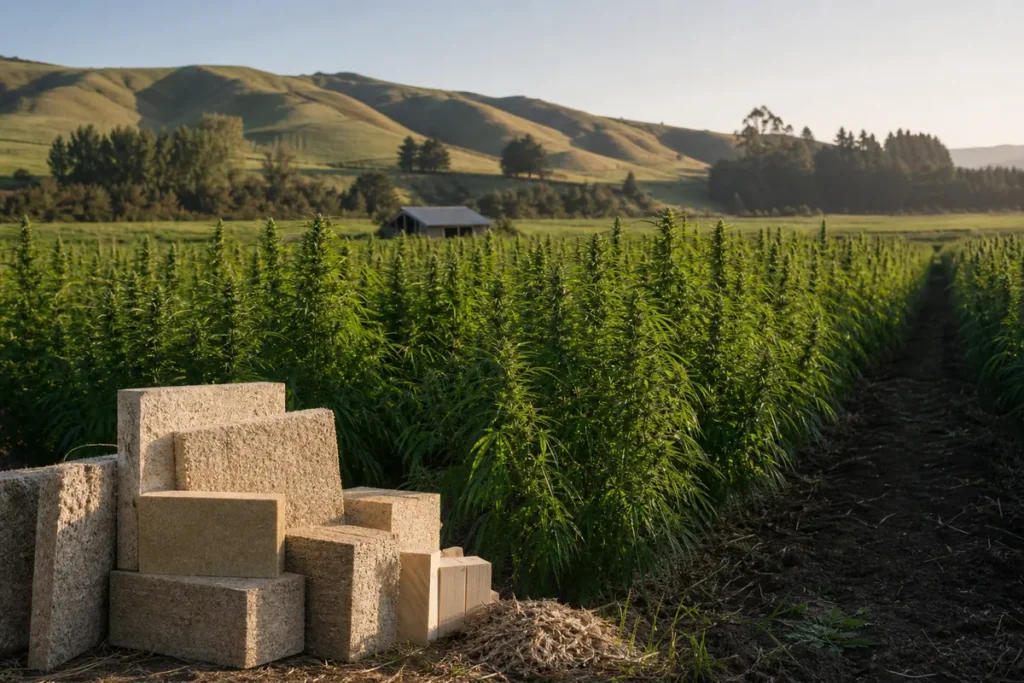
Hempcrete — hemp hurd + hydrated lime + water — is the most commercially developed natural building material in NZ right now. It’s carbon negative (hemp absorbs CO₂ while growing; lime sequesters further CO₂ as it cures over decades), highly insulating, breathable, fire resistant, and durable. Several NZ homes have been completed and consented, primarily in Central Otago and Golden Bay.
NZ status: Commercially available. Active builders (Erkhart Construction in Wanaka, Kohu Hemp in Takaka). Workshop training available. Hemp hurd now locally sourced and, following the May 2026 deregulation, licence-free to grow. A joint ANZ hempcrete building standard is in development.
Consent pathway: Alternative Solutions
Best for: Thermal performance, carbon negativity, long lifespan, breathable walls
→ Complete guide: Can I Build a Hempcrete Home in NZ?
Earth Building: Rammed Earth, Cob, Adobe — and Straw Bale
Earth building has the longest history and the best-supported consent pathway of any natural building category in NZ. Three NZ standards cover it — NZS 4297 (engineering design), NZS 4298 (materials and construction), and NZS 4299 (buildings not requiring specific design). All three were comprehensively revised and released in 2024 and are freely downloadable from Standards New Zealand, sponsored by MBIE.
One critical detail to get right before you design anything: the Building Code’s Acceptable Solutions — B1/AS1, B2/AS1 and E2/AS2 — still cite the 1998 versions of NZS 4298 and NZS 4299, not the 2024 revisions. The 2024 editions are the current, better standards and are well worth reading, but they are not the documents the Acceptable Solutions point to. If you intend to consent via the Acceptable Solution route, confirm with your Building Consent Authority which edition they are assessing against before you commit to a design. Getting this wrong can mean redoing documentation.
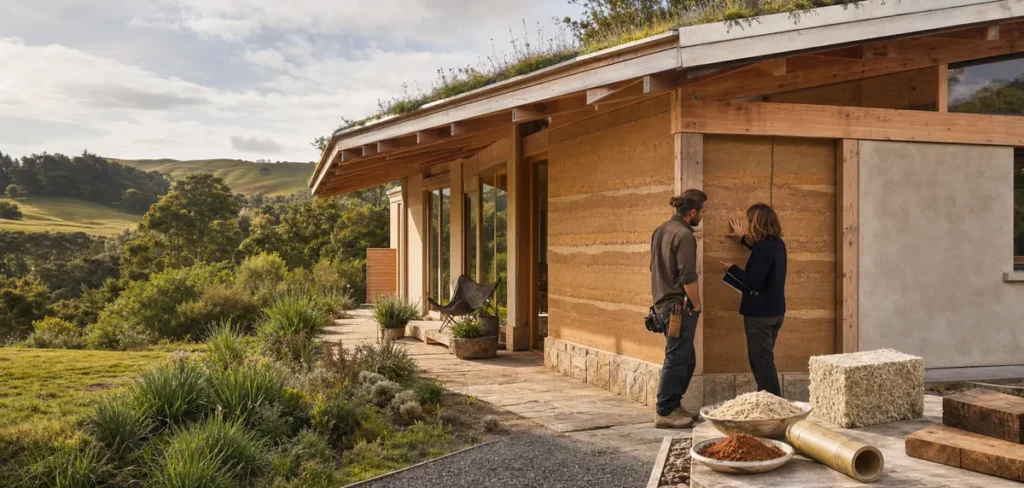
Rammed earth / pisé: Earth compacted in layers between formwork to create dense, thermally massive walls. Excellent thermal performance, beautiful aesthetic, and very durable. Active NZ practitioners, particularly in Hawke’s Bay and Central Otago where the clay content and climate suit the material.
Adobe / mud brick: Sun-dried earth blocks laid in mortar. The oldest building technology in the world, with a long NZ history. Suitable for warm, dry climates (Hawke’s Bay, Marlborough, Central Otago). Lower build cost than rammed earth due to lower-tech construction process.
Cob: Monolithic earth construction using a mixture of clay, sand, and straw worked by hand. Popular with owner-builders for its low equipment requirements. Suitable for smaller structures and warm dry climates. NZ’s earth building community has strong cob knowledge.
Straw bale: Compacted bales of straw used as wall infill (load-bearing or framed). Excellent insulation, good thermal mass, fire resistant (the density of a straw bale means it smoulders rather than burns). Note that straw bale is not a material covered by the NZ earth building standards — those cover adobe, cob, pressed earth brick, rammed earth and poured earth. The 2024 revisions include straw bale only as informative guidance on allied natural building techniques, so a straw bale build still goes through the Alternative Solutions pathway.
Key NZ resource: Earth Building Association of NZ (EBANZ) at earthbuilding.org.nz — industry body, practitioner directory, and publisher of earthBUILDING magazine. The most established natural building community in NZ.
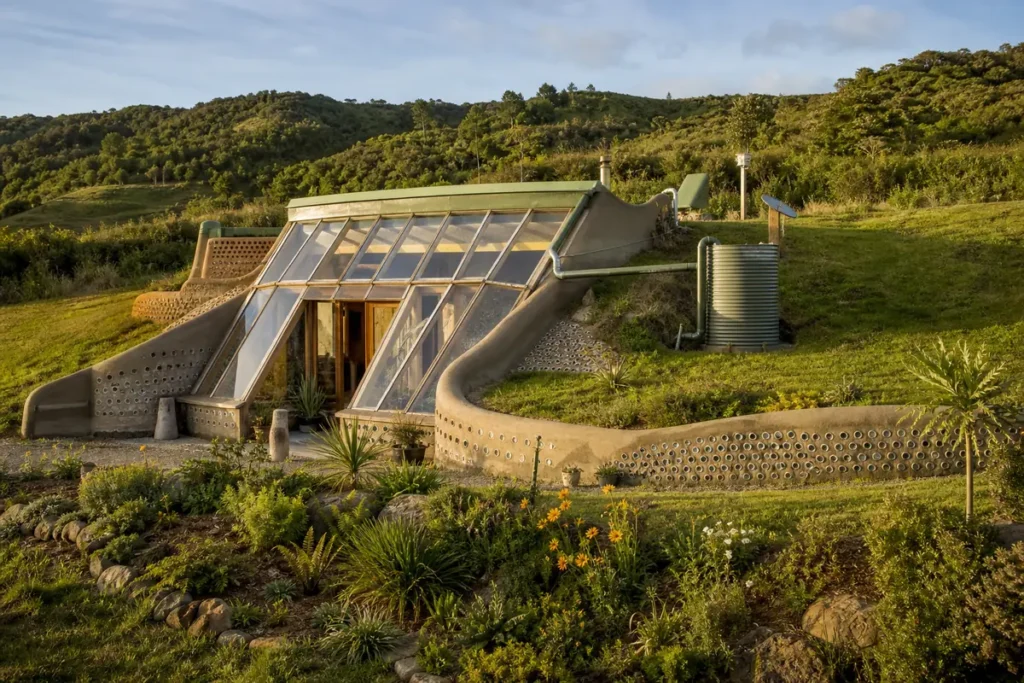
Earthships
Off-grid homes built from rammed tyre walls, recycled materials, and passive solar design. Two have been consented and completed in NZ (Ngaruawahia, 2004; Coromandel Peninsula, 2015). The consent process is more demanding than other natural building types — tyre walls have no Acceptable Solution and require full Alternative Solutions documentation including an engineer’s personal liability statement.
Key NZ resource: earthship.co.nz — NZ-specific FAQ and community hub.
→ Complete guide: Earthship NZ: What They Are and Whether You Can Build One in Aotearoa
Bamboo
Bamboo is one of the world’s most versatile natural building materials — it grows faster than any timber species, has excellent tensile strength, and is increasingly available in composite form for building use. In NZ, bamboo is currently available and commercially used for decking, cladding, flooring, and panelling — but structural bamboo framing remains essentially untested in the NZ market.
NZ bamboo suppliers:
- Plantation Bamboo (plantationbamboo.co.nz) — NZ bamboo specialist with showrooms in Auckland, Christchurch, Kāpiti and Wānaka. Supplies Bamboo X-treme decking and cladding. They state their cladding is tested and appraised by BEAL as compliant with the NZ Building Code — ask them for the current appraisal and its scope before specifying it.
- Eva-Last NZ (eva-last.co.nz) — Bamboo composite decking and cladding.
- You Bamboo (youbamboo.co.nz) — Sustainably sourced bamboo decking as an alternative to pine or Kwila.
For structural bamboo framing or bamboo composite structural panels: not currently available as a commercial product in NZ. Theoretically achievable via Alternative Solutions with appropriate engineering, but essentially untested here. An opportunity for the future.
Recycled Plastic Building Products
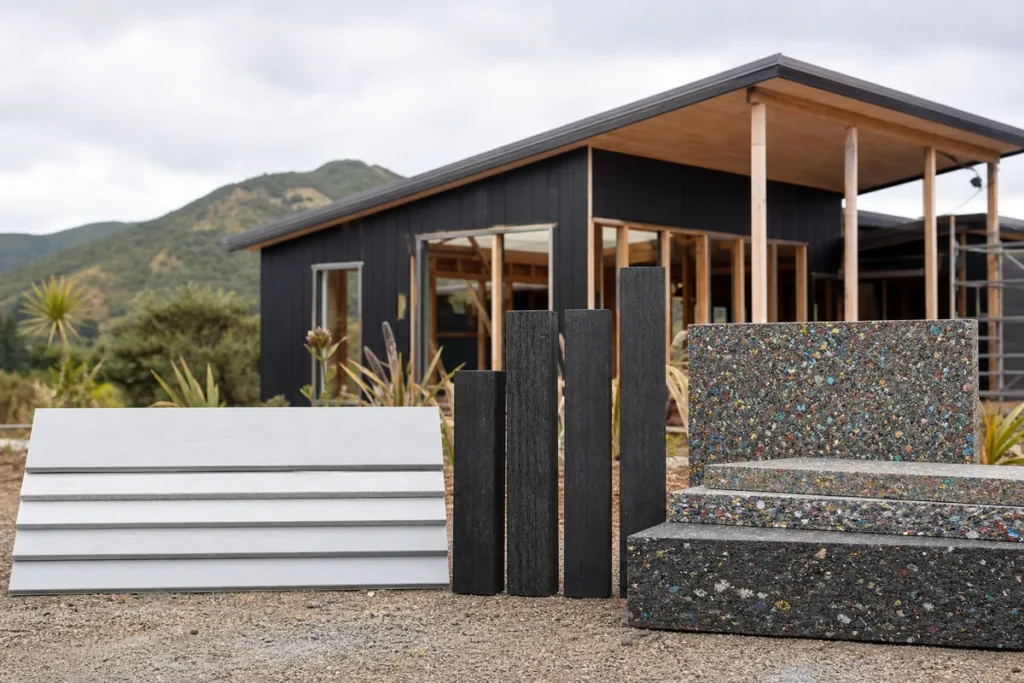
The category you are most likely to find on the shelf at a mainstream building supplier. Key products:
- saveBOARD — CodeMark-certified building boards from recycled packaging waste. Available through building supply retailers nationwide. Manufactured in Te Rapa, Hamilton and Warragamba, NSW.
- Critical. Cleanstone — Architectural panels from 100% reclaimed NZ plastic. Interior fit-out and feature applications. Buyback programme. 0.006–0.012 CO₂e/kg embodied carbon.
- Future Post — Fence posts from 100% recycled soft plastic blended with HDPE. 50+ year life expectancy claimed by the manufacturer. Made in Waiuku, South Auckland; widely available through rural suppliers.
→ Complete guide: Recycled Plastic Building Products in NZ: saveBOARD, Future Post and What Else Exists
Mycelium (Mushroom) Materials
Mycelium — the root network of fungi — can be grown around agricultural waste to produce a biodegradable, compostable material with properties useful for insulation and packaging. New Zealand has one significant company in this space:
Naturally Genius (naturallygenius.com) — formerly Mushroom Material, and rebranded since we first wrote this guide. Auckland-based, with an office in Singapore. They grow mycelium on agricultural waste to make protective packaging as a polystyrene alternative — the material offers impact protection, thermal insulation and sound dampening, and is home-compostable within months. We previously published funding, headcount, award and product-roadmap details here that we have since been unable to substantiate, so they have been removed. The company’s current public focus is packaging rather than construction products.
For NZ builders: mycelium building materials are not commercially available in NZ yet, but Naturally Genius is the company to watch. A packaging-first commercial model is a plausible route into construction products, though the company has not publicly committed to that step.
NZ Natural Building Materials: State of Play at a Glance
| Material | NZ Availability | Consent Pathway | Best For |
|---|---|---|---|
| Hempcrete | Commercial — active builders and suppliers | Alternative Solutions | Thermal mass, carbon negative, longevity |
| Rammed earth | Active practitioners | Earth building standards — Acceptable Solutions cite the 1998 editions | Thermal mass, durability, aesthetics |
| Adobe / mud brick | Active practitioners | Earth building standards — Acceptable Solutions cite the 1998 editions | Warm dry climates, low-tech owner-build |
| Straw bale | Available materials, active community | Alternative Solutions — not covered by the earth building standards | Insulation, thermal mass, owner-build |
| Earthship | Self-organised community; a small number of completed builds | Alternative Solutions (complex) | Off-grid systems, recycled materials philosophy |
| Bamboo (cladding/decking) | Commercially available | Standard (product appraised) | Exterior cladding, decking, flooring |
| saveBOARD | Commercially available, mainstream retailers | CodeMark-certified — must be accepted within its stated scope | Internal linings, panels, ceiling tiles, roof board, formwork |
| Future Post | Nationally available through rural suppliers | No consent required (fencing) | Farm fencing, property fencing |
| Mycelium | Not yet commercially available for building | n/a | Currently packaging; insulation panels a future possibility |
This table previously carried indicative per-square-metre cost bands for each material. We could not trace those figures to any published source, so we have removed them rather than leave them standing as fact. Build costs in NZ vary enormously by region, site, specification and builder — get quotes for your own project.
Key NZ Networks for Natural Builders
- Earth Building Association of NZ (EBANZ) — earthbuilding.org.nz — The most established NZ natural building body. Standards, directory, magazine.
- Hemp Building Association NZ (HBANZ) — hba.nz — Hempcrete advocacy and consent support.
- NZ Hemp Industries Association (NZHIA) — nzhia.com — Hemp growing, processing, and products.
- NZ Green Building Council (NZGBC) — nzgbc.org.nz — membership organisation behind the Green Star and Homestar rating schemes. The bridge between natural building and mainstream construction.
- Earthship New Zealand — earthship.co.nz — Earthship-specific NZ community and resources.
- Sustainable Business Network (SBN) — sustainable.org.nz — Broader sustainable business, including built environment. Annual awards; Circular Economy Directory.
Frequently Asked Questions
Are natural building materials legal in NZ?
Yes — the NZ Building Code’s performance-based framework means you can use virtually any material, provided you demonstrate it meets the code’s performance requirements. Some materials (earth building, bamboo cladding) have established consent pathways. Others (hempcrete, earthships) require more documentation but are demonstrably achievable.
Which natural building material has the easiest consent process in NZ?
Earth building — rammed earth, adobe, cob and pressed earth brick — has the best-supported NZ consent pathway, through the NZS 4297/4298/4299 earth building standards. Note two things: straw bale is not one of the materials those standards cover, and the Building Code’s Acceptable Solutions still cite the 1998 editions rather than the 2024 revisions, so confirm with your council which edition applies. Recycled plastic products like saveBOARD are CodeMark-certified, which a Building Consent Authority must accept within the product’s stated scope. Hempcrete is next most supported, with active NZ practitioners and a growing library of NZ-specific performance evidence.
Is natural building actually more expensive in NZ?
Upfront build costs for hempcrete and earth building are broadly comparable to mid-range conventional construction. The additional cost in natural building is typically in the consent documentation and engineering sign-off, not in the materials themselves. Over a lifetime horizon, natural building materials typically have dramatically lower maintenance and operating costs — many last centuries without the replacement and retreatment cycles conventional materials require.
Can I be an owner-builder using natural materials in NZ?
Yes — the Building Act 2004 provides an owner-builder exemption allowing unpaid friends and family to assist with Restricted Building Work on your own home. Many NZ natural building projects use this provision for the labour-intensive stages (tyre-ramming, hempcrete mixing and tamping, straw bale stacking). You will still need licensed building practitioners for structural, plumbing, and other licensed work categories.
Where is the best place in NZ to build with natural materials?
Regions with an established natural building community tend to be most supportive: Central Otago/Wanaka (hempcrete hub, Erkhart Construction and HempCentral), Golden Bay/Takaka (Kohu Hemp, strong eco-build culture), Northland/Bay of Islands (warm climate suitable for many natural materials), and Hawke’s Bay/Wairarapa (earth building tradition, suitable clay soils for rammed earth and adobe).
The Bottom Line
Natural building materials in NZ are no longer a fringe conversation. Earth building has formal NZ standards. Hempcrete has completed, consented homes and active professional builders. Bamboo composite products are available at mainstream hardware stores. Recycled plastic building products are CodeMark-certified and mainstream-ready. The ecosystem is real, it’s growing, and the knowledge base is increasingly accessible.
If you’re planning a build or renovation in 2026 and sustainability matters to you, the options are better than at any previous point. The right starting point depends on your material interests, your location, your budget, and your tolerance for consent complexity. Use this guide as your starting map — and dive into the category guides for the full picture on each material.
Reviewed September 2026, with consent pathways and product certification checked against MBIE, Standards New Zealand and Building CodeHub. Indicative per-square-metre costs previously shown in this guide have been removed as unsourced. Building consent processes, cited standard editions and material availability all change — always verify with your local council and relevant industry bodies before making building decisions. ThrivingKiwi is not a licensed building professional and this article does not constitute building advice.