Quick answer: Yes — you can build a hempcrete home in NZ. Several have been completed and received Code of Compliance Certificates. It requires an Alternative Solutions consent pathway (not the standard Acceptable Solutions), and needs a timber or steel structural frame (hempcrete is not load-bearing). HBANZ puts the cost at roughly the same as a brick and cement block house. The key NZ builders are Erkhart Construction (Wanaka) and Kohu Hemp (Takaka). Consent is achievable — it just takes more documentation than a conventional build.
Hempcrete is having a moment in NZ. A material that barely registered a decade ago now has completed homes, active builders, dedicated suppliers, and a growing community of homeowners who’ve chosen it over conventional construction. But for most Kiwis, it still raises basic questions: what exactly is it, does it work in NZ conditions, can you actually get consent for it, and what will it cost?
This guide answers all of those questions directly — based on NZ-specific data, not international case studies.
Disclaimer: This article is for informational purposes only. Always consult a licensed building professional and your local council before making building decisions.
What Is Hempcrete?
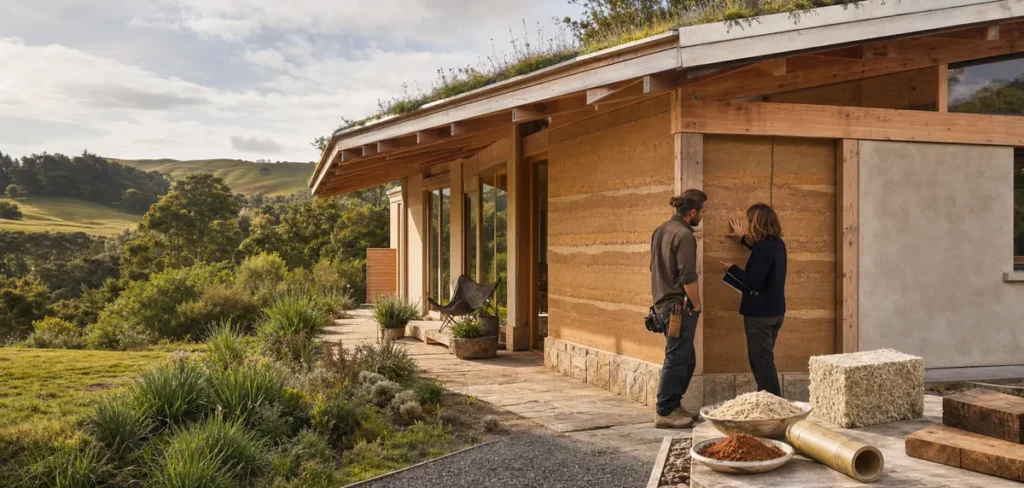
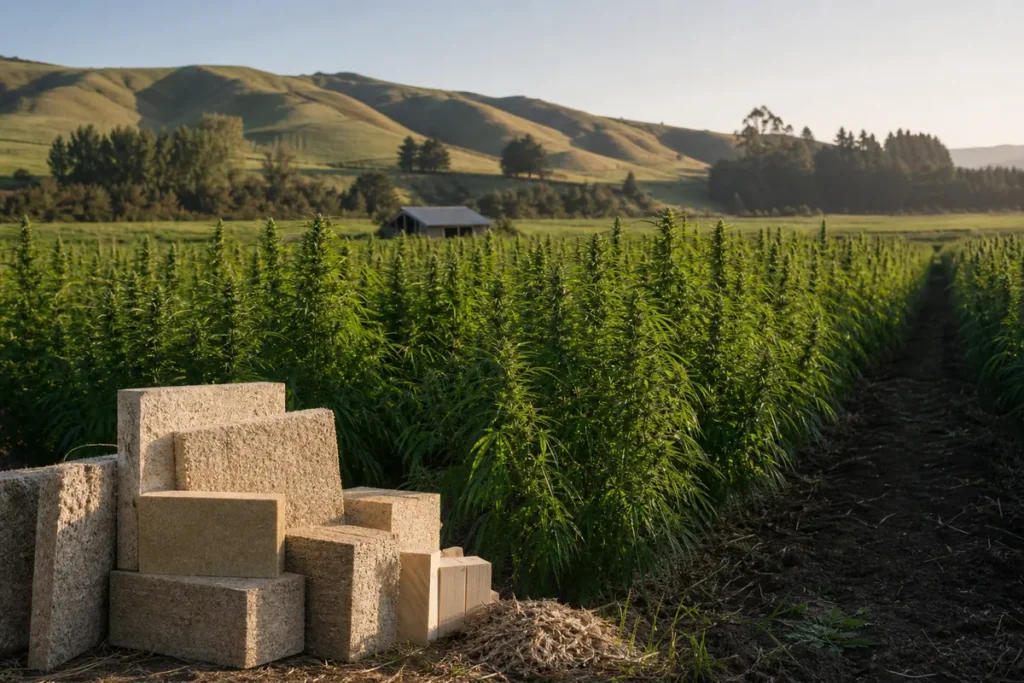
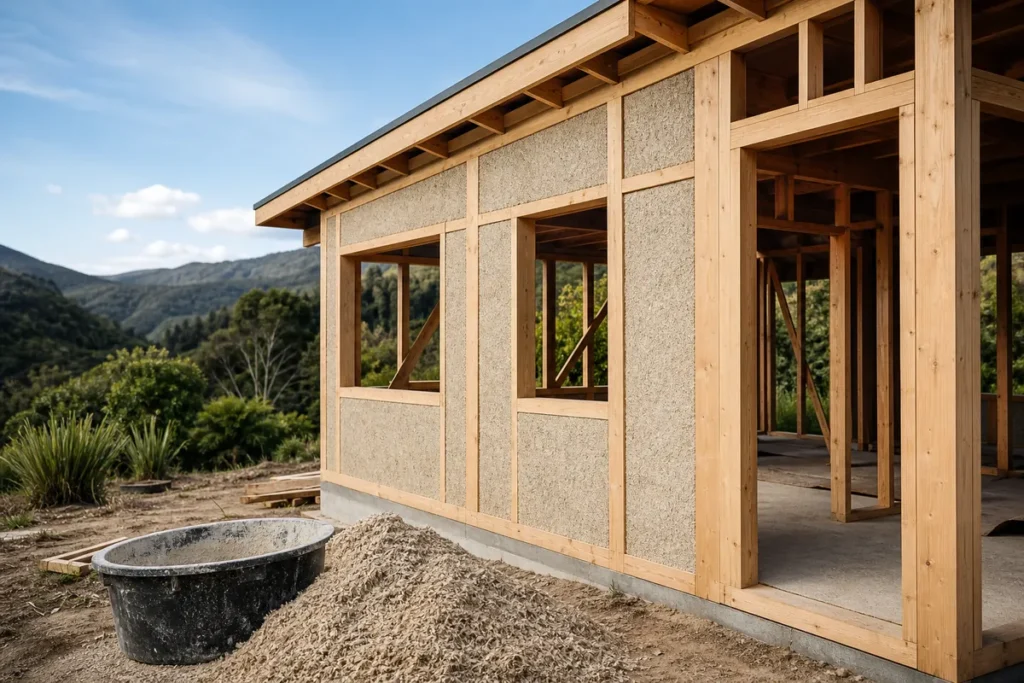
Hempcrete is a bio-composite building material made from three ingredients: hemp hurd (the woody core of the hemp plant stalk), hydrated lime, and water. Mixed together and cast around a structural frame, it sets to form a lightweight, highly insulating wall panel that’s breathable, fire resistant, and carbon negative.
Critically, hempcrete is not structural. It doesn’t carry loads — it wraps around a timber or steel frame that takes the structural load. Think of it as a high-performance insulating infill rather than a structural material. This is why it works so well alongside conventional framing: you’re not replacing structural engineering, you’re upgrading the wall system.
Why Hempcrete? The Core Properties
| Property | Hempcrete | Conventional (timber frame + insulation) |
|---|---|---|
| Carbon footprint | Carbon negative — hemp absorbs CO₂ as it grows; lime sequesters further CO₂ as it cures | Carbon positive — conventional insulation and materials have embodied carbon |
| Thermal mass | High — stores heat and releases it slowly, reducing temperature swings | Low with standard insulation batts |
| Breathability | Highly vapour permeable — regulates moisture without trapping it | Depends on membrane and insulation choice; can trap moisture |
| Fire resistance | Excellent — lime won’t burn, hemp chars but doesn’t sustain combustion | Moderate — timber frame is combustible |
| Pest resistance | High alkalinity of lime deters insects and mould | Timber frame requires treatment for borers and moisture management for mould |
| Lifespan | 100–500+ years (European hempcrete buildings hundreds of years old) | 50–100 years for typical NZ construction |
How Does the NZ Consent Process Work?
The NZ Building Code is performance-based, not prescriptive. This means you don’t have to use standard Acceptable Solutions — you can propose an Alternative Solution, as long as you provide sufficient evidence that it meets the code’s performance outcomes. Hempcrete falls under this pathway.
In practice, getting hempcrete consent in NZ requires:
- An engineer’s producer statement (PS1): A licensed building engineer takes personal professional liability for the structural design. This is standard for any Alternative Solutions build.
- Performance evidence: Documentation showing your hempcrete system meets the relevant Building Code clauses — particularly B1 (structure), B2 (durability), E2 (external moisture), and H1 (energy efficiency). UK and Australian performance data has been used successfully in NZ consent applications.
- A building consent application: Submitted to your local council’s Building Control Authority (BCA). The BCA assesses the evidence you provide against the code’s performance requirements. They cannot simply refuse — they must assess the technical evidence.
- Inspection and Code of Compliance Certificate (CCC): The build is inspected at key stages. On completion, a CCC is issued confirming the building complies with the Building Code.
Multiple NZ hempcrete homes have successfully completed this process. The Hemp Building Association NZ (HBANZ) at hba.nz is the industry body to approach early. Their FAQ states they “can potentially assist” with the performance documentation a council will want to see.
Which councils have a track record with hempcrete consents? Anecdotal evidence from the NZ hempcrete community points to councils in the Tasman/Nelson area (where Kohu Hemp operates from Takaka) and Queenstown Lakes District (where Erkhart Construction operates from Wanaka) as having processed hempcrete consent applications before. A joint ANZ hempcrete building standard is currently in development — when complete, this will significantly simplify the consent pathway by providing an Acceptable Solution for hempcrete.
What Does a Hempcrete Home Cost in NZ?
Honest answer: hempcrete is not a budget building option. The most reliable guide we can point to is HBANZ’s own FAQ, which puts hempcrete at “roughly equivalent to slightly above average” and says “it’s the same as a brick and cement block house” — mid-to-upper range of conventional construction. We previously published a specific per-square-metre range here; we could not trace it to a published source, so it has been removed rather than left standing as fact.
Costs vary widely with site, specification, finishes and how much labour you contribute yourself. Get quotes from the builders below for your own design rather than planning against a national figure.
Where the value is: The upfront cost premium needs to be considered against the lifetime performance. Hempcrete homes have dramatically lower heating and cooling costs (the thermal mass and breathability combination is highly effective in NZ climates), negligible maintenance costs compared to conventional construction, and a lifespan measured in centuries rather than decades. Over a 50-year horizon, the total cost of ownership is often lower than equivalent conventional builds.
Cost reduction strategies used by NZ builders:
- Growing your own hemp hurd on rural land (now significantly more accessible following the May 2026 deregulation — see our guide: Hemp Growing is Now Licence-Free in NZ)
- Volunteer/whanau labour for the hempcrete mixing and tamping (less skilled than conventional framing, more community-friendly)
- Retrofitting hempcrete into an existing timber frame rather than new-build
- Owner-builder contribution using the Building Act’s owner-builder exemption for unpaid labour
Best Hempcrete Builders and Suppliers in NZ
Erkhart Construction — Wanaka
Erkhart Construction is widely regarded as NZ’s most experienced hempcrete builder. Based in Wanaka, they have completed multiple hempcrete homes in Central Otago and have a deep understanding of the NZ consent pathway. Builder Lochy at Erkhart is the practitioner most likely to have current working knowledge of what councils require for hempcrete consent documentation.
Erkhart has also operated a hempcrete studio available as short-stay accommodation in Wanaka — documented in the NZHIA’s iHemp magazine — which is a rare opportunity to actually stay in a hempcrete building before committing to building one. It is not currently advertised on Erkhart’s own website, so check with them that it is still available rather than assuming. If it is, a night or two in it will teach you more about thermal comfort, acoustics and the feel of the material than any amount of reading.
Kohu Hemp — Takaka, Golden Bay
Kohu Hemp is based in Takaka and operates as both a hempcrete supplier and builder. Their HempKrete formula uses locally sourced NZ hemp hurd blended with hydrated lime. They supply nationally and run hands-on education through their “Educate to Regenerate” programme — an accessible way to get to grips with the material and meet the community of NZ hempcrete practitioners. Ask them what is running before you plan around it; workshop formats change.
HempCentral — Queensberry, Central Otago
HempCentral is based near Wanaka and runs hempcrete construction training courses in partnership with Erkhart Construction. A joint ANZ hempcrete building standard has been in development, and HempCentral has been involved in that technical work. We have removed a specific claim about who was appointed to the working group and when, as we could not verify it — ask HempCentral directly about the current standard’s status.
Hemp Building Association NZ (HBANZ)
HBANZ advocates for hemp building in NZ and publishes a genuinely useful FAQ covering the basics of building with hemp here — it is an essential first stop, and it is where the cost comparison above comes from. On consent documentation, their FAQ says HBANZ “can potentially assist”; treat them as a knowledgeable starting point and a route into the practitioner network rather than a documentation service.
Is Hempcrete Right for Your Build?
Hempcrete is an excellent fit for:
- Owner-builders willing to invest time in the consent process and hands-on construction
- Rural builds where the aesthetic of natural, tactile materials aligns with the setting
- Builds prioritising lifetime performance and low operating costs over lowest upfront build cost
- Clients who genuinely care about the environmental footprint of their home
- Renovations where hempcrete is being retrofitted into an existing structural frame
Hempcrete is not yet the right fit for:
- Fast-tracked builds where the Alternative Solutions consent process adds unwanted time
- Urban builds in councils with no prior hempcrete consent experience (not impossible, but harder)
- Builds with a fixed budget at the lower end of the NZ construction market
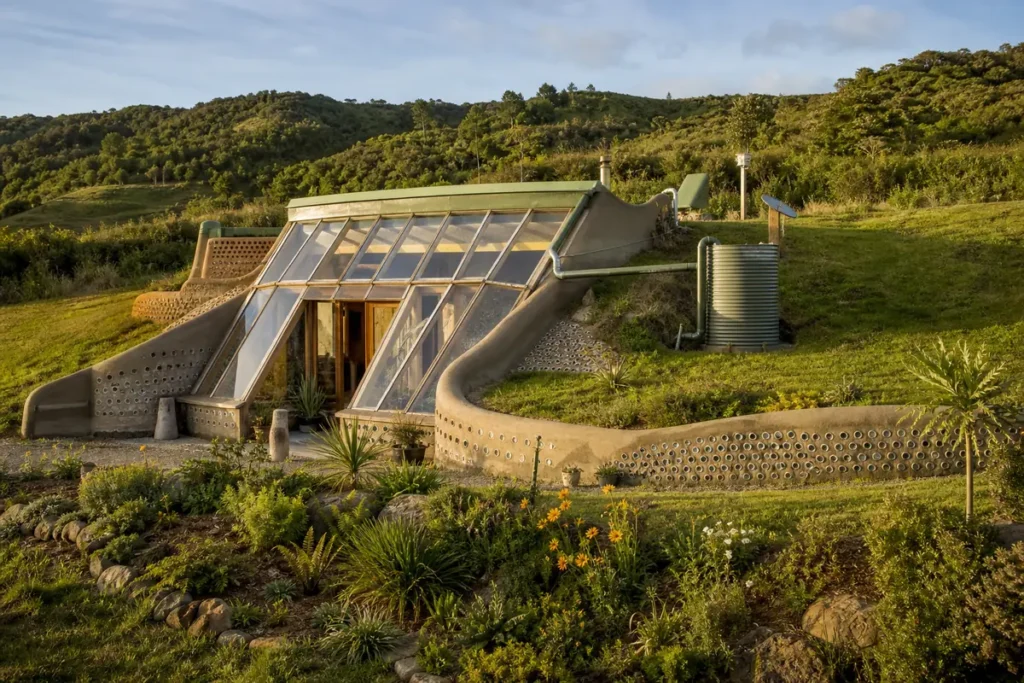
For another alternative building approach in NZ, see our guide to building an earthship in Aotearoa.
Frequently Asked Questions
Does hempcrete get building consent in NZ?
Yes. Multiple NZ hempcrete homes have obtained building consent and received a Code of Compliance Certificate. The pathway is the Alternative Solutions provision of the Building Act 2004 — you provide performance evidence rather than using standard Acceptable Solutions. It’s more work than a conventional consent application, but it’s been done successfully and the HBANZ can assist.
Is hempcrete warm enough for NZ winters?
Yes — hempcrete’s thermal performance is one of its strongest points. The combination of thermal mass (absorbing and slowly releasing heat) and its insulating properties creates stable internal temperatures that outperform conventional insulated frames in many climates. Central Otago — one of NZ’s most climatically extreme regions — has multiple hempcrete homes and their performance in cold winters is well-documented by Erkhart Construction.
How do I find a hempcrete builder in my region?
The Hemp Building Directory NZ lists NZ suppliers and builders by region. HBANZ (hba.nz) can also refer you to appropriate practitioners. Currently, the most active NZ hempcrete builders are centred in Central Otago/Wanaka (Erkhart, HempCentral) and Golden Bay/Nelson (Kohu Hemp).
Can I mix hempcrete myself?
Yes — hempcrete is a relatively accessible material to work with. The mixing process (hemp hurd + lime binder + water) is labour-intensive but doesn’t require specialised skills. Many NZ hempcrete homes have used volunteer and owner-builder labour for the mixing and tamping stages. Attending a Kohu Hemp or HempCentral workshop first is strongly recommended.
Is hempcrete available as prefabricated panels?
Prefabricated hempcrete block and panel systems exist internationally (particularly in the UK and France) but are not yet commercially available in NZ. Current NZ practice involves casting hempcrete in situ around the structural frame. Prefabricated options may become available as the NZ industry scales up.
The Bottom Line
Hempcrete is the most commercially developed natural building material in NZ right now, with a small but real track record of completed, consented homes. It’s not cheap and it requires more documentation than a conventional build — but it’s a genuine option for Kiwis who want to build something that will last centuries, perform exceptionally, and leave a positive rather than negative carbon footprint.
A sensible order: ask Erkhart whether their Wanaka hempcrete studio is still available to stay in, get hands-on through Kohu Hemp or HempCentral, then contact HBANZ. You’ll make a much better decision about whether hempcrete is right for you after experiencing it first-hand than you ever could from reading about it.
This article is for informational purposes only. Always consult a licensed building professional, structural engineer, and your local council’s Building Control Authority before proceeding with any alternative-materials build. Reviewed September 2026; unsourced cost figures previously shown here have been removed.